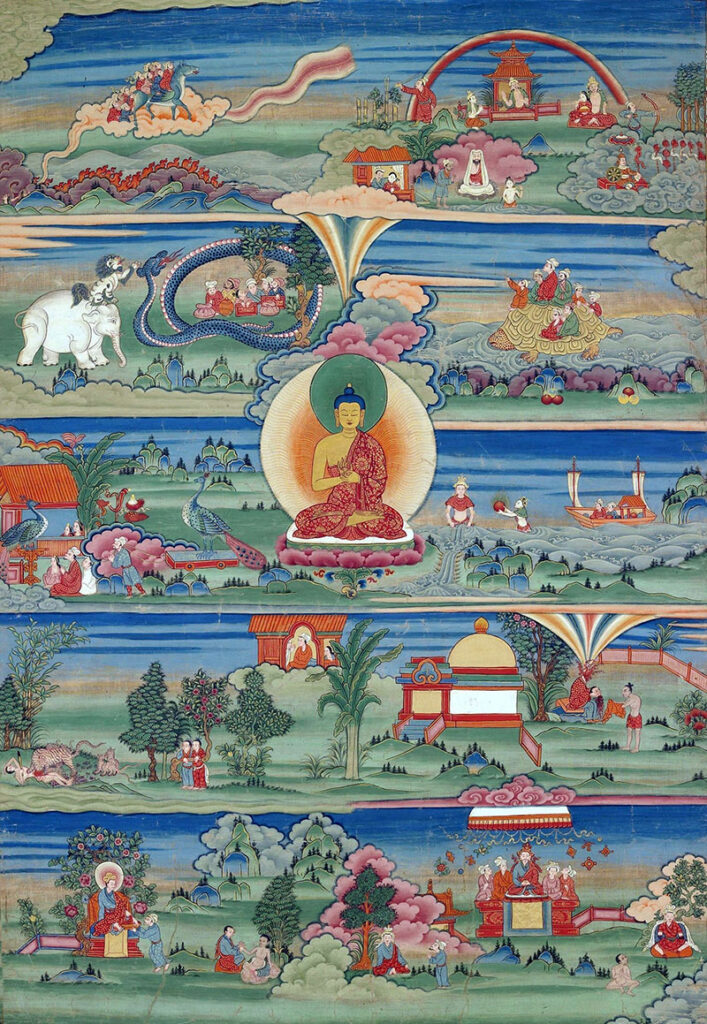
A large collection of approximately 550 stories about the Buddha’s former lives in both human and animal form. The stories are mostly set in the Indian subcontinent and are dated between 300 BCE and 400 CE. Some of the narratives are part of the Pali canon in Theravada Buddhism. Several of the stories are also the primary subjects of the Ajanta Cave murals.
More Definitions
Bhagavad Gita
Section of the Sanskrit epic Mahabharata, composed as a dialogue between the Pandava prince Arjuna and his charioteer and companion…
Kamasutra
An ancient Sanskrit text on sexuality and eroticism, dating to c. 400 BCE–300 CE and attributed to Vatsyayana. It is…
Stithi
Meaning "preservation" or "existence" in Sanskrit, it is one of the cosmic acts of the deities in the Hindu religious…
Padshahnama
The illustrated official history of the reign of the Mughal emperor Shah Jahan. Compiled in the mid-seventeenth century, it contains…
Abhinaya
According to the Natyashastra, it may be understood as a combination of two words — abhi meaning "towards" and naya…
Appar
A Shaivite poet-saint from seventh century Tamil Nadu. He was one of the Nayanar poet-saints and is believed to have…
Tenjur
A sacred text belonging to the Tibetan Buddhist canon, comprising commentaries, treatises and a collection of abhidharma (ancient Buddhist texts).…
Agamic Texts
Meaning “tradition” or “received knowledge” in Sanskrit, the term refers to a set of scriptures within Hinduism, Jainism and Buddhism.…