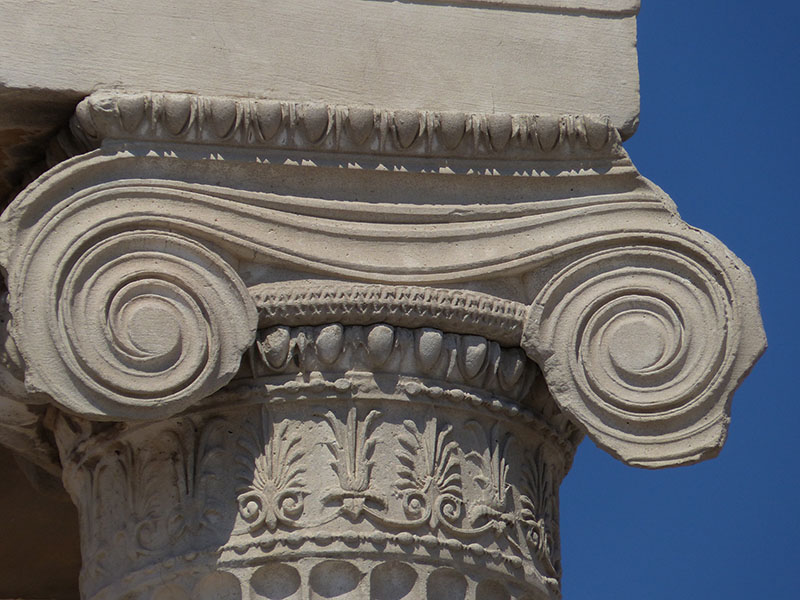
One of the three canonical orders of Western Classical architecture, it originated in the mid-sixth century in Ionia (present-day Turkey). It is characterised by the use of two symmetrical volutes on the pillar capital. Below the volutes, the column is typically designed with a wide collar or banding that separates the capital from the shaft of the pillar.
More Definitions
Neo-Impressionism
A late nineteenth-century movement in French painting that opposed the empirical realism of Impressionism. It used the scientific principles of…
Picturesque
An aesthetic category accorded to pictures that have an agreeable and appealing visual quality, and is particularly used for idealised…
Cubism
A modern art movement developed in the twentieth century by artists such as Pablo Picasso and Georges Braque which rejected…
Pop Art
An art movement that originated in the 1950s and 1960s in Britain and the United States of America, it challenged…
Bauhaus
A school of art and design founded by German architect Walter Gropius in 1919, which emphasised an interdisciplinary approach to…
Conceptual Art
An artistic movement that emerged in the 1960s which prioritised the concept behind an artwork over the finished work itself.…
Expressionism
A modernist art movement that emerged in Europe in the early twentieth century, particularly Germany, in response to the dominant…
Art Informel
Coined by French art critic and curator Michel Tapie in 1952, the term signifies French artistic and painting styles of…