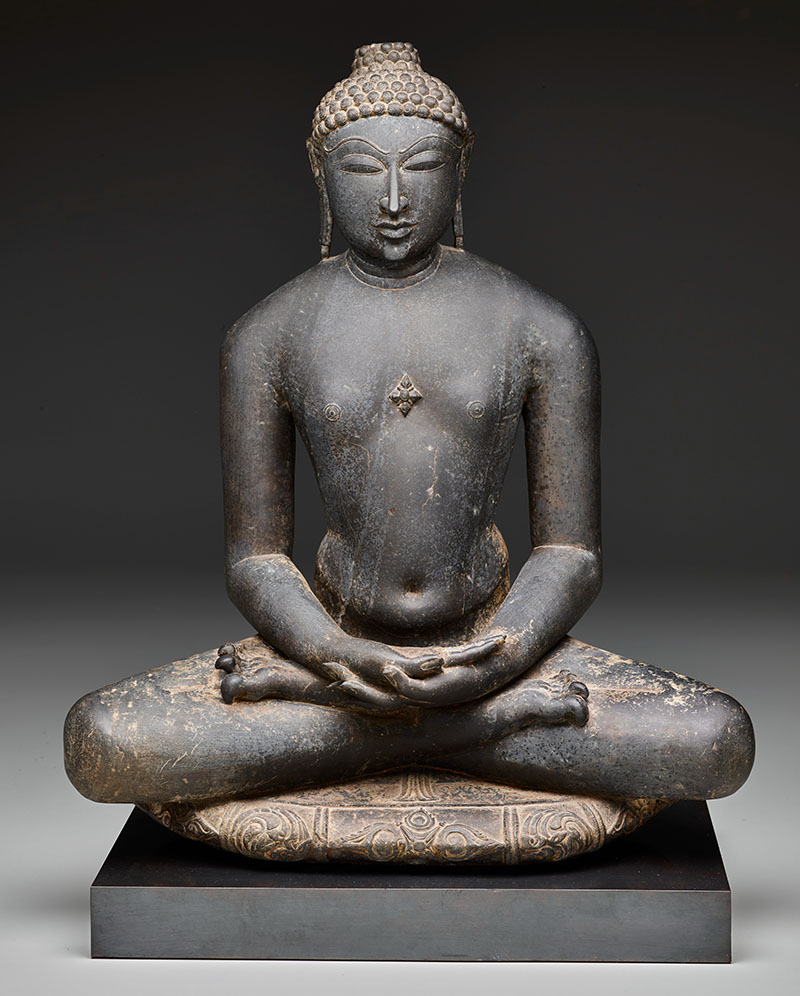
Meaning “sky-robed” in Sanskrit, it is one of two major ideologies within Jainism, the other being Svetambara. The two streams of thought differ on points of doctrine, such as theology, manner of worship and the ritual practices of monks and nuns. In the Digambara practice, the images of the Tirthankaras are left unadorned, as opposed to the Svetambara practice of adorning the images. The two ideologies also differ on the nature of a keval jnani (omniscient being), with the Digambara tradition believing the beings can live without food. In Digambara practice, initiated monks do not wear clothes and receive food from disciples in their hands, unlike the Svetambara practice of monks and nuns wearing white garments and receiving food in pots. Digambara also does not bestow equal importance on texts, which are codified as scriptures within the Svetambara tradition. The rift between the two ideologies within the religion is difficult to date, but historians suggest it is likely to have been formalised in the fifth century CE.
More Definitions
Adivasi
Member(s) of any of the heterogenous Indigenous communities of India and Bangladesh, whose social formations, cultures and religions are distinct from…
Karigar
A regional term used in parts of northern, central and western India to refer to artisans involved in several crafts,…
Mahayana
The largest sect of Buddhism in the world, it is characterised by the reverence of bodhisattvas, coupled with the pursuit…
Patua
An artisanal community from the eastern states of the Indian subcontinent, primarily West Bengal, Odisha, Bihar and Jharkhand, as well…
Hephthalite
Also known as the White Huns, they were a predominantly nomadic set of people living in Central and South Asia…
Khatri
A community of predominantly Kshatriya Hindus, as well as Muslims and Sikhs, whose origins can be traced to the Punjab…
Siddi
Culturally and linguistically varied community of African descent in South Asia, mostly concentrated in the Sindh province of Pakistan —…
Gelugpa
A Tibetan Buddhist monastic order, founded by Je Tsongkhapa in the early fifteenth century. Tsongkhapa along with his disciples founded…