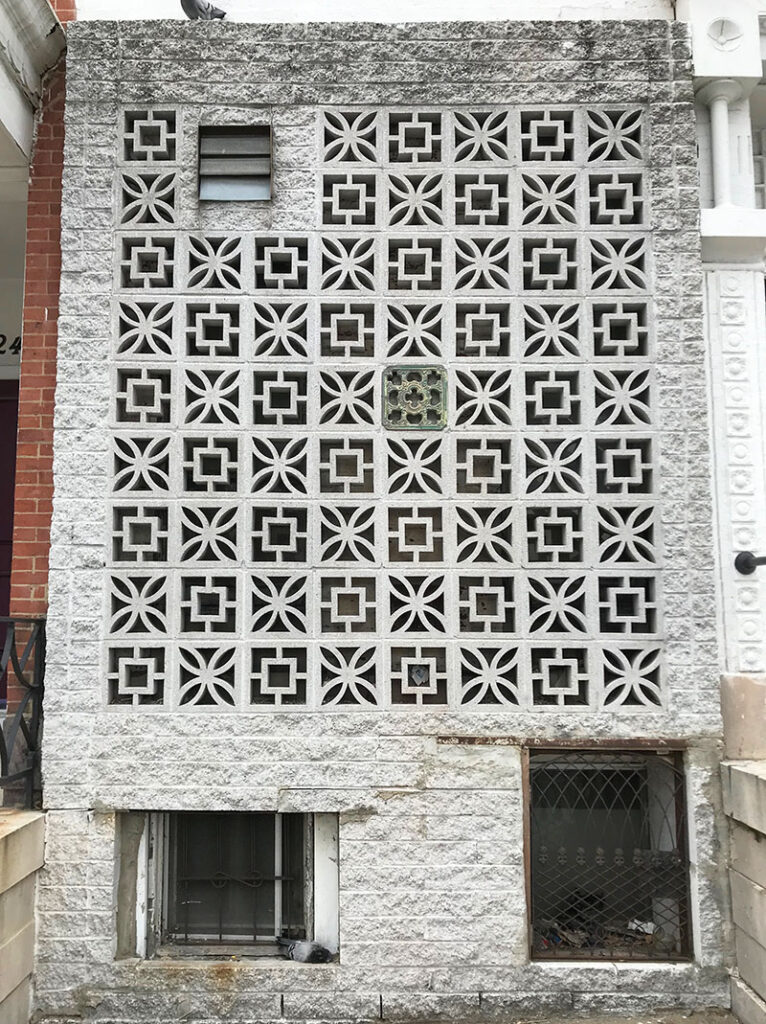
Lightweight construction brick developed during the 1800s in the US, Europe and Australia by binding Portland cement with coke breeze, a coal-burning byproduct. Offering good heat resistance and thermal insulation, breeze — or cinder — blocks were initially used in factories and warehouses, and later widely in residential and commercial buildings for walls bearing lighter loads. Solid blocks with patterned surfaces — called ‘textile blocks’ — were notably used by Frank Lloyd Wright in the 1920s. Mass-produced hollow breeze blocks introduced in the 1900s were even lighter and more affordable; their permeability to light and air made them particularly well-suited to tropical climates. In the post-war housing boom of the 1950s, breeze blocks became prominent architectural features, used in boundary as well as partition walls and screens, in North America, Australia, the UK, and New Zealand. A variety of available designs, such as Edward Durell Stone’s patented Empress Ornamental Wall Block, made breeze blocks a visual identifier of mid-century Modernist architecture.
breeze block
Link copied!