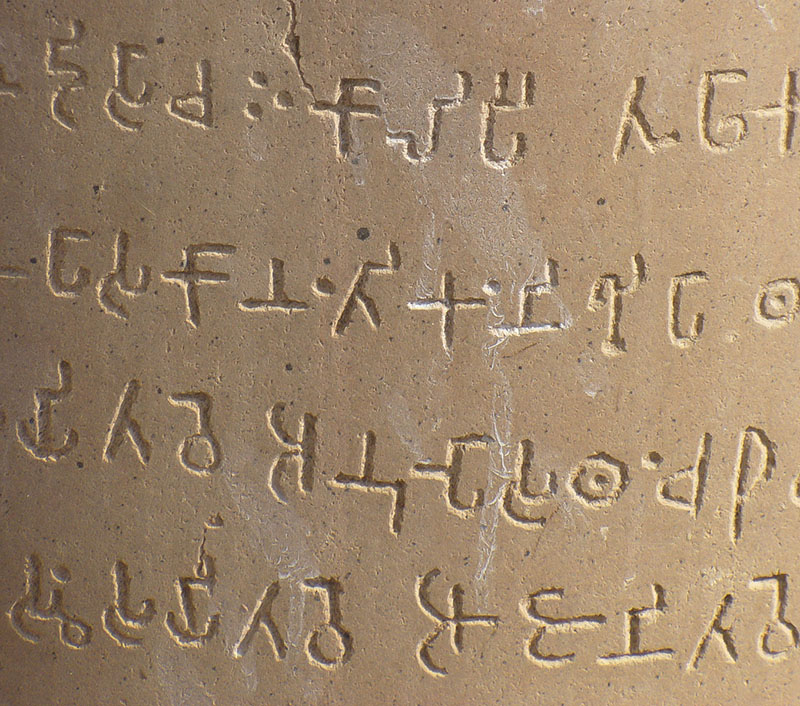
A writing system or script that appeared as a fully developed universal system in Asia c. third century BCE. It is believed to be the ancestor of later South Asian and Southeast Asian scripts. The earliest evidence of the use of the script is from the pillar and rock-cut edicts of Ashoka, dated c. 250–232 BCE. It was first deciphered in 1837 by James Prinsep, an archaeologist with the East India Company.
More Definitions
Yana
A metaphor for a mode or method of spiritual practice in Buddhism, which refers to the vehicles of teaching imparted…
Abhinaya
According to the Natyashastra, it may be understood as a combination of two words — abhi meaning "towards" and naya…
Mudra
Originating from the Sanskrit word for "seal" or "mark," it is a symbol or ritual gesture that is performed using…
Tarikh-i-Khandan-i-Timuriya
An illustrated manuscript that details the history of Timur and his descendants in Iran and India. It was commissioned by…
Rigveda
Earliest extant text from the Vedic corpus, dated roughly between 1700 and 1200 BCE. Like the other Vedas, the Rigveda…
Laila Majnun
A seventh-century Arabic tale that narrates the love story of the poet Qays ibn al-Mulawwah and Layla bint Mahdi. Popularly…
Mahabharata
The longest Indian epic poem, traditionally attributed to the legendary sage Vyasa and compiled into its extant recension sometime between…
Karma
A philosophical concept in Hinduism, Buddhism, Jainism and Sikhism, and a spiritual principle of cause and effect wherein the actions…