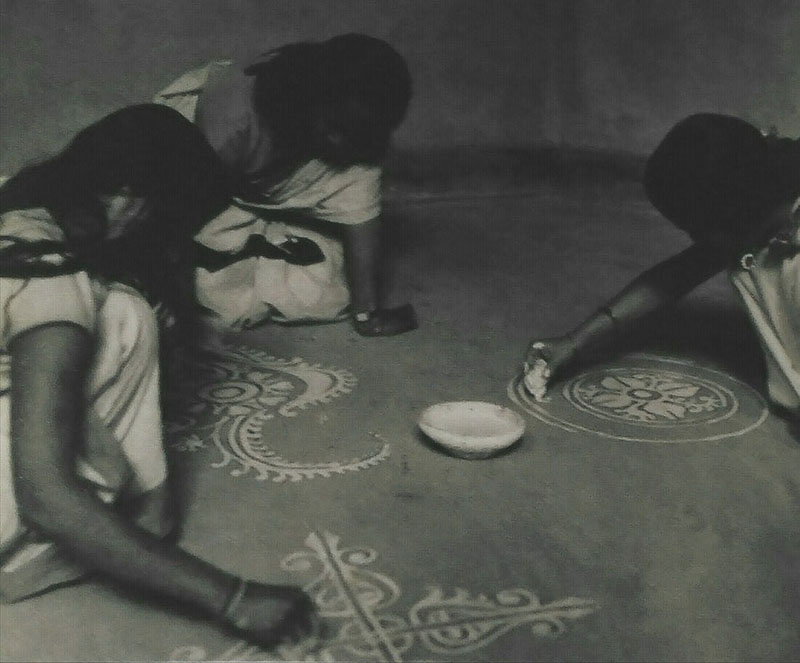
A ritual Bengali practice of making designs and paintings featuring religious motifs and patterns, typically made in white using a pigment derived from rice powder. It is traditionally made by women during festivals and ceremonies. From the Sanskrit alimpana, meaning “to plaster” or “to coat with.”
More Definitions
Rathyatra
A public chariot procession associated with the worship of the Hindu god Jagannath and predominantly celebrated in the states of…
Purdah
A religious and social practice of seclusion in some Hindu and Muslim communities that involves the physical segregation of women…
votive object
An object that is ritually offered or sacrificed to a deity, typically to mark the fulfilment of a vow, express…
Jainamaz
A floor mat or rug used for namaz or daily prayer in mosques. From the Persian word jainamaz, meaning “floor…
Vanamala
An important motif in Vaishnavite Hinduism, it is offered as a garland to Krishna and Vishnu. It is usually identified…
Panigrahana
A rite performed during a Hindu wedding ceremony in which the groom holds the bride’s hand. It is considered one…
Agamic Texts
Meaning “tradition” or “received knowledge” in Sanskrit, the term refers to a set of scriptures within Hinduism, Jainism and Buddhism.…
Utsavamurti
Processional idol in Indian temples, usually made of metal. During temple festivals, a representation of the temple’s central deity/deities is…