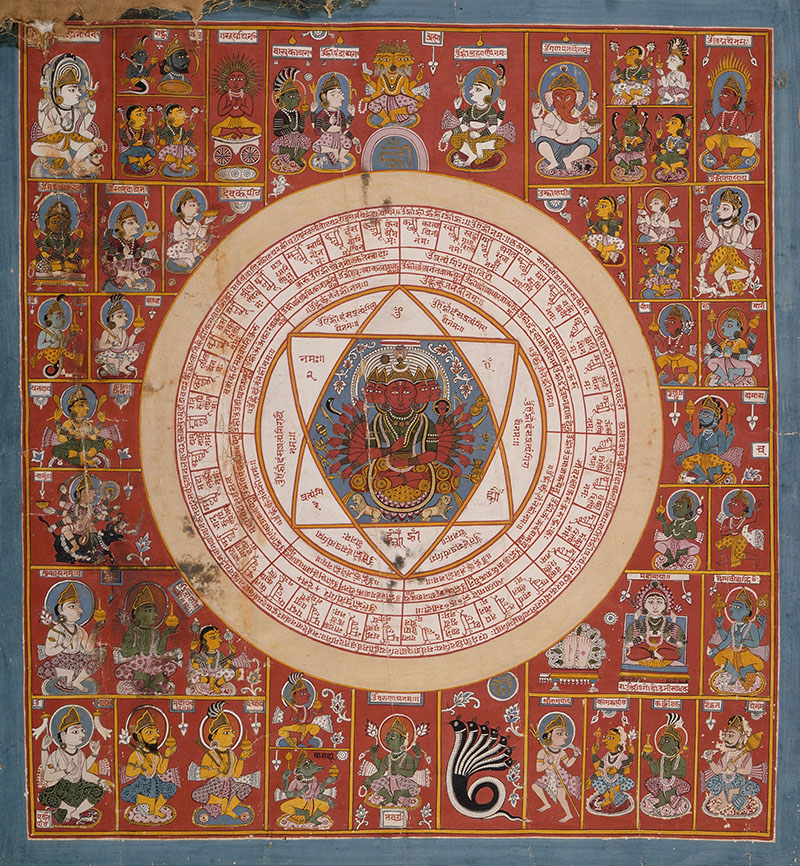
A specialised type of mandala or geometric diagram used in Tantric worship in Hinduism, Buddhism, and Jainism. A yantra (Sanskrit for ‘instrument’) is an abstract representation of a particular deity and may be used as a tool for meditation (dhyanayantra), a base for ritual (sthapanayantra), an image for regular worship (pujayantra), in magical rites for various spiritual or material purposes, or as a talisman. Compared to mandalas, yantras are typically smaller, less colourful, generally showing no figural images, and often mobile — although they are sometimes installed at places of worship. A yantra may be a diagram; drawn on materials such as paper, cloth, bone, or skin; or a three-dimensional structure, usually made of metal. Yantra designs feature various geometric shapes — most commonly inverted triangles, upright triangles, and hexagrams symbolising respectively the yoni, lingam, and the union of the two — arranged in a pattern around a central dot, or bindu, symbolising the point of spiritual emanation. These are typically bounded by lotus petals and a square representing the four cardinal directions. A sriyantra is an especially elaborate yantra showing nine interlocking triangles.
yantra
Link copied!