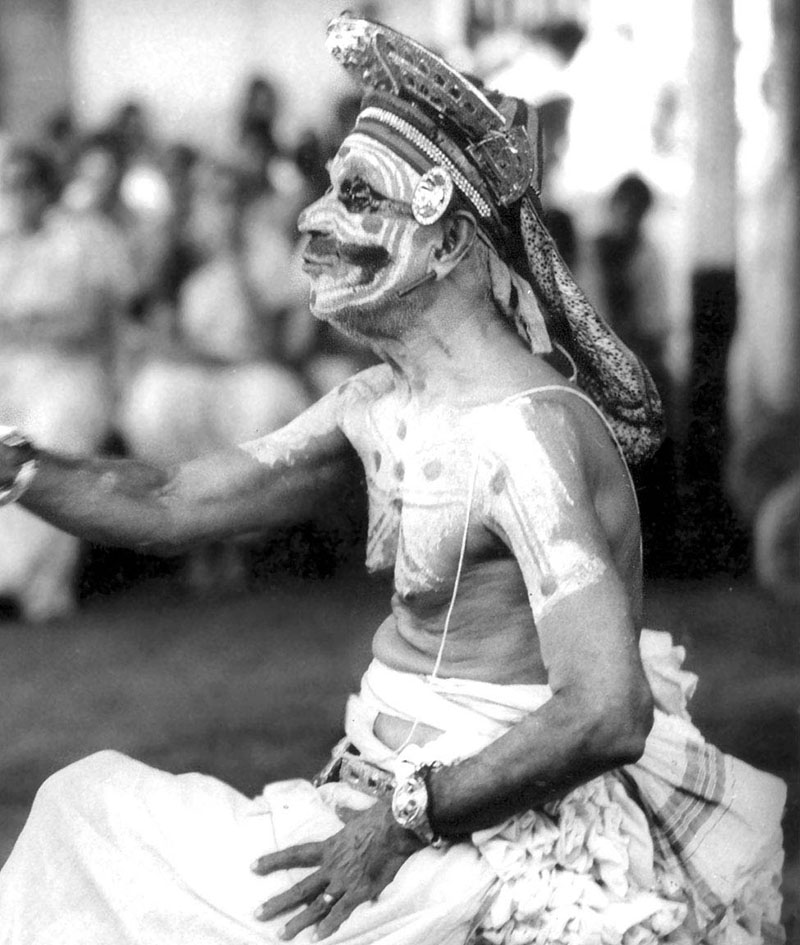
Within Sanskrit drama, it describes the good-natured jester or clown who often provides comic relief, usually through explicitly humorous action and gestures. It could also refer to a character that ridicules social norms. He is an essential part of the narrative and a close ally of the hero. According to Bharata, there are four kinds of vidushakas — Lingi or Tapasa, linked to the celestial hero; Dvija or Brahmin, the companion of a royal hero; Rajajivi, an employee connected with a minister (or merchant); and Shishya, a pupil who accompanies a Brahmin teacher.
More Definitions
Kerala Sangeetha Nataka Akademi
Founded in 1958 and located in Thrissur, it is an arts and culture institution managed by the Kerala state government’s…
Tandava
A form of dance codified in the Natyashastra, an ancient treatise on the performing arts. The tandava carries divine associations,…
Dandahasta
A gesture in which the arm is presented forward and held straight, like a stick. The hand is positioned similar…
Nadanta
An alternate name to describe the anandatandava, the cosmic dance of Nataraja, a form of the Hindu deity, Shiva.
Tawaif
A dancer, singer or entertainer trained in Hindustani classical music, ghazals, dance forms such as Kathak, literature and shayari (poetry).…
Egmore Museum Theatre
A theatre in Chennai constructed in 1896 by the British as a replica of London's Globe Theatre and synthesised in…
Bishnupriya Dutt
Bishnupriya Dutt (b. n.d.) is an Indian scholar of theatre studies and performance arts, as well as a professor and…
Gaja Hasta
A single-handed gesture in South Asian iconography in which the palm is stretched out and downwards from the wrist, with…