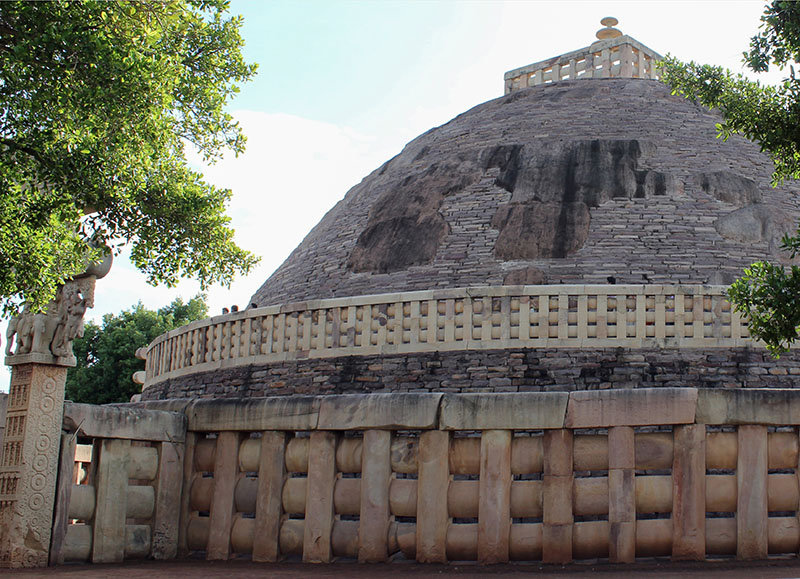
Meaning ‘railing’ or ‘raised platform or altar’ in Sanskrit and Pali, vedika refers to the outer railing around a sacred monument or object in Buddhist and Hindu architecture. Constructed around sacred trees, mounds or stupas, it usually bears low-relief inscriptions depicting protective deities, mythological events and other religious iconography. It often encloses a space for circumambulation around the central shrine.
More Definitions
Monolith
A structure that is excavated or carved out of a single block of rock. Monoliths are usually not moved from…
mezzanine
Platform or balcony projecting as a partial, intermediate storey between the floor and ceiling of a full-heighted space. The mezzanine…
Shamiana
A ceremonial tent or awning featuring removable walls that consist typically of decorated or coloured cloth. They were used by…
Krishna Mandapa
A open-air bas relief sculpture in Mamallapuram, Tamil Nadu, attributed to the reign of the Pallavas. It is 8.8 meters…
gopuram
Towering, multi-storeyed gateway characteristic of South Indian Dravida temple architecture. A temple may have several gopurams, or gopuras, punctuating the…
Peristyle
A row of pillars surrounding an enclosed space or enclosing an open space, taking the form of a porch or…
Uttaranga
In Indian temple architecture, it is the term for the lintel located above a doorway. It is often a carved…
Ikshvaku Architecture
Architecture patronised by the Andhra Ikshvakus (c. fourth to third century BCE) (not to be confused with the legendary Ikshvaku dynasty…