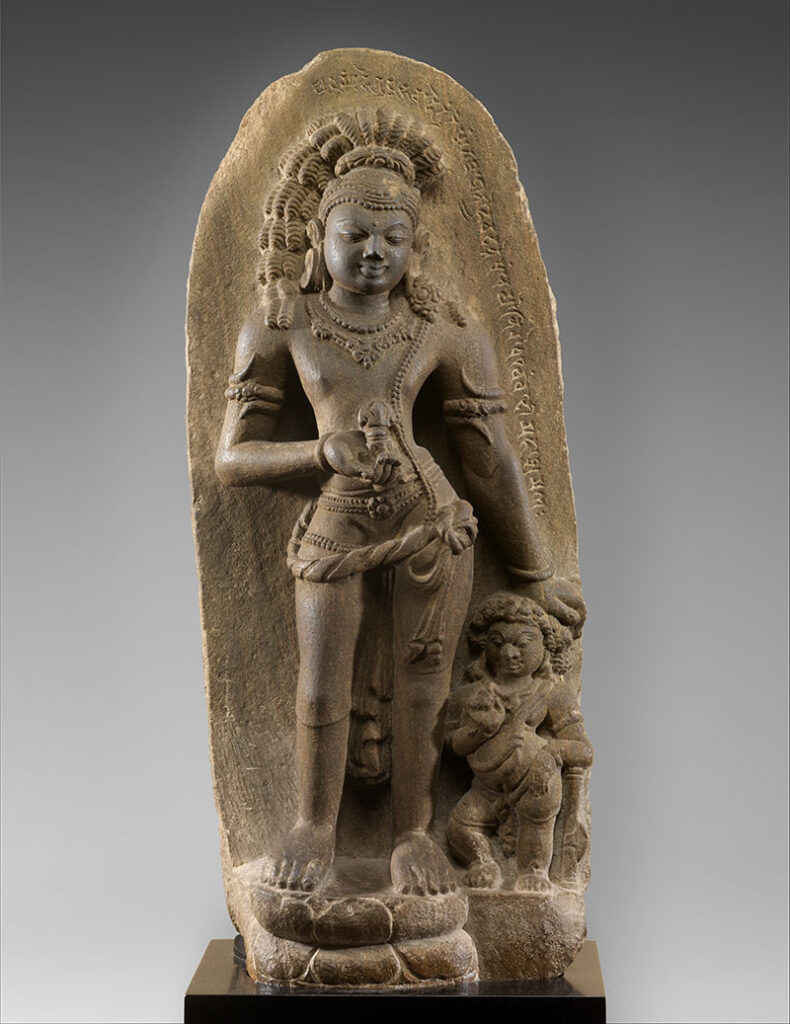
A bodhisattva from Mahayana Buddhism and the protector and guide of the Gautama Buddha as well as a manifestation of his power. He is considered one of the earliest of the three protective deities surrounding the Buddha and one of the major dharmapalas (protectors of dharma) in Mahayana Buddhism. The deity is manifested in two distinct ways — his human form, which is depicted with a vajra (weapon) in his right hand, and his dharmapala form, Acarya-Vajrapani, depicted with four heads, arms, legs and a third eye, and shown holding a bell and a lasso. He is depicted as a yidam (a manifested deity representing Buddhahood) in Vajrayana Buddhism, with multiple limbs, treading on demons or lying on snakes. He is also depicted in the yab-yum (primordial union) position with his consort. From the Sanskrit words vajra, meaning “thunderbolt” and pani, meaning “in hand.”
More Definitions
Sardula
Another name for yalis or vyalas, they are guardian deities in Hindu and Buddhist mythology depicted as a composite creature,…
Agamic Texts
Meaning “tradition” or “received knowledge” in Sanskrit, the term refers to a set of scriptures within Hinduism, Jainism and Buddhism.…
Paadal Petra Sthalam
A group of 275 shrines dedicated to the Hindu deity Shiva and concentrated in southern India. They are mentioned in…
Amitabha
A principal figure in Pure Land Buddhism, he is one of the five Dhyani Buddhas. According to Mahayana texts, the…
Narasimha
One of the ten avatars of the Hindu deity Vishnu, he is depicted with the body of a man and…
Vishwamitra
In Hindu Puranic and epic literature, one of the seven maharishis (great sages). He is also known as the royal…
Shaivism
One of the largest and oldest sects of Hinduism, with Shiva and his consort Shakti as the supreme deities —…
Bhagirath
The mythical king of the Sagara Dynasty who performed several years of penance in the Himalayas. He is known to…