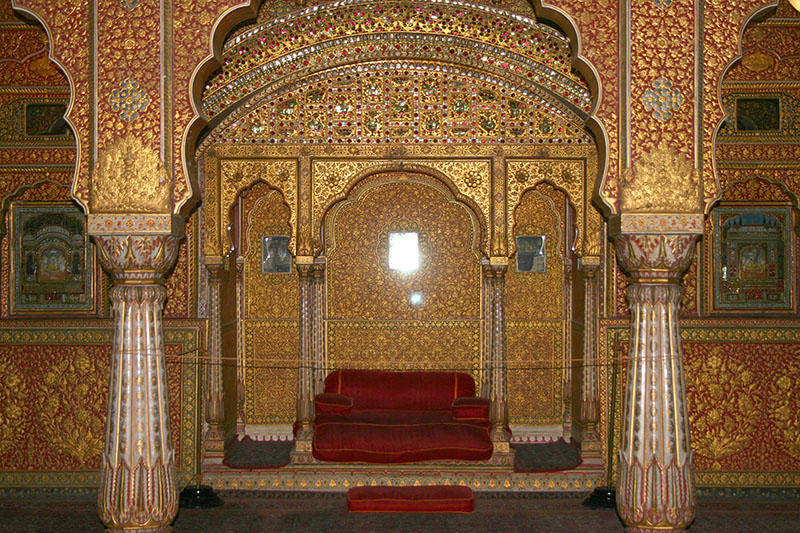
A traditional form of decorative gesso painting practised primarily in Bikaner, Rajasthan. It derives its name from the Usta community of artisans who specialise in the technique. The community migrated from Multan in present-day Pakistan to the Mughal court in Delhi and, later, to Bikaner. The technique was used to decorate interior surfaces, such as the walls and pillars of structures like the Junagadh Palace and Anup Mahal in Bikaner. Since the colonial era, it has also been used to decorate objects made from camel hide. It typically consists of two processes: manoti or munabhati, the embossing on a flat surface, and nakashi or naqqashi, the painting of the manoti.
More Definitions
Kanha
Kanha (b. n.d.; d. c. 1590) was a miniature painter in the court of Mughal emperor Akbar and worked from…
Secco
Also called fresco secco or fresco finto, this is a technique of wall or mural painting wherein casein, tempera or…
European Realism
A movement originating in France in the 1840s, which rejected then-prevalent ideals of Romanticism in French art and literature in…
Action Painting
A style of abstraction where paintings are produced through vigorous and spontaneous application of paint over the canvas, in sweeping…
Expressionism
A modernist art movement that emerged in Europe in the early twentieth century, particularly Germany, in response to the dominant…
yantra
A specialised type of mandala or geometric diagram used in Tantric worship in Hinduism, Buddhism, and Jainism. A yantra (Sanskrit…
Ratnadeep Gopal Adivrekar
Ratnadeep Gopal Adivrekar (b. 1974) is a contemporary artist born in Mumbai, Maharashtra, known for his work on Indian and…
Firka
A genre of paintings associated with the Patna School, which depicted people engaged in caste-based occupations. Frequently produced and sold…