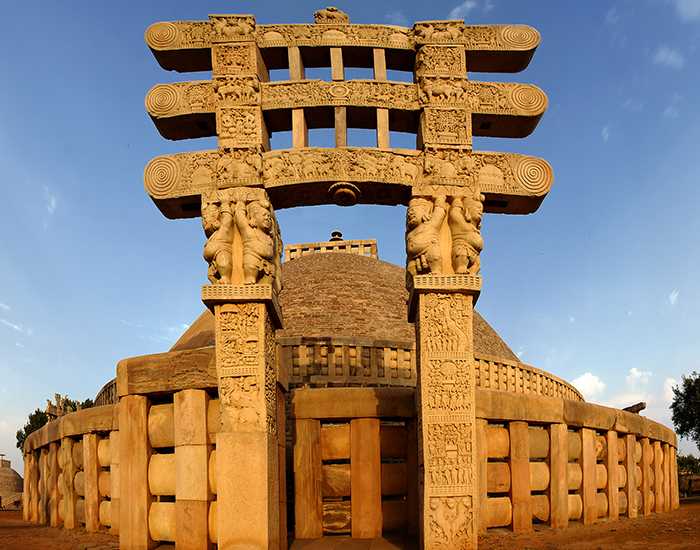
Meaning ‘gateway’ or ‘arched entrance’ in Sanskrit and Pali, torana refers to a free-standing gateway marking the entrance to a Buddhist shrine or stupa, or a Hindu temple. Usually made of stone, it comprises two pillars supporting two or three transverse beams extending beyond the pillars on both sides, or an ornamented arch forming a single structure. The oldest surviving Buddhist torana is at the Bharhut Stupa, dated to c. 250 BCE.
More Definitions
Garbhagriha
Translating to 'womb chamber' from Sanskrit, it is the innermost sanctuary in Jain, Buddhist and Hindu temples, within which the…
ridge beam
Longitudinal beam along the top of a pitched or vaulted roof. The ridge beam is a load-bearing structural member of…
Cushion Capital
In architecture, it is a type of crown, which is the top-most part of a column, pillar or pilaster. It…
Collonade
A row of columns, typically equidistant from each other and joined by an entablature. A colonnade may be freestanding or…
Peristyle
A row of pillars surrounding an enclosed space or enclosing an open space, taking the form of a porch or…
Hirka-i-Sharif Mosque, Istanbul
Mosque in Istanbul, Turkiye, built in 1851 to house the cloak relic of Prophet Muhammad, from which it receives its…
Kapotabandha
In Indian temple architecture, it is a style of decorative moulding seen on a tier of the adhisthana, the raised…
Mihrab
A niche in the wall of a mosque which indicates the qibla (direction of the Kaaba in Mecca) and is…