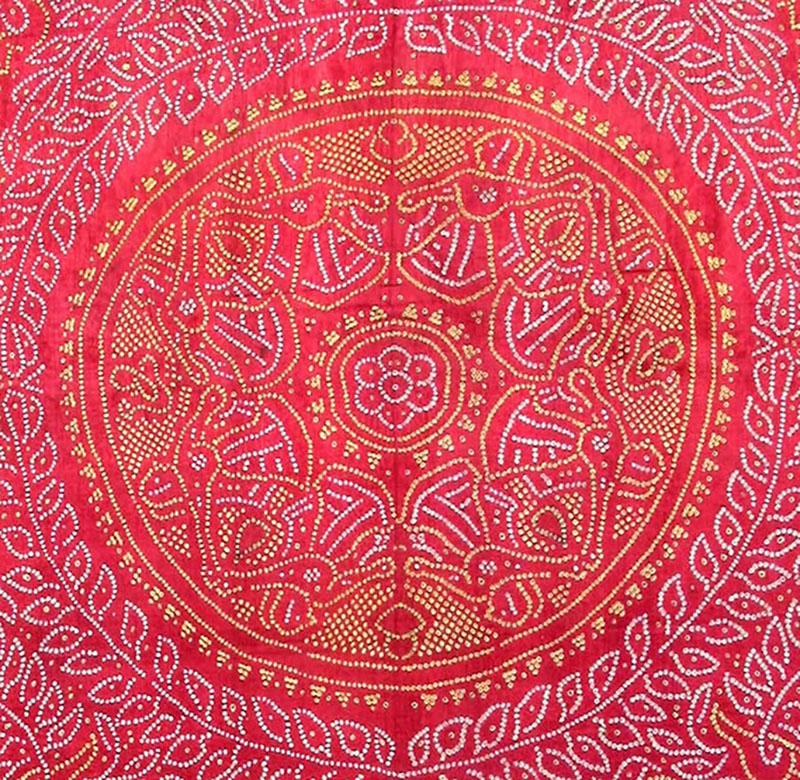
A traditional Gujarati design, commonly seen in bandhani silk saris, it depicts a circle of dancing women within a medallion setting, surrounded by floral and foliate motifs, and animals such as peacocks and elephants. The dense pattern is set in distinct borders, usually on a bright red ground. It derives its name from raas, the traditional Gujarati dance form.
More Definitions
Lalitasana
A pose found depicted in the religious art of Sikhism, Hinduism, Buddhism and Jainism, it is also known as “the…
Chandesanugrahamurti
A benevolent form (anugrahamurti) of the Hindu deity Shiva, in which he is depicted bestowing his blessings upon his devotee,…
Tribhanga Pose
Also known as the "triple-bend position," it is a standing pose found in Indian classical dance forms such as Odissi…
Peepal
Also known as Bodhi tree or sacred fig tree, it is significant in Buddhism as the tree under which Siddhartha…
Kayotsarga Pose
A meditation posture in Jainism, it is frequently observed in artistic depictions of the Tirthankaras (or great teachers) of the…
Fleur-de-lis
From the French fleur, meaning "flower," and lis, meaning "lily," it is a decorative element or symbol commonly associated with…
Ayudhapurusha
The anthropomorphic representation of divine weapons in the Hindu pantheon. These personified weapons are depicted either in human form or…
Rope Borders
A motif that resembles a twisted, coiled rope, it is used as a border around another image or motif. The…