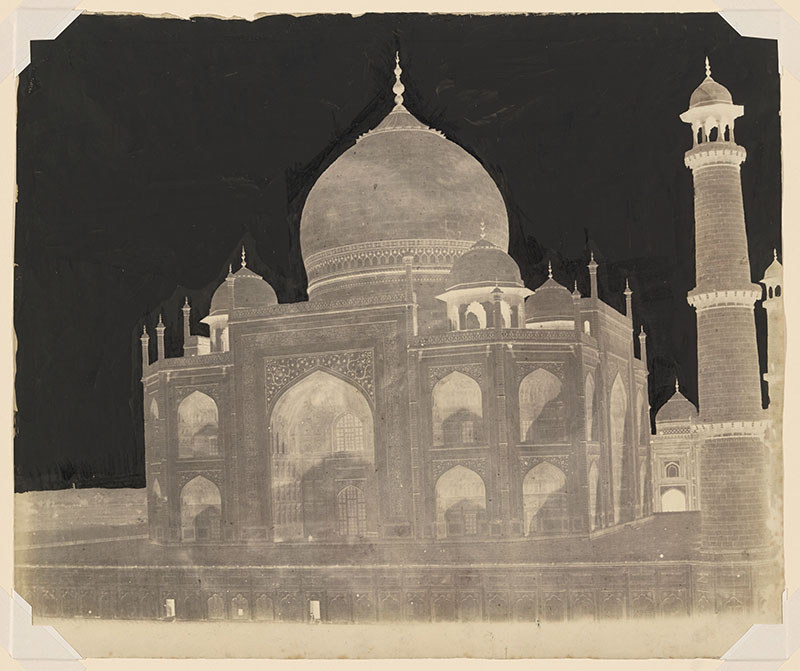
A photographic negative created on paper, rather than on modern cellulose film or a glass plate. William Henry Fox Talbot’s calotype process from the 1830s was among the earliest techniques to use paper negatives, with several variations emerging around 1850, such as those using waxed paper. It remains in use as an alternative photographic medium, as the texture of the paper and the possibility to scratch or draw on it before printing create room for artistic expression.
More Definitions
Dobby
A mechanism attached to a loom that controls warp threads to allow for the weaving of small, usually geometric or…
Frame Loom
Made of rods and boards fixed at right angles, it is a compact, box-shaped loom. It is portable and can…
photosensitive paper
Paper coated with a photosensitive emulsion, used for making photographic prints, usually in a darkroom. It is first exposed to…
Naksha
Also known as a jala, it is an arrangement of threads that maps the desired design and is attached to…
Large Format Camera
Film cameras that produce images that are 9 cm x 12 cm or larger.
Camera Lucida
An optical device and precedent to the camera, which was used as an aid for drawing and sketching. Developed in…
Low-Warp Loom
Handloom commonly used for traditional tapestry and carpet weaving, in which the warp threads are stretched parallel or nearly parallel…
developer
In photography, a chemical solution used to reveal the latent image that has been captured on the photographic film, as…