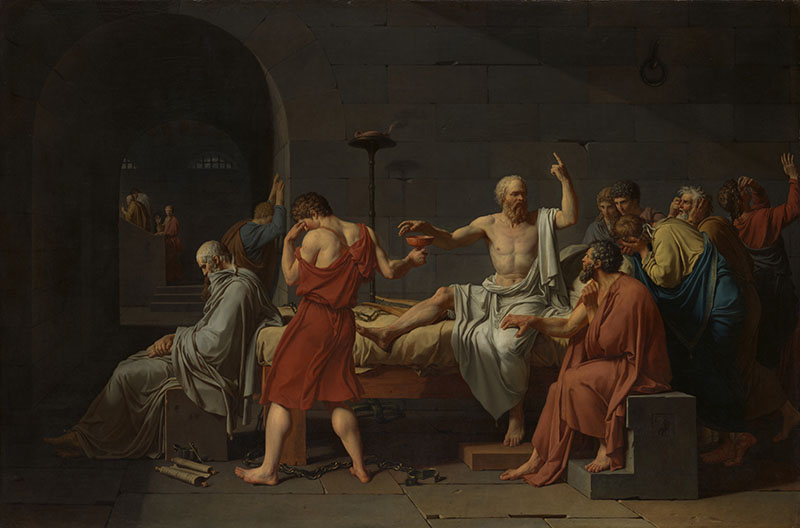
An eighteenth century cultural movement that drew inspiration from the arts and culture of classical antiquity. It embraced classical themes and subject matter as well as principles of linear design, harmony and idealism. Prominent artists include Jacques-Louis David, Jean Auguste Dominique Ingres, Jean-Baptiste Debret and Angelica Kauffman.
More Definitions
Firka
A genre of paintings associated with the Patna School, which depicted people engaged in caste-based occupations. Frequently produced and sold…
Picturesque
An aesthetic category accorded to pictures that have an agreeable and appealing visual quality, and is particularly used for idealised…
European Realism
A movement originating in France in the 1840s, which rejected then-prevalent ideals of Romanticism in French art and literature in…
Art Brut
An art movement that emerged after World War II in reaction to academic aesthetics and in favour of obscene and…
Indian Modernist architecture
The adaptation of Western Modernist principles — functionalism, minimal ornamentation, and the use of industrial materials like reinforced concrete —…
manorath paintings
In the Pushtimarg sect of Vaishnavism, manorath paintings were made as temple records or pilgrimage souvenirs, typically depicting individual devotees…
Second Diffusion
A religious revival movement between c. tenth and eleventh centuries CE, credited with establishing Buddhism as a majority religion in…
Bauhaus
A school of art and design founded by German architect Walter Gropius in 1919, which emphasised an interdisciplinary approach to…