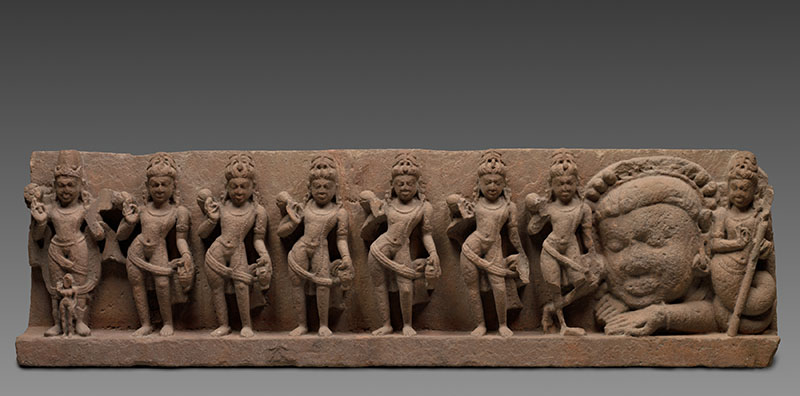
Meaning “nine planets” in Sanskrit, it is a grouping of astronomical bodies and their nine associated deities in Hinduism. These deities also find mention in Jaina texts, where they are included as Jyotiska Devas (“heavenly beings”). The nine deities are Ravi (Sun), Soma or Chandra (Moon), Mangala (Mars), Budha (Mercury), Brihaspati (Jupiter), Sukra (Venus), Sani (Saturn), Rahu (the ascending node of the Moon) and Ketu (the descending node of the Moon). They may be carved onto architectural elements, such as the doorways or niches of a temple, or may be worshipped in a separate shrine within the temple complex.
More Definitions
Bhagirath
The mythical king of the Sagara Dynasty who performed several years of penance in the Himalayas. He is known to…
Kalpavriksha
Also known as the kalpataru or kalpadruma, it is a sacred, wish-granting tree that is a recurring image in Hinduism,…
Samsara
The concept of the continuous cycle of birth, death and rebirth, fundamentally seen in most Indian religions, including Buddhism and…
Guru Nanak
The first of the ten Sikh gurus, Guru Nanak (b. 1469, d. 1539) was the founder of Sikhism. Born in…
Hermes
Deity of the Greek Olympian pantheon, believed to be the messenger of the gods and a trickster who frequently travelled…
Chenrezig
Another name for Avalokitesvara, the bodhisattva of compassion, he is the patron bodhisattva of Tibet. He is usually depicted dressed…
Vashishtha
In the Hindu religious tradition, one of the seven maharishis (great sages). In the Indian epic Ramayana, he is a…
Brahmi And Sundari
Within Jainism, they were the daughters of the first Tirthankara Rishabhanatha and princesses in the kingdom of Ayodhya. According to…