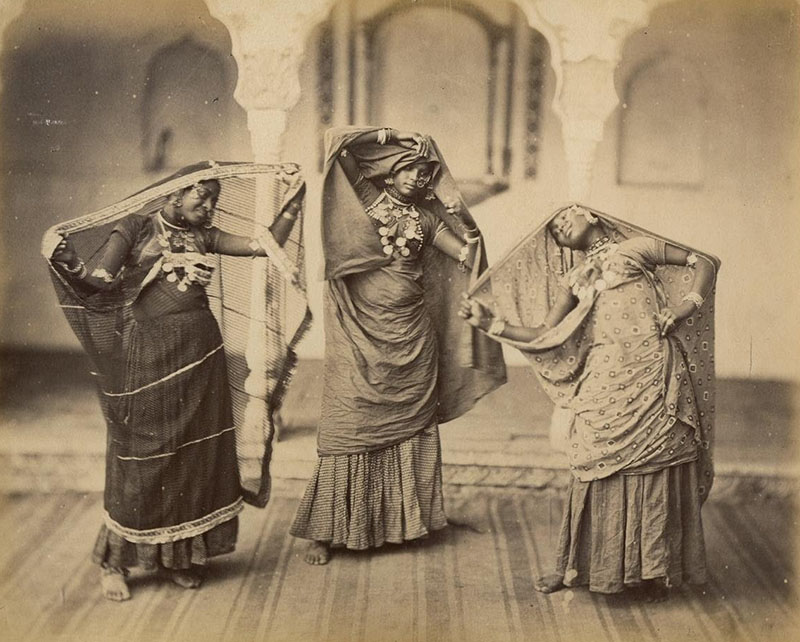
A term used for female dancers who performed nautch (a dance related to Kathak, Dasi Attam and folk dances) at royal courts during the early modern period, primarily in Mughal and Nawab courts and in princely states. By the eighteenth century, their popularity spread to include the patronage of smaller courts, local zamindars and officers of the East India Company. From the Hindi word naach, meaning “dance.”
More Definitions
Jambavati Kalyanam
A sixteenth-century Sanskrit play authored by the Vijayanagara ruler Krishnadevaraya. According to inscriptions, the play was performed for the general…
Abhinaya
According to the Natyashastra, it may be understood as a combination of two words — abhi meaning "towards" and naya…
Taala
Meaning “clap" in Sanskrit, it is a measure of rhythm or metre in South Asian musical traditions. It works in…
Nayika
The heroine in dramatic representation, as outlined in the Natyashastra, who is represented in different scenarios with the nayaka, who…
Paryankasana
Composed of two parts — paryanka, meaning "bed" or "couch", and asana meaning "pose" –– it is a yoga pose…
Dandahasta
A gesture in which the arm is presented forward and held straight, like a stick. The hand is positioned similar…
Tawaif
A dancer, singer or entertainer trained in Hindustani classical music, ghazals, dance forms such as Kathak, literature and shayari (poetry).…
Gaja Hasta
A single-handed gesture in South Asian iconography in which the palm is stretched out and downwards from the wrist, with…