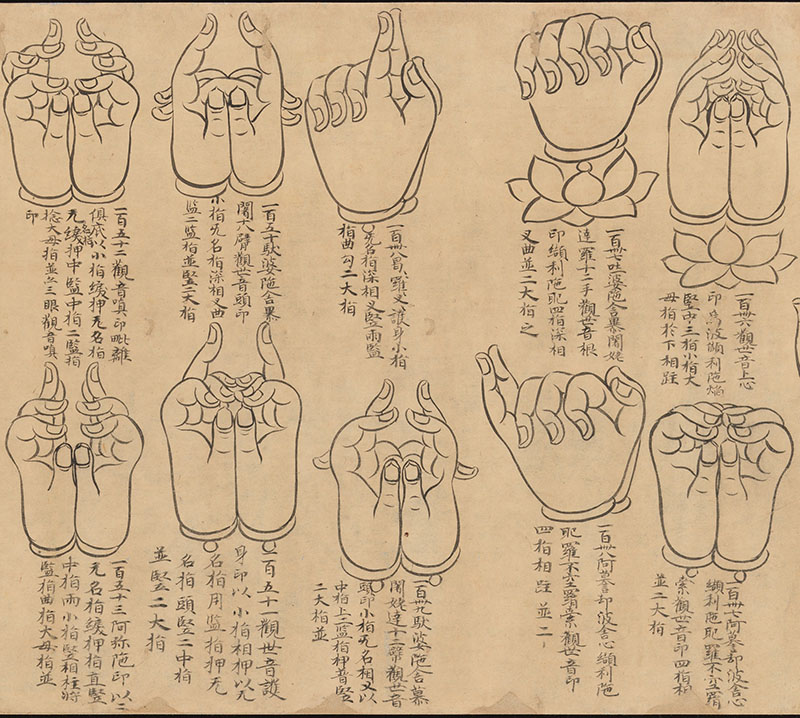
Originating from the Sanskrit word for “seal” or “mark,” it is a symbol or ritual gesture that is performed using the hands and fingers, though at times it may involve the entire body. Each mudra has a variety of meanings within the visual iconography and practises of Indian religions such as Hinduism and Buddhism. Mudras are also an important element in several traditional Indian dance forms and in yoga.
More Definitions
Sangam Period
The early historical period of the southernmost region of India, corresponding to present-day Tamil Nadu and parts of Kerala. Dating…
Gita Govinda
A Sanskrit poetic epic that describes the love between the Hindu god Krishna, his chief consort Radha and the gopikas…
Sahitya Akademi
Established in 1952 and inaugurated in 1954, it is India’s National Academy of Letters, created for the promotion and preservation…
stambha
Sanskrit for ‘pillar’, historically appearing in various contexts, including Vedic liturgy, Brahmanical mythology, and Brahmanical treatises on architecture, theatre and…
Devi Upanishad
A minor Upanishad often classified as one of the eight Shakta Upanishads, it is one of the nineteen late-Vedic texts…
Bhakti
A set of devotional practices that emerged in South India from the sixth century CE and spread to north India…
Mahabharata
The longest Indian epic poem, traditionally attributed to the legendary sage Vyasa and compiled into its extant recension sometime between…
Doha
A form of Indian poetry, it is a self-contained rhyming couplet consisting of two lines and formed of twenty-four syllables…