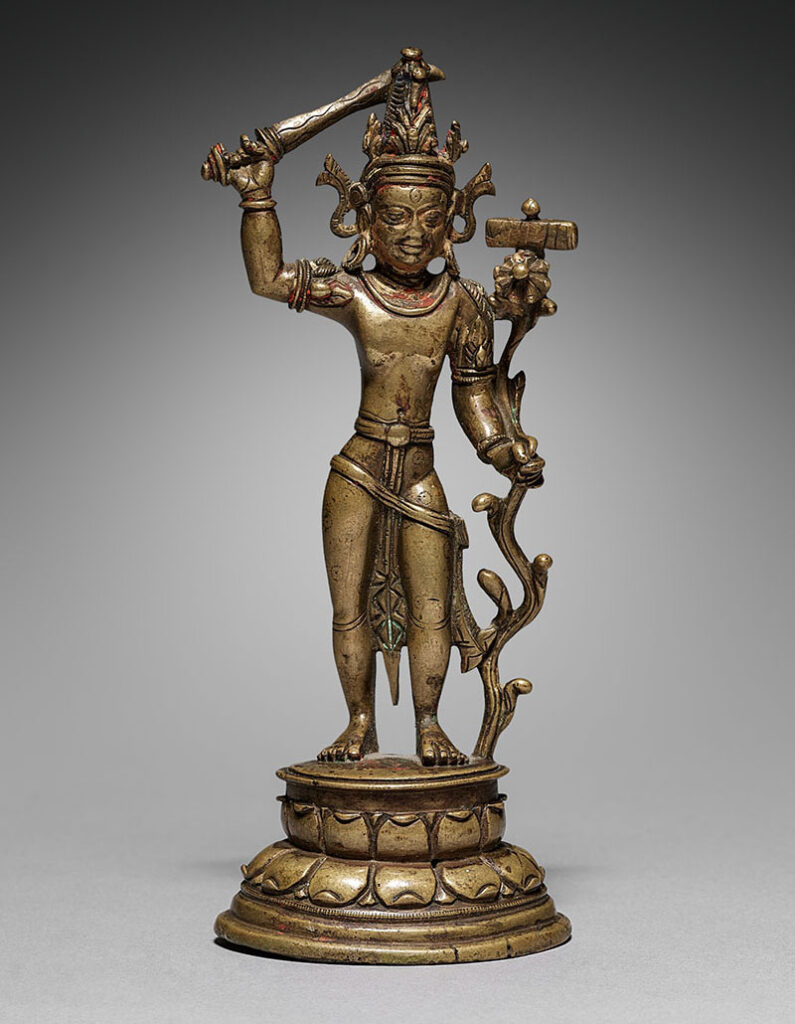
Also known as Manjughosa and Vaigsvara, he is a bodhisattva who is associated with prajna (wisdom) in the Mahayana and Vajrayana traditions of Buddhism. His name derives from the Sanskrit term manjusri, meaning “gentle glory.” He is conventionally depicted with a sword of wisdom in one hand and a manuscript of the Prajnaparamita Sutra in the other. Within Tibetan Buddhism, he is depicted in a triad along with Avalokitesvara and Vajrapani. In his wrathful form, he is known as Yamantaka or “the destroyer of death.”
More Definitions
Sardula
Another name for yalis or vyalas, they are guardian deities in Hindu and Buddhist mythology depicted as a composite creature,…
Hinayana
A term coined by the Mahayana Buddhist tradition to denote followers of the contrasting, more orthodox school of Buddhism. Literally…
Duldul
Within Islamic tradition, one of the beloved mules of the Prophet Muhammad, given to him by the Mukawkis. Duldul is…
Prahlada
In the Vaishnava tradition of Hinduism, he is the the son of the daitya king Hiranyakashipu and his queen Kayadhu.…
Vajrabhairava
Also known as Yamantaka, he is a deity considered to be the destroyer or conqueror of death in Buddhism and…
Vishwamitra
In Hindu Puranic and epic literature, one of the seven maharishis (great sages). He is also known as the royal…
Drupada
In the epic Mahabharata, the ruler of Southern Panchala and the father of Draupadi, Shikhandi, Satyajit, Dhrishtadyumna, Uttamaujas and Yudhamanyu.…
Mahabharata
The longest Indian epic poem, traditionally attributed to the legendary sage Vyasa and compiled into its extant recension sometime between…