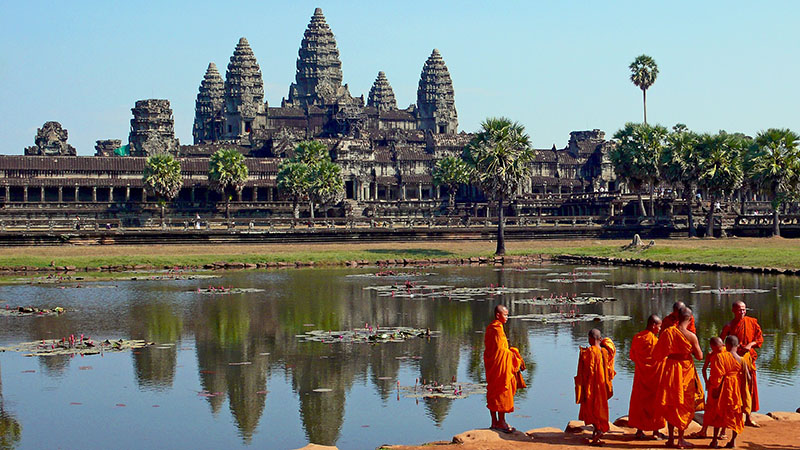
Southeast Asian state that was founded in 802 CE and declined in 1431 CE. At its height, the Khmer empire encompassed modern-day Cambodia, Thailand, Laos and southern Vietnam. Maritime trade with India deeply influenced its material and spiritual culture — Shaivism, Vaishnavism and Buddhism were favoured by Khmer royalty, and Khmer art often reflects a composite Hindu-Buddhist iconography. For most of the empire’s history, its capital was located in the city of Angkor, where Khmer kings commissioned the construction of the elaborate, sprawling Hindu-Buddhist temple Angkor Wat, the world’s largest religious complex.
More Definitions
Rudrasena III
Rudrasena III (b. n.d.; d. n.d.) was a king of the Western Kshatrapa dynasty, which ruled parts of western and…
Kaurvaki
Kaurvaki (b. 288 BCE; d. n.d.) was the second queen of the Mauryan king Ashoka and the only queen to…
Narasimhavarman II
Also called Rajasimha, he was a ruler of the Pallava Dynasty and ruled parts of present-day Tamil Nadu and Andhra…
Pushyamitra
Pushyamitra (r. c.185 BCE–c.149 BCE) was the founder of the Shunga Dynasty, which emerged after the end of the Maurya…
Western Chalukya Dynasty
Southern Indian dynasty in the Deccan region from the last quarter of the tenth century to the close of the…
Eastern Ganga Dynasty
Also known as the Rudhi or the Prachya Gangas, this is an early medieval dynasty that ruled over Kalinga (present-day…
The Partition
The division of British India in 1947 into India and Pakistan, spurring a great migration of people from and to…
Devanampriya Priyadarshi
A title used by the emperor Ashoka to refer to himself, it derives from the Pali Devanampiya Piyadassi, meaning "He…