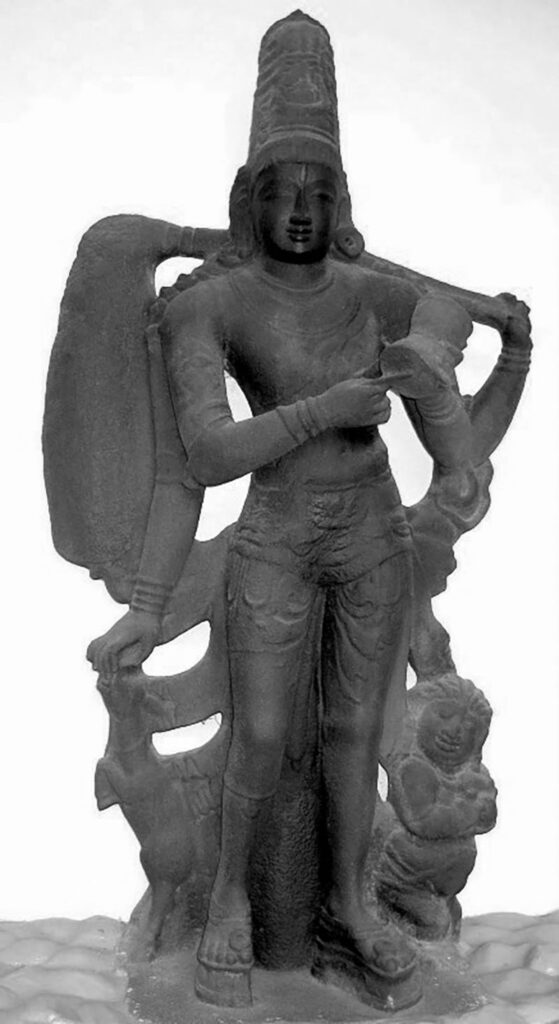
A form of the Hindu deity, Shiva, in which he is shown with a kankala-danda (a staff bearing the bones of a dead being). In iconographical representations, an ornamented Shiva is shown with his right leg bent, to suggest walking, and the kankala-danda held on his left shoulder. He is surrounded by women, bhutagana (his attendants), as well as sages, semi-divine beings and deities. This form is primarily found in southern India. A depiction of it can be found at the Gangaikondacolisvaram Temple in Tamil Nadu, India.
More Definitions
Dhanushpurusha
The personification of Vishnu's bow as a male figure, following the Ayudhapurusha tradition.
Bhudevi
A deity personifying the earth. She is also known as Bhumi Devi and is considered an incarnation of Mahalakshmi. She…
Gopi
A group of women significant to the worship of the Hindu deity Krishna, especially when coupled with his consort Radha.…
Bharthari
Also known as Jogi Sant Bharthari, he is a popular king from the folk legends of northern and central India.…
Tumburu
Tumburu is a divine being in Hinduism and Jainism. In Hindu mythology, he is the leader of the Gandharvas, the…
Nandi
The vahana (mount) of the Hindu deity, Shiva, he is represented in the form of a white bull. In Hindu…
Anandatandava
Meaning “dance of bliss,” it is a cosmic dance performed by the Hindu deity, Shiva, in his Nataraja form.
Ajivika Sect
An early sramana (ascetic) sect led by Makkhali Gosala in the fifth century BCE, it was a nastika (heterodox) school…