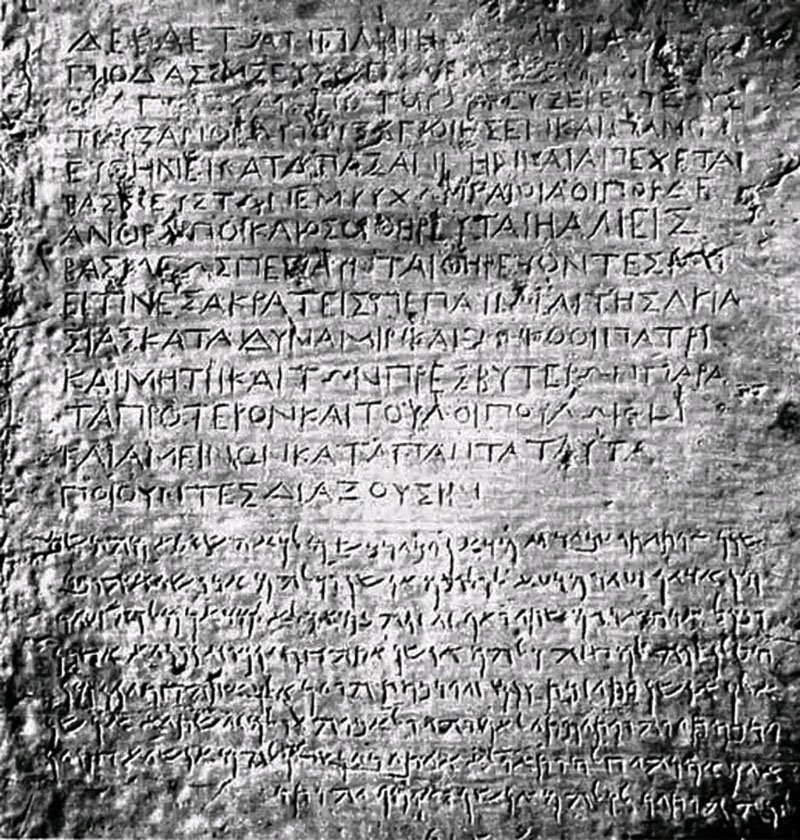
A bilingual edict, written in Greek and Aramaic, dating to c. 260 BCE. It is the earliest known rock edict of the emperor Ashoka, preceding all other known inscriptions of the ruler by ten years. The edict was discovered during excavation work near the site in 1958.
More Definitions
Abhinaya
According to the Natyashastra, it may be understood as a combination of two words — abhi meaning "towards" and naya…
Mahavastu Avadana
A text of the Lokottaravada school of early Buddhism, it was written in Sanskrit, Pali and Prakrit between the second…
Devi Upanishad
A minor Upanishad often classified as one of the eight Shakta Upanishads, it is one of the nineteen late-Vedic texts…
Sangam Period
The early historical period of the southernmost region of India, corresponding to present-day Tamil Nadu and parts of Kerala. Dating…
Nayanar
A group of sixty-three Shaivite poet-saints in Tamil Nadu between the third to eighth century CE. Belonging to diverse castes,…
Driglam Namzha
Code of public etiquette in Bhutan, based on the founding principles of Bhutanese culture, namely humility, compassion and respect. It…
Bhagavad Gita
Section of the Sanskrit epic Mahabharata, composed as a dialogue between the Pandava prince Arjuna and his charioteer and companion…
Kanjur
A sacred text of the Tibetan Buddhist canon that outlines the principles of vinaya (rules governing monastic communities), monastic discipline,…