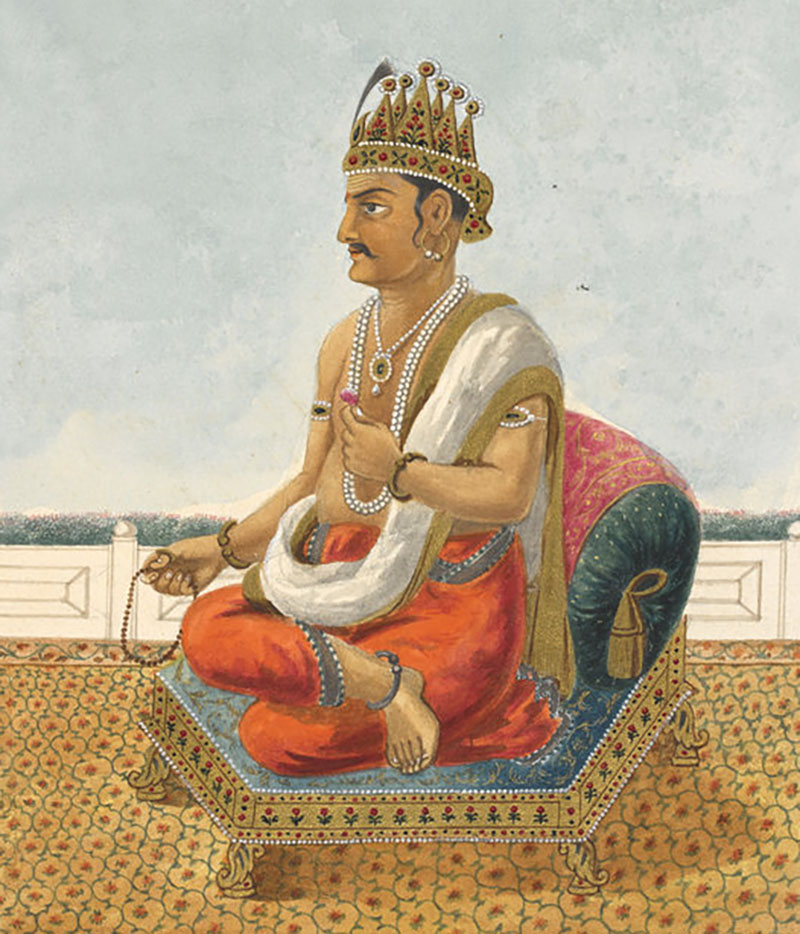
In the Indian epic Ramayana, the father of Sita and father-in-law of Rama. In later Vedic texts, Janaka is stated to be a ruler of Videha, a region corresponding to parts of present-day Bihar and Nepal, and historians suggest a possibility of him having been a historical figure who may have lived and ruled between the ninth and seventh centuries BCE.
More Definitions
Pashupati
An epithet originally used for the Vedic deity Rudra and now denoting one of the incarnations of the Hindu deity…
Mahavidyas
A group of ten goddesses from the Tantric Hindu pantheon, consisting of Kali, Tara, Shodashi, Bhuvaneshvari, Chhinnamasta, Bhairavi, Dhumavati, Bagalamukhi,…
Shaivite Upanishads
A body of fourteen Upanishadic texts dedicated to Shaiva traditions and practice, which expound on the worship of the Hindu…
Bhairava
A fierce form or manifestation of the Hindu god, Shiva, he is a guardian deity and one of the central…
Nadanta
An alternate name to describe the anandatandava, the cosmic dance of Nataraja, a form of the Hindu deity, Shiva.
Purusha
The conception of man according to Hindu philosophy as established in the Vedas and the Upanishads. The purusha is a…
Ajivika Sect
An early sramana (ascetic) sect led by Makkhali Gosala in the fifth century BCE, it was a nastika (heterodox) school…
Aiyanar Sasta
The guardian deity of several folk and Hindu traditions in south India. Temples to Aiyanar Sasta are usually built at…