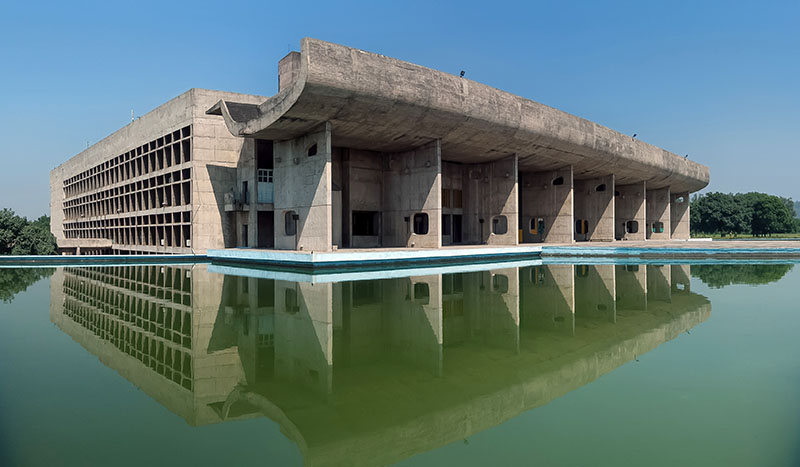
The adaptation of Western Modernist principles — functionalism, minimal ornamentation, and the use of industrial materials like reinforced concrete — to India’s climatic, social, and cultural contexts, which emerged in the mid-twentieth century and gained momentum by the mid-1970s. Inspired by Prime Minister Jawaharlal Nehru’s vision of the potential of architecture to address technological advancement, Modernist architecture in India marked a shift away from the country’s colonial architectural past to that of a modern nation-state. While the works of foreign architects like Le Corbusier and Louis Kahn in India were influential, from the 1960s Indian architects such as Balkrishna Doshi, Achyut Kanvinde and Charles Correa developed an architectural language that integrated Modernist aesthetics with regional materials, local building knowledge systems, traditional forms, and climate-responsiveness, reflected in housing, planning, and institutional projects. Recent scholarship also considers lesser known built forms from the early twentieth century as expressions of Indian architectural Modernism.
More Definitions
Tropical Modernism
Architectural style that adapts Modernist architectural principles and materials for thermal comfort in the hot and humid climate of the…
Constructivism
An early twentieth century artistic and architectural movement that was started in Russia by painter and architect Vladimir Tatlin and…
International Style
Style of architectural design characterised by lightweight, rectilinear structures using industrial materials such as steel, concrete and glass, often featuring…
Modernism
A cultural and philosophical movement that originated in western Europe and sought new paradigms in art and socio-cultural discourse to…
Pastiche
A style associated with postmodern trends in visual art, music and literature, pastiche indicates works of art that imitate or…
iconic representation
Representation of a deity or divine figure in a personified form or generally figurative mode, as opposed to aniconic representation…
Pop Kitsch
The use of popular and everyday materials and images in pop art. Kitsch in German signifies art, objects and design…
Art Informel
Coined by French art critic and curator Michel Tapie in 1952, the term signifies French artistic and painting styles of…