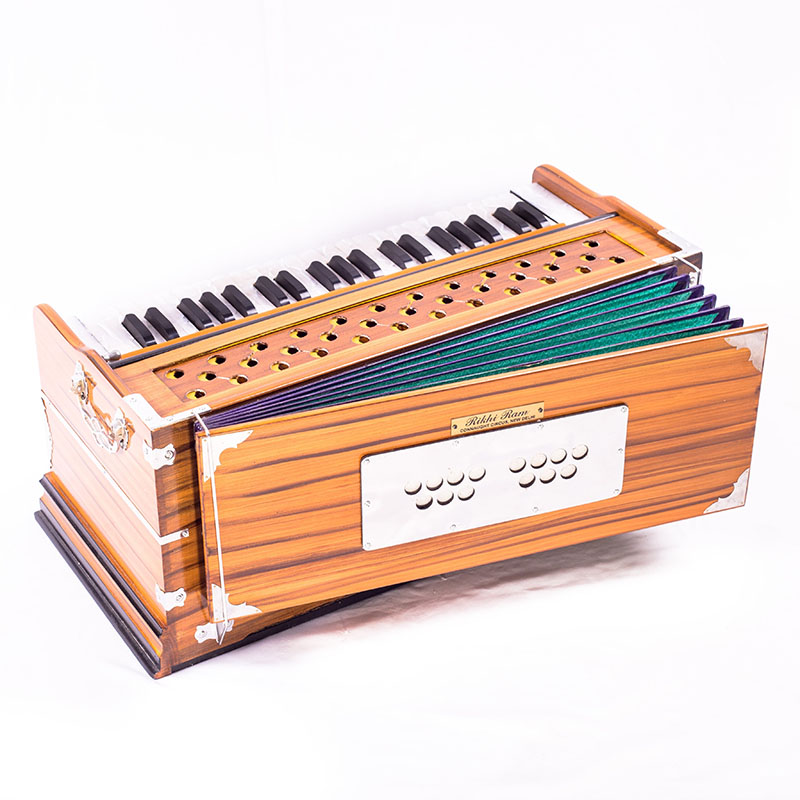
An Indian stringed instrument shaped like a portable wooden box with keys and bellows, measuring approximately 2 feet by 1 foot and about 9 to 10 inches high. At the top of the box, the side closer to the musician has keys that are attached to reeds that play different notes, while the back of the box has a hand-operated bellow. It is a derivation of a reed organ, which is likely to have been brought to India by the British; the Indian harmonium is said to have been devised in 1857 by Dwarkanath Ghose in Kolkata. It is an important instrument within South Asian music and is often used to accompany the vocalist.
More Definitions
Thumri
A vocal style or genre within Hindustani classical music inspired by the romantic, devotional literature of the medieval-era Bhakti movement.…
Taala
Meaning “clap" in Sanskrit, it is a measure of rhythm or metre in South Asian musical traditions. It works in…
Manjira
An Indian idiophonic instrument whose simplest form consists of a pair of small metal cymbals connected by a string. The…
Dhruva
A classification of songs from chapter thirty-two of the Natyashastra, which pertains to songs sung on stage during a performance.…
Dhol
A percussion instrument in the Indian subcontinent, it is made of wood, brass, leather, cotton, parchment and metal. Though there…
Mridangam
An Indian percussion instrument, the mridangam is a two-headed drum with an angular, barrel-shaped body made of wood, with an…
Santoor
A South Asian stringed instrument, it is a hollow trapezoid wooden box which generally has twenty-five bridges, with four steel…
Reproduce
A collective of artists in New Delhi working on sound and music across physical and digital venues, with an emphasis…