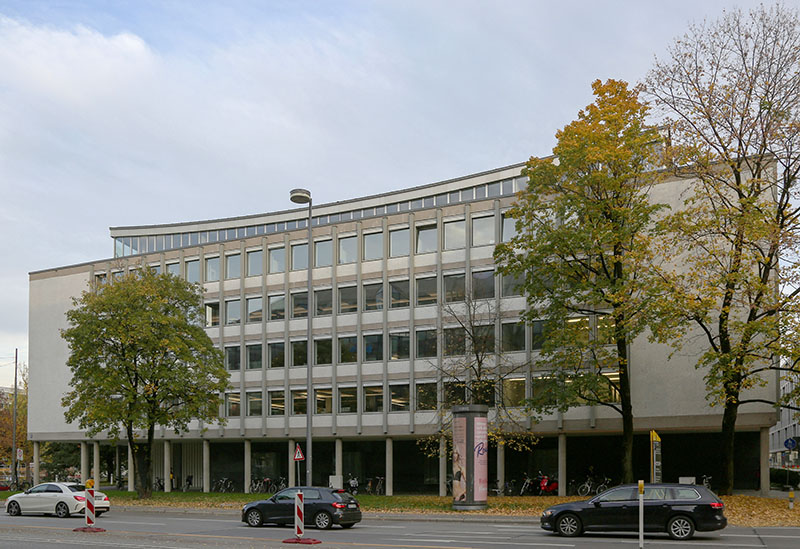
Cultural institute established by the German government in 1951 to promote the teaching of the German language and organise cultural collaborations across the world. Named after the writer and scholar Johann Wolfgang Goethe (1749–1832), it was first established in Germany after World War II as a replacement for the Deutsche Akademie. Its first international centre opened in Athens, Greece, in 1952; at the time of writing, it has centres in 98 countries around the world. The centres in India are also called Max Mueller Bhavans, after the German philologist and Orientalist.
More Definitions
Asian/Pacific/American Institute
An institute established in 1996 at New York University to focus on research and public programmes on cross-cultural dialogues and…
Dutch East India Company
Founded in 1602, the United East India Company or Vereenigde Oost Indische Compagnie was a commercial organisation comprising several trading…
Film Southasia
Biennial documentary film festival organised since 1997 in Kathmandu, Nepal by the Southasia Trust, a Nepal-based non-profit organisation. It showcases…
Bauhaus
A school of art and design founded by German architect Walter Gropius in 1919, which emphasised an interdisciplinary approach to…
Sericulture Information Linkages and Knowledge System (SILKS)
An interactive web portal developed by the North East Space Application Centre and the Central Silk Board, India to provide…
Sant Kabir Award
Instituted in 2009, it is an award given by the Government of India to textile craftspeople for their outstanding contributions…
Asiatic Society Of Bengal
An organisation in Kolkata, West Bengal, that holds a vast collection of old manuscripts from India. It was founded by…
Tata Institute of Fundamental Research
A public university and research institute established in 1945 in Mumbai by nuclear physicist Homi J Bhabha, under whose directorship…