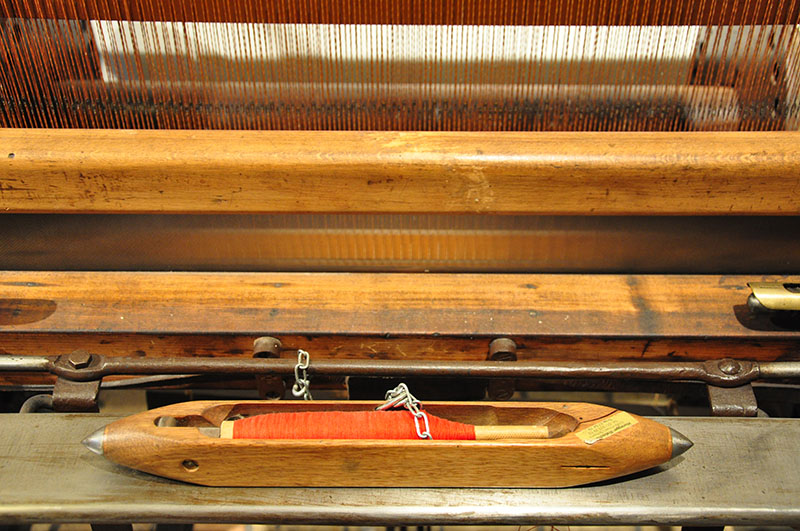
Mechanical tool installed on a loom for textile weaving, which enables the weft thread to be drawn through the warp more quickly and easily across wider spans. It is an oblong piece of wood with pointed metal ends, a central space with a spool for the thread, and wheels on its underside. A single weaver can propel it back and forth along a track by pulling a cord, eliminating the need for two or more weavers to throw and catch it at either side of the loom — as previously needed for making textiles wider than an arm span. Devised by British engineer John Kay in 1733, it was a major early landmark in the Industrial Revolution and the subsequent automation of weaving, and was soon incorporated into handloom industries beyond Britain and Europe.
More Definitions
Throw-Shuttle
A type of loom in which the shuttle, containing the weft yarn, is passed through the warp threads by hand.…
darkroom
Light-sealed room used for chemically processing photographic film and making prints. While developing film requires complete darkness, prints are made…
ground glass
Glass that has been given a coarse surface finish, usually with a fine abrasive, to be used as the viewfinder…
Non-Fungible Tokens
A unique digital certificate or token that authenticates the ownership of a virtual or physical asset such as a collectible,…
Ari
An embroidery tool resembling a crochet needle, it comprises an elongated wooden handle and a long, fine needle tipped with…
Hollowed Bone
A tool made from shaping human or animal bone and used by prehistoric people as tools as well as to…
photosensitive paper
Paper coated with a photosensitive emulsion, used for making photographic prints, usually in a darkroom. It is first exposed to…
fixer
In photography, a chemical solution used in the final stage of processing photographic film. It contains sodium or ammonium thiosulphate,…