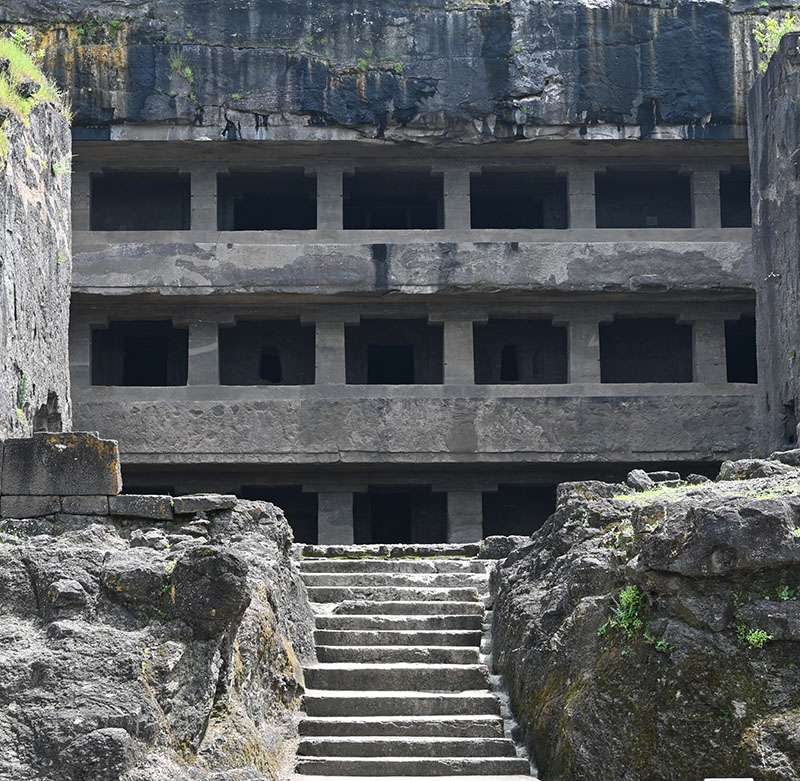
A cave temple in Ellora dating to the eighth century CE and discovered in 1876. Marked as Cave 11, it features carved images of the Buddha, Ganesha and Durga. It has a broad court and deep recessing halls, which have sanctuaries for images. Initially a congregational Mahayana Buddhist structure, it was later appropriated for Hindu worship. It was named Do Thal (literally, “two-storeyed”) since it was initially believed to have two levels; however, further excavation revealed three levels.
More Definitions
Maski
An archaeological site in the district of Raichur, Karnataka, famous for a Minor Rock Edict etched on gneiss that identifies…
Paadal Petra Sthalam
A group of 275 shrines dedicated to the Hindu deity Shiva and concentrated in southern India. They are mentioned in…
Hemakuta
A hill near Hampi, Karnataka, it is the site of the oldest and best-preserved structures built in the pre- and…
Darasuram
A municipality in Thanjavur, Tamil Nadu, known as the site of the Airavatesvara Temple constructed by Rajaraja Chola II in…
Pattadakal
Located in present-day Karnataka, it was a capital and coronation site of the Early Western Chalukyas. It is noted for…
Lumbini
A historical site in present-day Nepal considered to be the birthplace of the Buddha. It is also renowned for an…
Thanjavur
A city in present-day Tamil Nadu, it was formerly known as Tanjore and was the capital of the Chola Dynasty.…
Mohenjo-Daro
An archaeological site located in present-day Sindh, Pakistan, and dated to c. 2500 BCE. It was one of the largest…