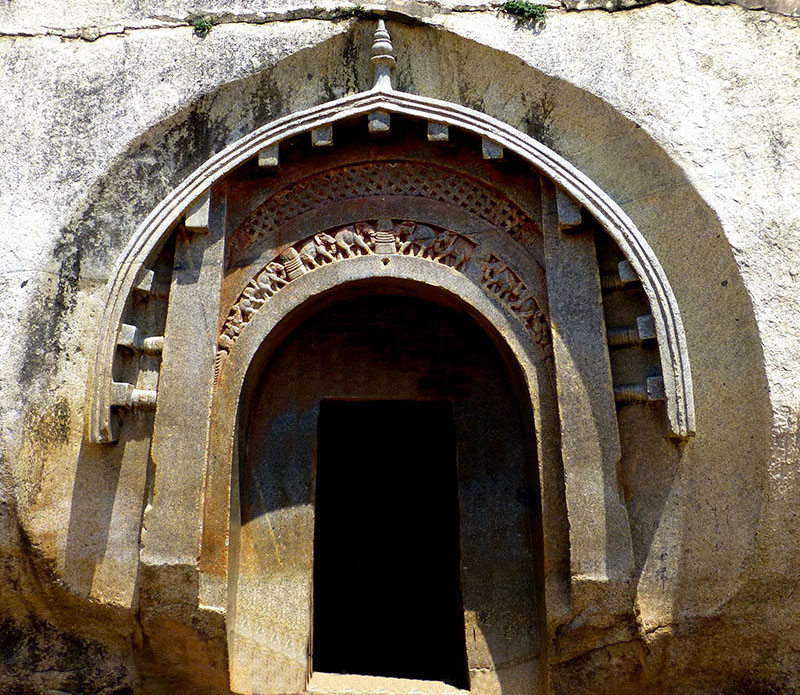
A decorative motif similar to a barrel-vaulted roof, with a circular dormer-shaped or horseshoe-shaped arch. It is commonly found in rock-cut monuments and structural temples in India, with the earliest evidence found in the Lomas Rishi Cave. From the Sanskrit, meaning “moon window.” It is occasionally found in the facade of chaitya halls, and is known as a chaitya arch. It is also incorporated as a decorative element in structural temples in southern India and known as gavaksha (or kudu in Tamil).
More Definitions
Krishna Mandapa
A open-air bas relief sculpture in Mamallapuram, Tamil Nadu, attributed to the reign of the Pallavas. It is 8.8 meters…
Dormer
A triangular or cylindrical projection from a roof that usually contains a window. It is an architectural motif commonly found…
Collonade
A row of columns, typically equidistant from each other and joined by an entablature. A colonnade may be freestanding or…
Ikshvaku Architecture
Architecture patronised by the Andhra Ikshvakus (c. fourth to third century BCE) (not to be confused with the legendary Ikshvaku dynasty…
Sarvatobhadra
A type of Hindu temple architecture characterised by a door in each of the four cardinal directions of the sanctum.…
Hirka-i-Sharif Mosque, Istanbul
Mosque in Istanbul, Turkiye, built in 1851 to house the cloak relic of Prophet Muhammad, from which it receives its…
Groyne
A long, rigid hydraulic structure constructed perpendicular to the seashore or riverbank to interrupt flow of water. They are usually…
Blind Bays
In architecture, a recess or space between two vertical supports that is set on a wall without doors or windows.