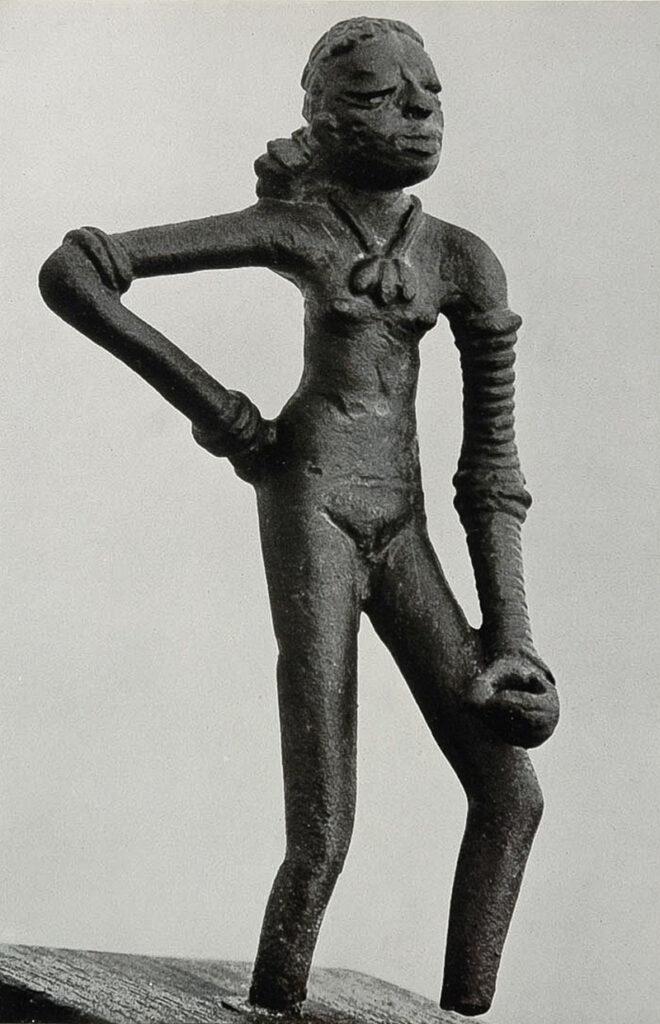
A prehistoric period characterised by the production and use of bronze as well as signs of urbanisation. Its commencement varies in different regions of the world, such as the Indus Valley Civilisation (3300–1300 BCE), Greece and China (c. 3000 BCE), and the United Kingdom (c. 1900 BCE). It is the second of the three-age classification of human history, preceded by the Stone Age and followed by the Iron Age. The transition from the Neolithic cultures to the Bronze Age is known as the Chalcolithic period.
More Definitions
Photographic and Lithographic Office of the Survey of India
A department within the Survey of India that was responsible for making photographs and lithographic reproductions of major archaeological sites.…
TA Gopinatha Rao
TA Gopinatha Rao (b.1872, d.1919) was an Indian archaeologist and epigraphist with the Archaeological Survey of India. In 1908, he…
Indus Valley Civilisation
A Bronze Age civilisation located along the basin of the Indus river, in the northwestern regions of South Asia comprising…
Harappa Museum, Punjab
A museum in Punjab, Pakistan, that houses artefacts from the Indus Valley Civilisation. The museum was established in 1926 and…
Surkh Kotal
An archaeological site in present-day Afghanistan that was excavated between 1952 and 1965. The excavations uncovered an architectural complex, including…
Chalcolithic Period
The period that marked the transition from Neolithic cultures to the Bronze Age, characterised by rudimentary writing systems as well…
FO Oertel
Friedrich Oscar Oertel (b.1862; d.1942) was a German engineer and archaeologist best known for his excavations at Sarnath in 1904–05,…
Taxila
An archaeological site in present-day Rawalpindi, Pakistan. Founded c. 1000 BCE, the site was located along trade routes between Central…