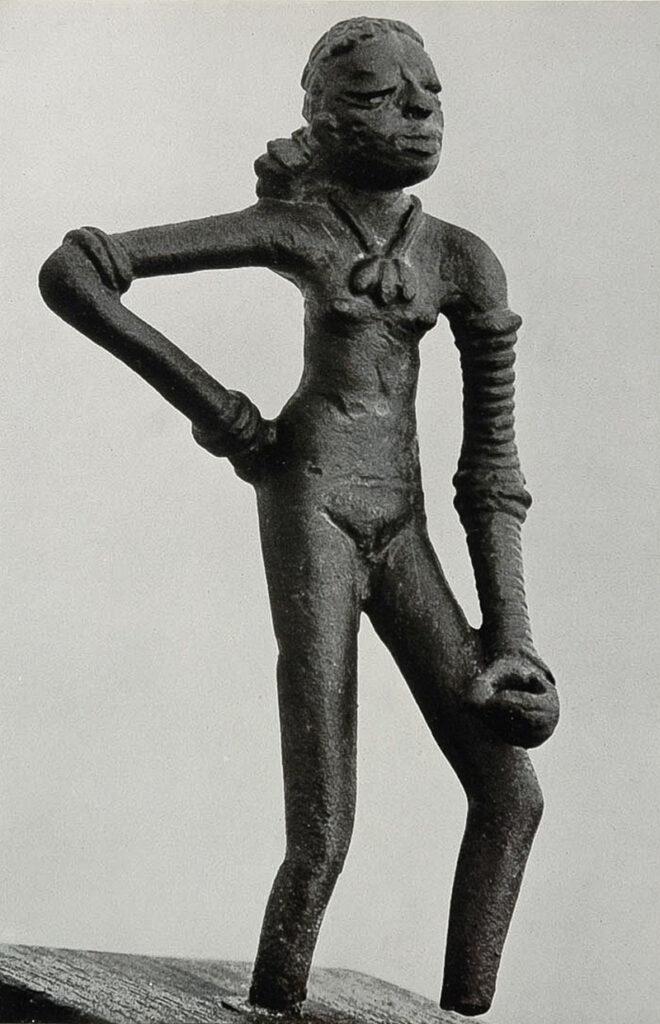
A prehistoric period characterised by the production and use of bronze as well as signs of urbanisation. Its commencement varies in different regions of the world, such as the Indus Valley Civilisation (3300–1300 BCE), Greece and China (c. 3000 BCE), and the United Kingdom (c. 1900 BCE). It is the second of the three-age classification of human history, preceded by the Stone Age and followed by the Iron Age. The transition from the Neolithic cultures to the Bronze Age is known as the Chalcolithic period.
More Definitions
Early Harappan Phase
The early period of the Indus Valley Civilisation that lasted from 3300–2600 BCE and was succeeded by the Mature Harappan…
Madho Sarup Vats
Madho Sarup Vats (b.1896; d.1955) was an Indian archaeologist and Sanskrit scholar who served as the Director-General of the Archaeological…
Kurkihar Hoard
A hoard of 226 bronzes dating between the ninth and twelfth centuries and discovered in 1930 at Kurkihar, Bihar. Most…
Tube Drill
A technology for drilling developed during the Mature Phase (c. 2600–1900 BCE) of the Indus Valley Civilisation. It was made…
Photographic and Lithographic Office of the Survey of India
A department within the Survey of India that was responsible for making photographs and lithographic reproductions of major archaeological sites.…
Albert H Longhurst
Albert H Longhurst (b. 1876; d. 1955) was a British archaeologist and art historian specialising in the arts of southern…
Mohenjo-Daro
An archaeological site located in present-day Sindh, Pakistan, and dated to c. 2500 BCE. It was one of the largest…
Late Harappan Phase
The last phase of the Indus Valley Civilisation that lasted from c. 1900 to 1300 BCE and was preceded by…