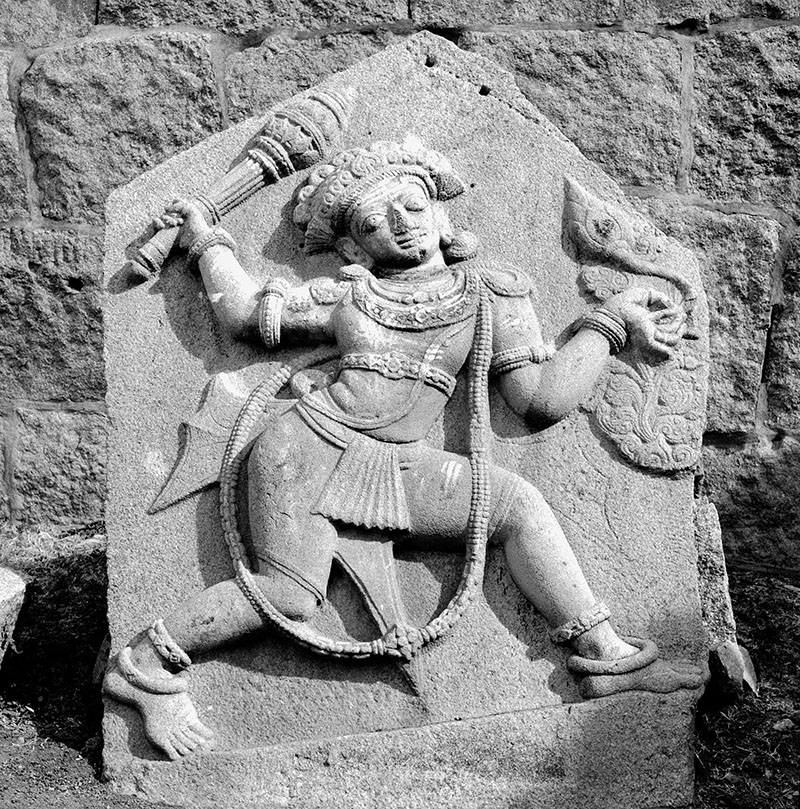
Second of the five mythical Pandava brothers and protagonists of the Sanskrit epic Mahabharata, known for his heroism, exceptional skills as a warrior, passionate loyalty, and voracious appetite. Bhima in Sanskrit means ‘formidable’ or ‘fearsome’. His superhuman strength is at times attributed to his conception through his mother Kunti’s invocation of Vayu the wind god. Early in the Mahabharata, Bhima marries the rakshasi Hidimbi and has a son, Ghatochka, who also becomes a great warrior. Bhima plays a pivotal role in the epic’s narrative: he effectively ends the Kurukshetra war by killing all hundred Kaurava antagonists. Notably, he fulfils a vow to kill Dushasana, drink his blood, and wash Draupadi’s hair with it, as vengeance for her humiliation at the Kaurava court; this episode in particular has been widely depicted in Indian art. Outside South Asia, legends of Bhima are especially popular in Indonesia.
More Definitions
Bhairavi
The consort of Bhairava and a form of Devi, the supreme goddess in Hinduism. She is also one of the…
Vedas
A body of religious texts composed in Sanskrit and considered the oldest scriptures in Hinduism. There are four primary texts…
Kama
In Hinduism, Kama is the god of love and desire. Some of his iconographical attributes are a bow made from…
Yogishvara
An aspect of the Hindu deity Shiva, where he is depicted seated in padmasana and worshipped as the lord of…
Chenrezig
Another name for Avalokitesvara, the bodhisattva of compassion, he is the patron bodhisattva of Tibet. He is usually depicted dressed…
Mahavidyas
A group of ten goddesses from the Tantric Hindu pantheon, consisting of Kali, Tara, Shodashi, Bhuvaneshvari, Chhinnamasta, Bhairavi, Dhumavati, Bagalamukhi,…
Somaskanda
A representation of the Hindu deities Shiva and Parvati with their son Skanda, the god of war. This representation emerged…
Shankhanidhi
One of the nine nidhis (treasures) of Kubera, the Hindu god of wealth, Shankanidhi is associated with shankha (the conch…