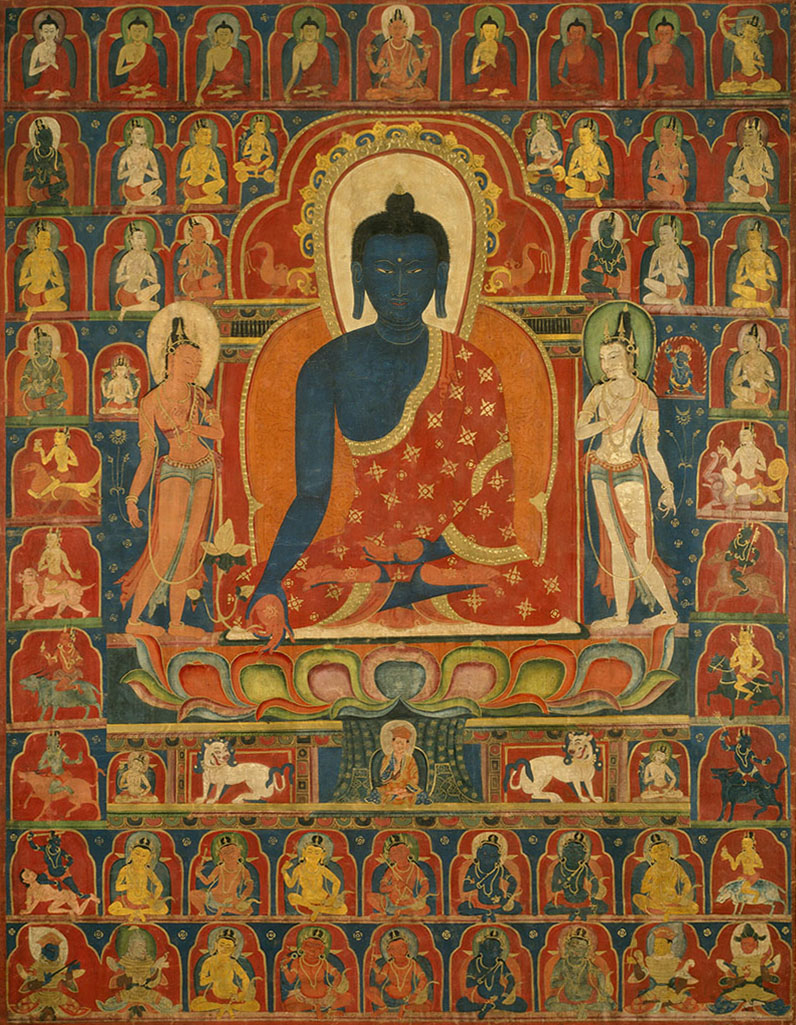
Also known as the Medicine Buddha, he is the Buddha of healing and medicine in Mahayana Buddhism and is believed to cure suffering through his teachings. He is considered a bodhisattva who took twelve significant vows upon attaining enlightenment. He is also an important deity in Chinese Buddhism, along with Amitabha and Shakyamuni. The deity is typically depicted seated, holding a lapis or blue jar of medicine in his left hand and the stem of the aruna fruit (myrobalan or Terminalia chebula) in his right hand. He is also depicted with a blue halo. From the Sanskrit bhaisajyaguru, meaning “medicine master.”
More Definitions
Hayagriva
The horse-headed avatar of Vishnu, he is the deity of knowledge and wisdom within the Hindu pantheon. He is usually…
Vedic religion
Polytheistic religion developed by Indo-Aryan-speaking settlers who migrated from Central to South Asia in the second millennium BCE. It originated…
Agni
The god of fire in the Vedic pantheon and one of the five elements of Indian cosmology. Agni is also…
Padmasambhava
A Tantric master in Vajrayana Buddhism considered to have disseminated Vajrayana in Tibet between c. eighth and ninth centuries CE.…
Bharata (Jainism)
In Jain mythology, he is the first chakravartin ("universal emperor") and the oldest son of Rishabha Deva, the first Tirthankara.…
Manjushri
Also known as Manjughosa and Vaigsvara, he is a bodhisattva who is associated with prajna (wisdom) in the Mahayana and…
Andhaka
A malevolent asura king from the Hindu pantheon who fought a war with Shiva and other devas after being granted…
Adipurana
A Sanskrit poem on the life of Rishabnath, the first Tirthankara of Jainism and his sons Bharata and Bahubali. It…