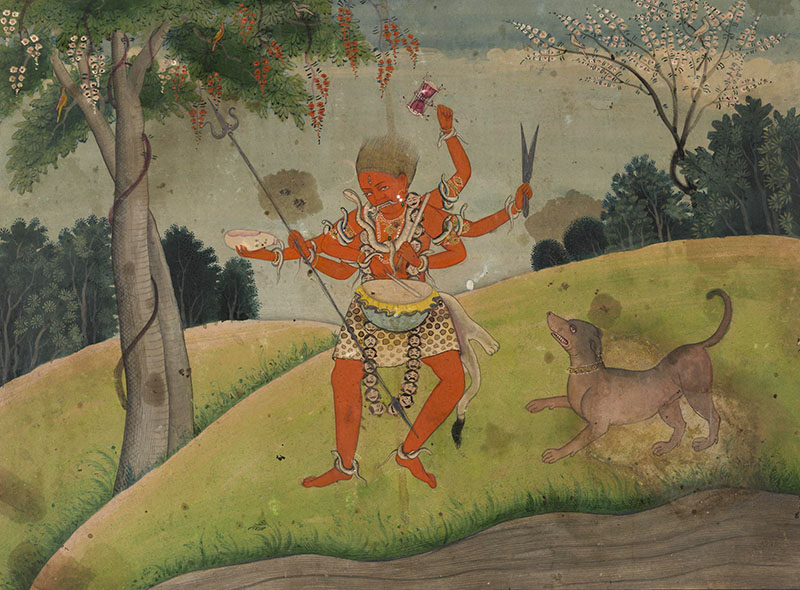
A fierce form or manifestation of the Hindu god, Shiva, he is a guardian deity and one of the central deities of Tantrism and Kashmir Shaivism. Within the Hindu religious tradition, there are several further forms and aspects of Bhairava, including the Eight Bhairavas, the 64 Bhairavas and Vatuka-Bhairava. His iconographical depictions may include elements such as matted locks, protruding teeth, snakes as ornaments, a garland of skulls or a skull held in one hand, along with several weapons.
More Definitions
Mount Mandara
In Hindu mythology, the name of the mountain that appears in the mythological episode of the Samudra Manthan (churning of…
Dhyani-Buddha
Denoting any of the five celestial and meditative Buddhas — Vairochana, Akshobhya, Ratnasambhava, Amitabha and Amoghasiddhi — it was a…
Anandatandava
Meaning “dance of bliss,” it is a cosmic dance performed by the Hindu deity, Shiva, in his Nataraja form.
Pasupatastra
A destructive weapon attributed to the Hindu deities Shiva, Kali and Mahadevi. The weapon is considered powerful enough to destroy…
Agamic Texts
Meaning “tradition” or “received knowledge” in Sanskrit, the term refers to a set of scriptures within Hinduism, Jainism and Buddhism.…
Subrahmanya
A Hindu deity of war worshipped predominantly in southern India. The worship of Subrahmanya as Murugan is particularly popular in…
Parvataraja
Meaning “king of the mountains” in Sanskrit, it is an epithet that refers to the father of Parvati, the consort…
rakshasa
Type of mortal being associated with evil and mischief, appearing first in Vedic texts and throughout later Brahmanical mythology. Typically,…