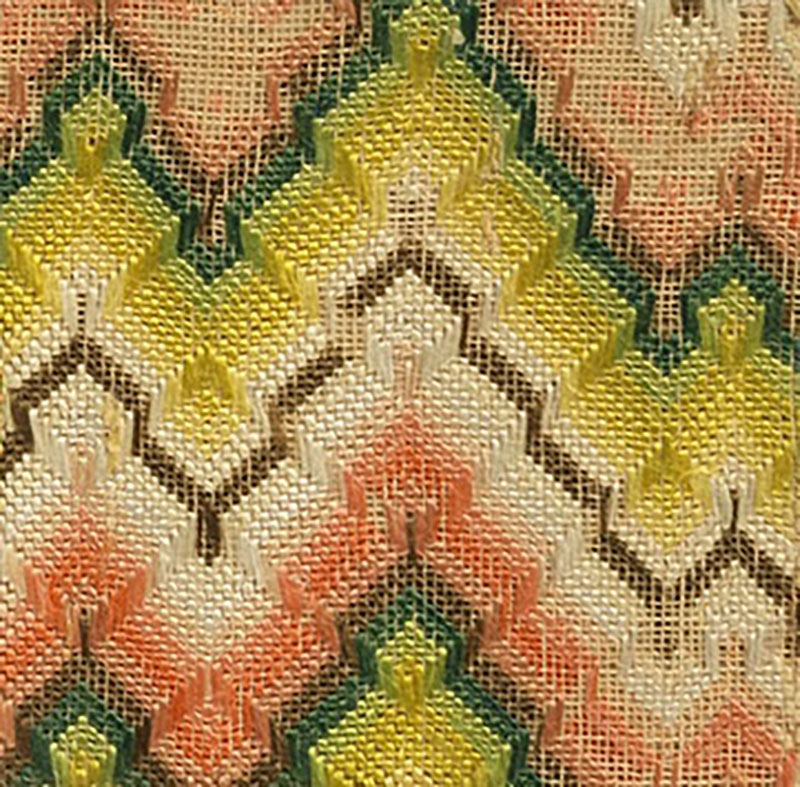
An embroidery technique in which patterns are made by sewing vertical stitches of different lengths in a row, according to an ascending or descending sequence. The most common stitch associated with the technique is the flame stitch, which is also known as the Bargello stitch, the Florentine stitch, the Hungarian stitch or the Irish stitch. Traditionally worked in wool or silk on canvas fabric, the row-based sequence of stitches creates a wave-like pattern, emphasised using different-coloured threads.
More Definitions
Somak Weaving
A flat-weave tapestry weaving technique where weft yarns are wrapped over four warp threads before being twisted back under the…
Termeh Tapestry
A Persian handwoven woollen cloth produced primarily in Isfahan, Iran, and characterised by a jujube red, green or black ground.…
Rib Weave
A variation of the plain weave, it is created by passing the weft over and under the warp threads in…
Waxed Paper Negative
A photographic negative using a base of paper coated with oil or beeswax before the application of dry and stable…
Kasavu
The gold zari used in the border of a traditional white Kerala textile, such as a sari or a mundu…
Amli
Also known as amlikar, it is a needle-embroidered Kashmiri shawl dating to the nineteenth century. While it is likely to…
Badla
A thin, flattened metallic wire that is used as yarn for sewing or embroidering decorative fabrics. The term also refers…
Naqshaband
The designer of the naqsha (map or design plan) of Banarasi brocade. They sketch and create the map of motifs…