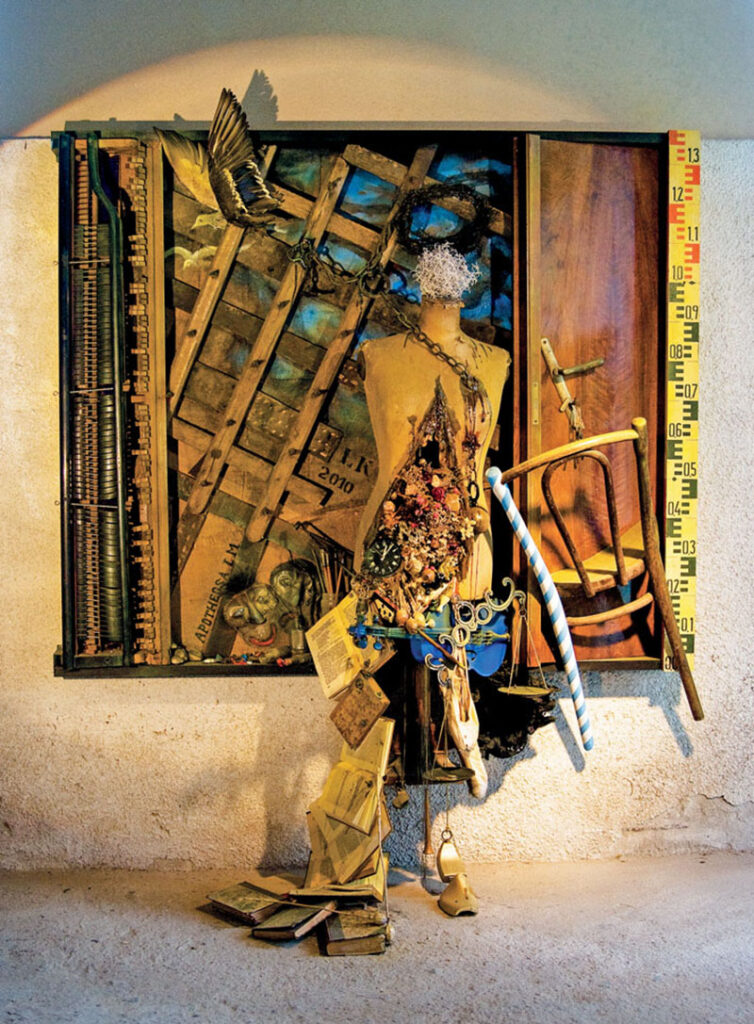
Art made by assembling disparate elements from everyday or found objects. Assemblages are often associated with movements such as Dadaism, Neo-Dadaism, Arte Povera and Young British Artists. The term was coined by the artist Jean Dubuffet in the 1950s and notable artists include Marcel Duchamp, Robert Rauschenberg, Kurt Schwitters, Joseph Cornell, Louise Nevelson and Jean Tinguely.
More Definitions
Bindu-Varttana
An ancient Indian shading technique wherein the artist retains their brush to paint miniature dots of differing density. The technique…
Gouache
An opaque water-soluble paint that contains a gum binder and a white pigment such as chalk mixed with a high…
Kashikari
Painted and glazed ceramic ware, particularly tiles, common in the Islamic world, typically featuring colourful arabesques, floral and geometric motifs,…
Naqshaband
The designer of the naqsha (map or design plan) of Banarasi brocade. They sketch and create the map of motifs…
Engine Oil Painting
Paintings made using engine oil as the pigment binder, instead of typically used oils such as linseed or safflower oil.…
Schiffli
A multi-thread machine used to create machine embroidery and lace, invented in 1893 by Swiss inventor Isaak Grobli. The term…
Herringbone Stitch
A needlework technique that uses stitches resembling bones extending from the spine of a herring fish. It is found in…
Khapa Sari
Also known as patiya sari, it is a tussar silk sari characterised by extra weft rib weaves in the pallu…