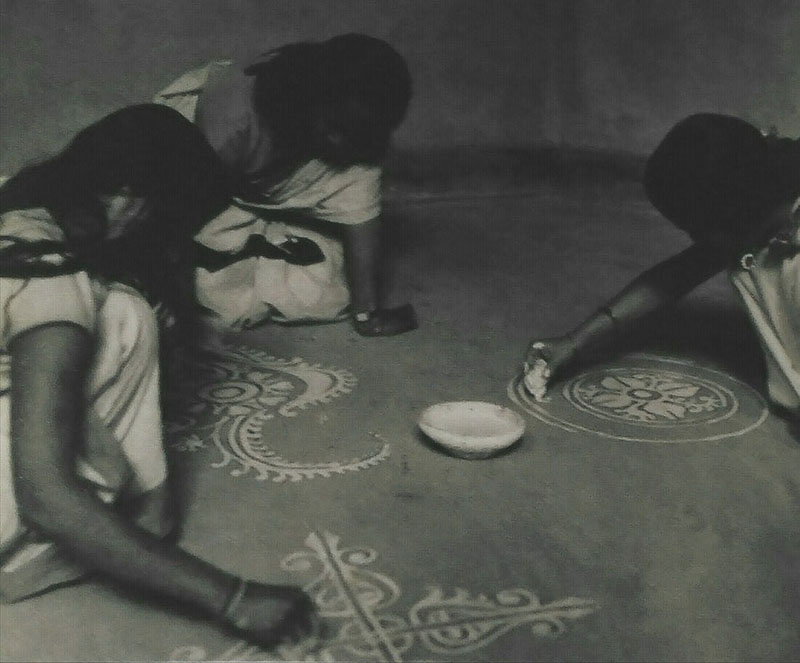
A ritual Bengali practice of making designs and paintings featuring religious motifs and patterns, typically made in white using a pigment derived from rice powder. It is traditionally made by women during festivals and ceremonies. From the Sanskrit alimpana, meaning “to plaster” or “to coat with.”
More Definitions
Agamic Texts
Meaning “tradition” or “received knowledge” in Sanskrit, the term refers to a set of scriptures within Hinduism, Jainism and Buddhism.…
Karva Chauth
A Hindu festival, it is primarily celebrated by women in northern India during the Hindu month of Kartika. On this…
Panigrahana
A rite performed during a Hindu wedding ceremony in which the groom holds the bride’s hand. It is considered one…
Gurpurab
A festival of the Sikh religion, which marks important events in the lives of the Sikh gurus, including birth anniversaries…
Rathyatra
A public chariot procession associated with the worship of the Hindu god Jagannath and predominantly celebrated in the states of…
Alam
A religious processional object used by the Shi’a community on Ashura, the tenth day of Muharram. It is considered a…
Janeu
The sacred thread worn Brahmin men after initiation rites of upanayana, which marks the advent into adulthood.
Rudraksha
Deeply grooved ritual bead derived from the cleaned, dried pit of the fruit of the blue marble tree (Elaeocarpus angustifolius…