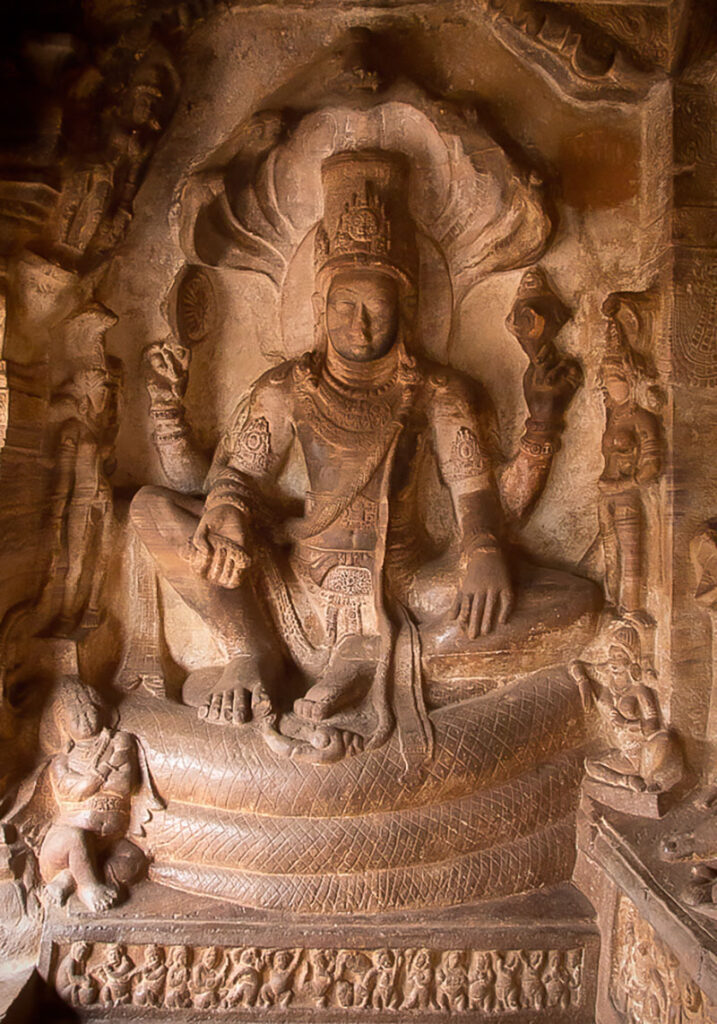
Also known as Para Vasudeva, it is a manifestation of the Hindu deity Vishnu. The conventional iconography of the form depicts Vishnu seated on the coils of the serpent Sesha, with his left leg folded and his left hand placed on his left knee. Sesha’s hood is shown to be covering his head, in the manner of a parasol. However, in the Tirumala Venkateswara Temple in Andhra Pradesh, Vishnu is depicted standing on the serpent, his head shielded by the snake’s hood.
More Definitions
Tirthankara
Also known as jinas, Tirthankaras are teachers and guides in Jain devotional practices who lead their followers on the path…
Shi’ism
The second largest denomination of Islam after Sunnism, Shi'ism is believed to have originated in 632 CE in Medina, present-day…
Vedic religion
Polytheistic religion developed by Indo-Aryan-speaking settlers who migrated from Central to South Asia in the second millennium BCE. It originated…
Gelugpa
A Tibetan Buddhist monastic order, founded by Je Tsongkhapa in the early fifteenth century. Tsongkhapa along with his disciples founded…
Vishwakarma
A deity in the Hindu pantheon, Vishwakarma is considered a divine engineer and was the architect of Dwarka, Lanka and…
Yadavaraya
A Vaishnava sect that emerged prominently in southern India during the late medieval period. Vishnu and his consort Sri are…
Animism
It is a belief system that attributes a spiritual essence to plants, animals and inanimate objects.
Nrittamurti
The term used for a deity’s dancing form in Hindu religious iconography. It is most commonly associated with the Shiva,…