-
ChicagoImpart Encyclopedia of Art. "Puan." April 21, 2022. https://imp-art.org/articles/puan/.
-
MLA"Puan." Impart Encyclopedia of Art, Apr. 21, 2022, https://imp-art.org/articles/puan/.
-
HarvardImpart Encyclopedia of Art (2022) Puan. Available at: https://imp-art.org/articles/puan/ (Accessed: 3 March 2026).
A long, handwoven cloth wrapped around the waist as a lower garment, the puan (‘cloth’ in Mizo) is historically worn by various communities in Mizoram, Northeast India. Earlier worn by men and women, since the twentieth century it is more common as women’s attire. Puans of different types are made for various occasions such as weddings, dances and festivals, and their weaving, design and motifs distinguish between tribes and indicate social status.
Before the twentieth century puans consisted of an uncut rectangular cloth that was draped over a blouse by women and wrapped around the body by men. Following the arrival of missionaries and British administrators in the region, by the early twentieth century the communities began incorporating the puan with western wear, which informed the present form of the women’s puan, which is similar to a wrap skirt. Subsequently, the puan was incorporated into traditional and formal clothing worn by Mizo women, whereas men only wear puans during performances or in informal or domestic settings.
A typical puan is about 90 cm wide and 110–140 cm long. It was traditionally woven by women using cotton or wool yarn on a loin or backstrap loom; as the width is restricted on such looms, the puan was woven in two parts, which were later stitched together lengthwise.
Two balls of yarn are hand-rolled simultaneously to wind them on a bamboo stick, with a porcupine quill used to untangle the yarn while it is being wound. On the backstrap loom, a wooden slab with grooves, called tukkrek, holds the warp yarn taut; the weft is introduced into it using a shuttle or themtleng, which is made from the wood of the Meihle tree (Caryota mitis) . Traditional puans are woven using the plain-weave technique, while designs such as the striped pattern are woven with wool threads using the rib-weave technique, with patterns inserted through swivel weaving. The decorative motifs on the puan, called zeh, are woven using the extra-weft technique using thread work to tie the weave from the reverse of the puan.
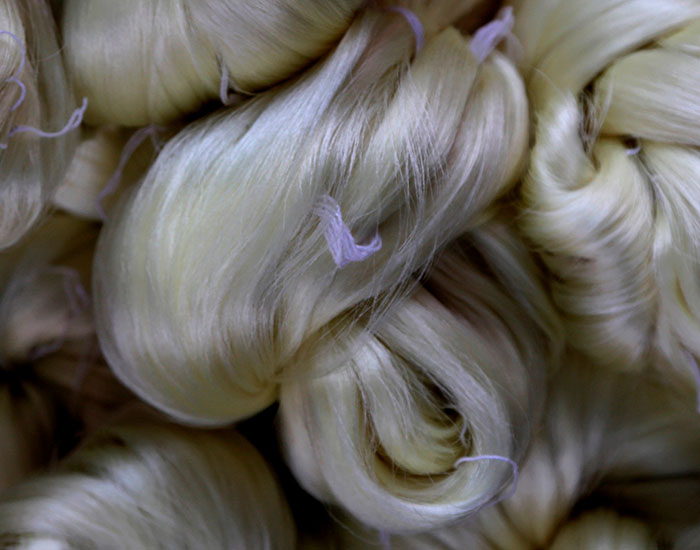
Backstrap looms have been largely been replaced by frame looms, and contemporary puans use acrylic, rayon and mulberry silk yarn sourced from Assam and West Bengal. Yarns of various colours are first wound on a warping drum using a spinning wheel. The yarn is then transferred to a wooden beam set on the loom and passed through reeds and heddles which set the yarn according to the design, with the heddles tied to the bamboo deck below for footwork movement of the loom. The number of bamboo rods differ based on the desired design: five rods are used for twill-weave work, four for double-thread work and two for single-thread work. The frame loom produces single-width puans, as opposed to the two sections woven using the loin loom. The yarn for motif weaving is suspended on a rod above the woven fabric for easy access. The motifs are inserted using the same process as in the backstrap loom, with the threads tied on the reverse.
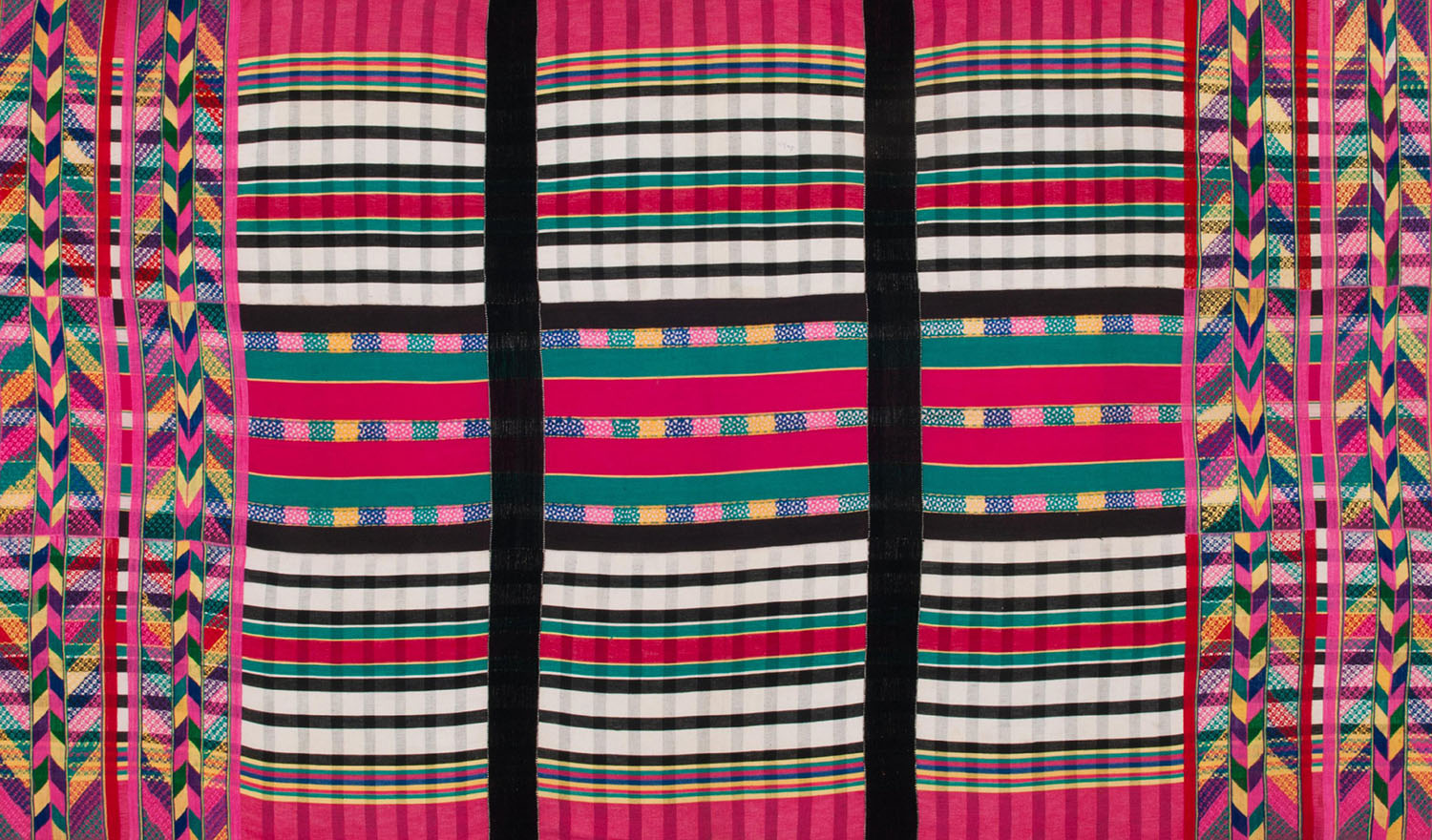
Common motifs on puans include designs inspired by native flora and fauna, such as sawhthing (ginger flower), stars, roses, saskei or kepui (tiger skin), sinar (geometrical diamond, triangular or zig-zag patterns), kikau (geometrical zig zag pattern), hruih (plain black stripe), kawkpuizikzial (entwined leafy plants), disul (sungrass) and lenbuantham (two or four triangles, signifying the junction of the branches of the Lenbuan tree). The predominant colours on a puan are black, white and red. Traditional puans may also be decorated with gold and silver zari threads sourced from Assam. Handspun puans with bright colours generally have bold stripes due to the warp-dominant structure of the garment.
The earliest forms of the puan were the puangngo, a white puan made of coarse cotton; the puanmawl, a puan in a single colour with no design; and the puanhlap, a larger puan that could also be used as a shawl or a blanket. Though the puan is largely worn by women, some types such as the ngotekherh, chyna hno and puanchei may also be worn by men. There are over thirty kinds of puan, including the puan laisen, which has a red horizontal section in the middle; the thihni, a heavily embellished puan worn by the Lai and Mara community of South Mizoram; and the shorter hmaram, which is worn with a petticoat and a girdle. The puak puan is a sling-like variation that is worn around the body and used to carry children.
Different varieties of puans are used for different occasions, most commonly during weddings, cultural and ceremonial occasions and festivals such as Christmas and Easter, and are distinguished by their colour combinations and patterns. It is also worn with the kawrchei (decorated blouse) and vakiria (headdress) by women during Cheraw performances. Notable varieties of the puan include the puanchei, puan laisen (ceremonial costume with a red horizontal middle section), puandum, tawlhlohpuan and ngotekherh. Contemporary design experiments and variations in puan designs have altered the colour palette of traditional puans, incorporating bright colours, artificial diamond needle-work and embroidery. While early puans were woven in undyed white, they eventually began to be rendered in naturally dyed cloth. In recent years, synthetic dyes have replaced natural dyes, making it possible for variations to the traditional colour palette.
The primary knowledge of weaving and units remain generational, passed down within a family of weavers. After the independence of India in 1947, the village of Thenzawl near Aizawl emerged as an important centre of puan weaving, with concentrated efforts to train weavers in the fly-shuttle technique through a Weavers’ Service Centre certificate course instituted in 1979. By the 1980s, it had emerged as an important centre for traditional and frame-loom based puan weaving and has contributed significantly to the economy of the state. Lengpui village is another important centre for loin loom puans, whereas Zuangtui village consists primarily of frame loom puan weavers. Today, the fabric is also used in accessories such as bags, cushion covers, table runners and tailored shirts, in addition to the skirt.
The tawlhlohpuan, puanchei, puandum and ngotekherh received the Geographical Indication (GI) tag in 2019. Puans are also held in the collections of museums such as the Museum of Fine Art, Boston; the Yale University Art Gallery; the Philadelphia Museum of Art; and the Pitt Rivers Museum.
First published: 21 April 2022
Image Gallery
Bibliography
Chhangte, Cherrie L. “Textiles of Mizoram: The Puan.” Journal of the Mizoram English Literary Society 1, no. 1 (June 2014): 50–60. https://miels.in/uploads/journals/Textiles%20of%20Mizoram,%20The%20Puan.pdf.
Deccan Chronicle. “Loin loom is the main source of income for the native of Mizoram.” Accessed August 29, 2021.
https://www.deccanchronicle.com/lifestyle/fashion-and-beauty/210319/loin-loom-is-the-main-source-of-income-for-the-native-of-mizoram.html
Direct Create Community. “Mizo Puan Weaving.” Accessed August 29, 2021.
https://medium.com/@DirectCreate/mizo-puan-weaving-1592f8184a75
Ranganna, Akhila. “Wrap conscious: puan wraparound.” The Hindu, October 13, 2017.
https://www.thehindu.com/life-and-style/fashion/wrap-conscious/article19854685.ece
Rai, Larah. “Social Wrap: An examination of the Puanchei.” Textiles and Clothing Research Centre e-Journal 2, no. 4 (August 2018): 22–24.
https://www.tcrc.in/wp-content/uploads/2020/07/v2i4-Article-4_LR.pdf
Wovensouls. “A Glimpse of Stunning Mizo Textiles – The Puanchei.” Accessed August 29, 2021.
https://wovensouls.org/2015/01/26/a-glimpse-of-stunning-mizo-textiles-the-puanchei/
Feedback