-
ChicagoImpart Encyclopedia of Art. "Bombay School Pottery." September 1, 2025. https://imp-art.org/articles/bombay-school-pottery/.
-
MLA"Bombay School Pottery." Impart Encyclopedia of Art, Sep. 1, 2025, https://imp-art.org/articles/bombay-school-pottery/.
-
HarvardImpart Encyclopedia of Art (2025) Bombay School Pottery. Available at: https://imp-art.org/articles/bombay-school-pottery/ (Accessed: 3 March 2026).
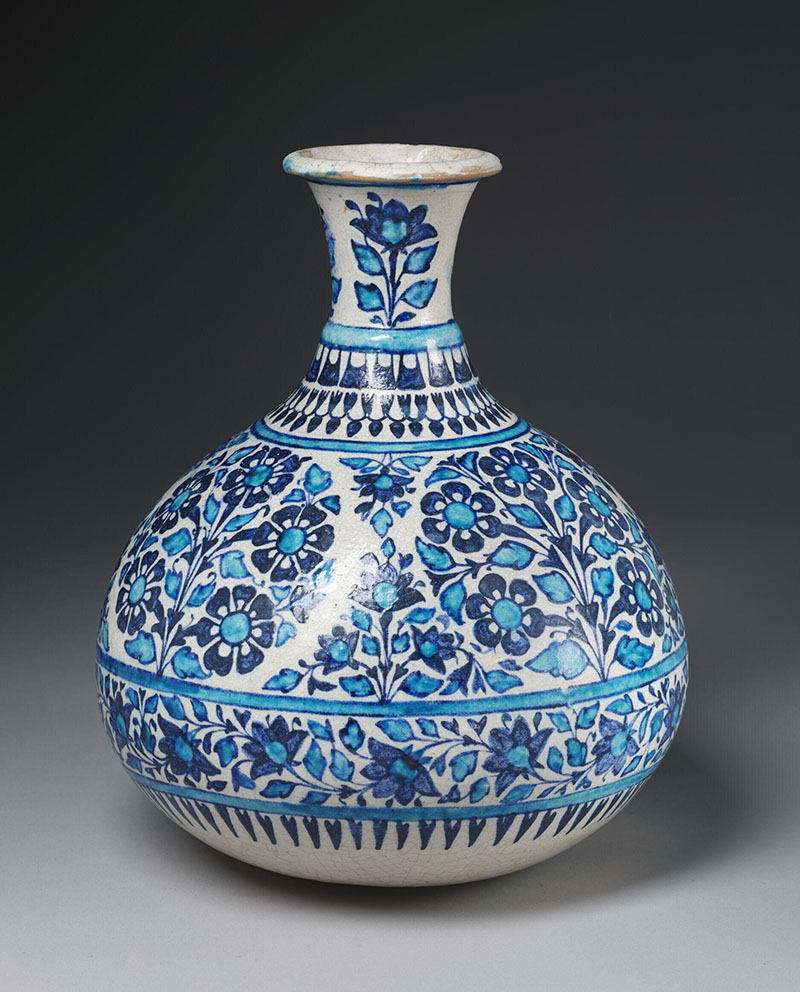
A range of densely painted, glazed earthenware produced by a studio at the Sir JJ School of Art, Bombay (now Mumbai) between 1873 and the early twentieth century, Bombay School pottery, as it is often known, was made primarily for export to the British market. The enterprise, named Wonderland Art Pottery, was started by British curator and the school’s principal George Wilkins Terry, after whom the ceramics were also called Terryware. The products aimed at an indigenous appearance, using regional techniques, materials, colours and motifs, notably imagery from the ancient murals at the Ajanta caves.
Historical background
The documentation and survey of the crafts practices of the Indian subcontinent was of interest to the administrators of the East India Company and later the British Raj, who sought to create an international economic market for indigenous goods and materials. Museums and colonial exhibitions — held both internationally and in India — served to popularise these objects, but collectors were often frustrated by what they felt to be a lack of formalised standards of structural quality and design among Indian artisans. The Sir JJ School of Art, set up in 1857 as the School of Art and Industry, was among several art colleges established in colonial India that purported to improve or revive indigenous arts and crafts practices to produce marketable goods, such as Terryware. They aimed to impart standardised training and scientific knowledge to artisans, while retaining ‘traditional’ design that could be marketed as indigenous. Terry and other later principals of the Sir JJ School were also strongly influenced by the Arts and Crafts movement in Britain, which opposed industrial mass production of artistic goods and sought to develop handmade craft industries, mainly in Britain and to a limited extent in the colonies.
Origins and development
Terry, the first drawing master and Superintendent of the JJ School of Art, also served as the head of several exhibition committees and curator at the Victoria and Albert Museum in Bombay (now the Dr. Bhau Daji Lad Museum) for several years during his tenure. His work in these roles led him to study the various glazed potteries of Sindh (present-day Pakistan), the Punjab, and Gujarat (present-day India), and allowed him to source material and labour for the production of goods for exhibitions. In 1872, he set up a workshop in a shed on the school’s campus, hiring potters from Gujarat and Multan to shape various objects on the wheel, and appointing as Head Potter a Sindhi artisan named Nur Mohammed, who fired, painted and glazed the thrown wares using his specialised knowledge.
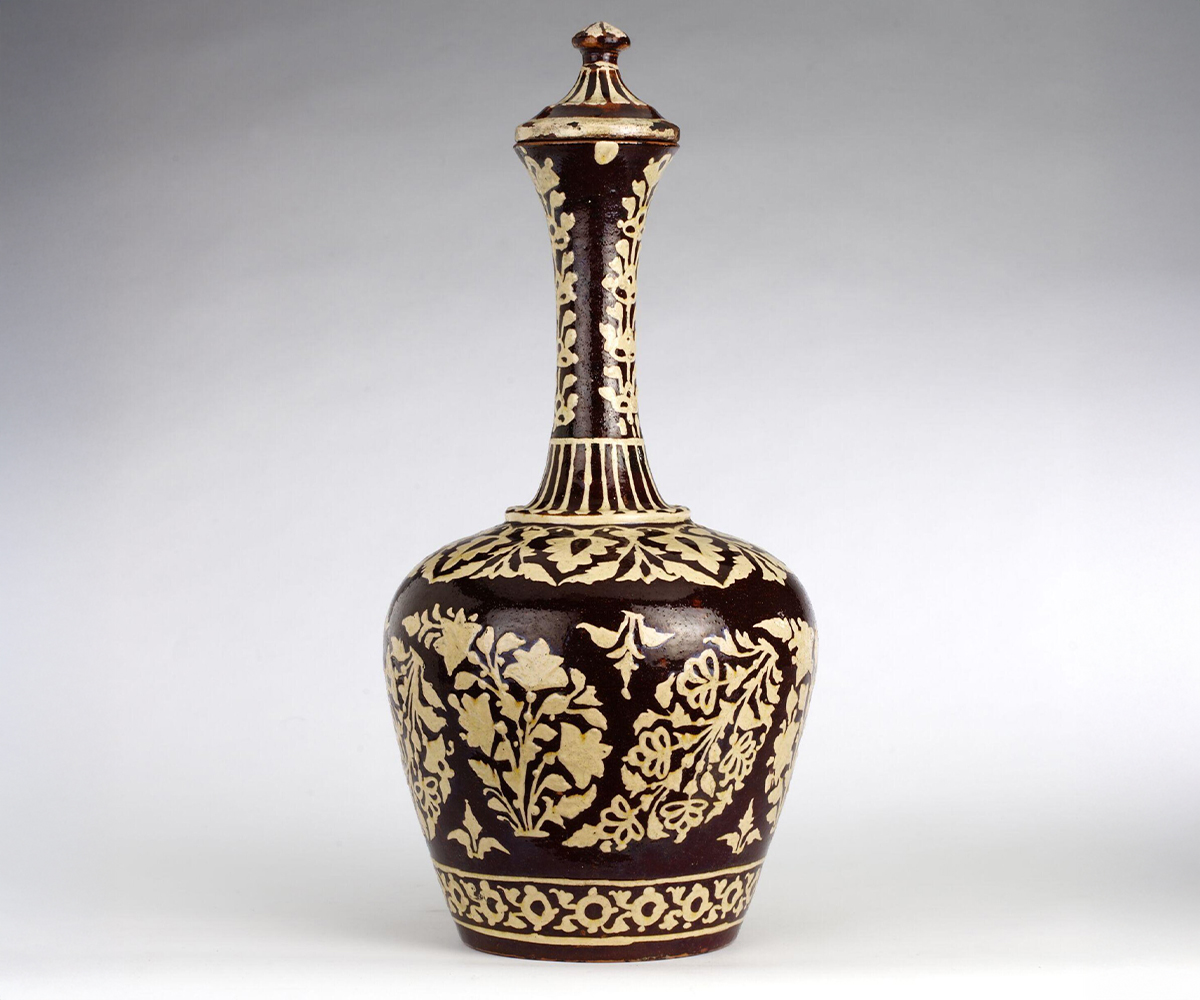
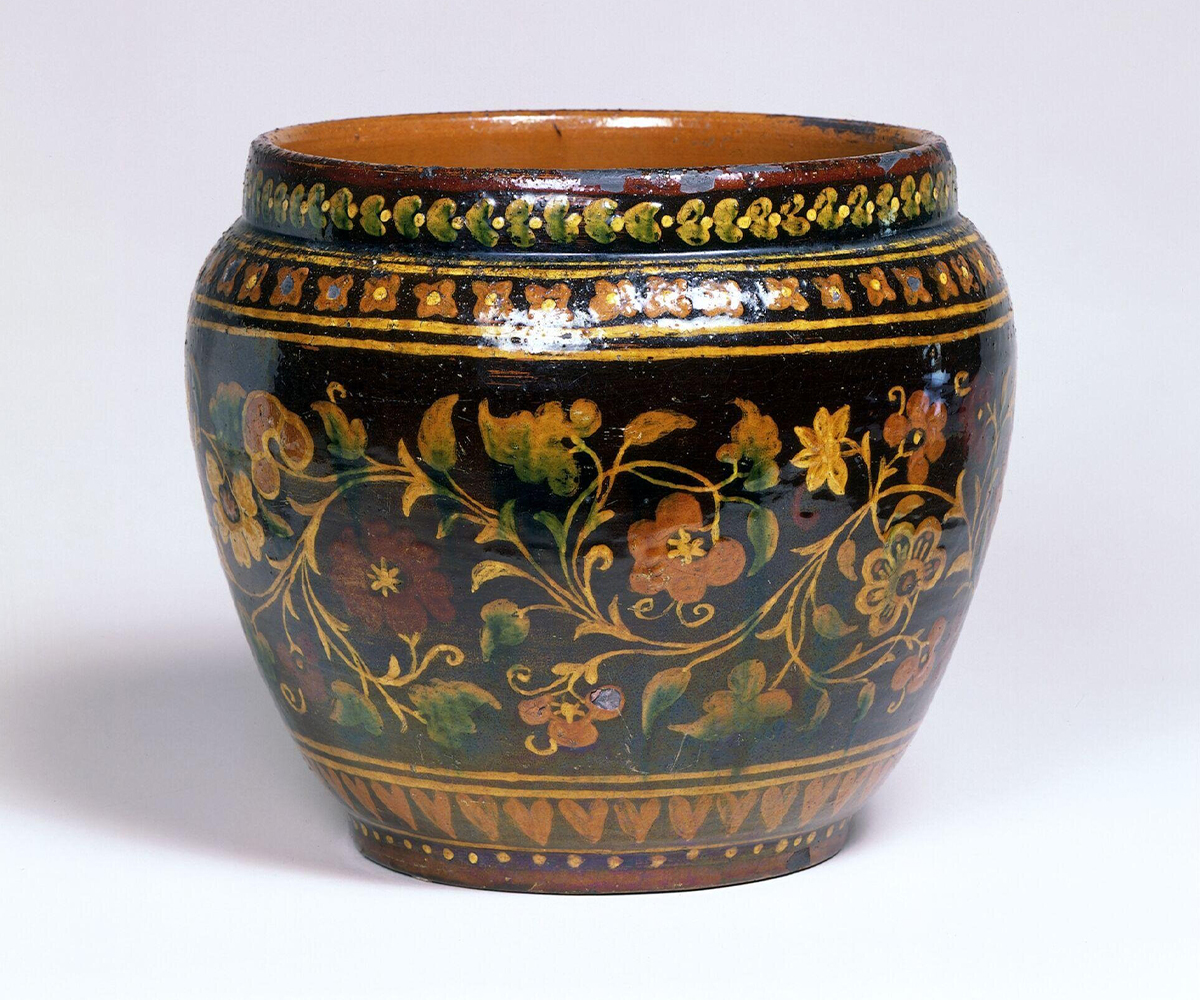
The workshop became a commercial production the following year. Students also worked on the objects made for export, though the exact nature of their collaboration with the artisans at the studio is unclear. With the school’s relocation to larger, more permanent premises in 1878–79, the pottery studio also expanded, entering its most prolific phase in the following decade. The products became more uniform and distinctive as Terry took on a greater role in design, developing the style that came to be recognised as Bombay School pottery. He had visual elements from the recently rediscovered Ajanta murals incorporated into the painting on the ceramics, following the lead of his colleague John Griffiths, who was pioneering a practice of copying the eroding murals as part of his decorative painting classes at the school. This exercise would also become a major part of other later revivalist movements such as the Bengal School, as a way of preserving as well as studying the ancient imagery.
Under the guidance of Terry and Nur Mohammed, the studio experimented with various firing and glazing techniques, sometimes with inconsistent results; they are noted to have been overly porous and prone to breakage. The products were nevertheless sold as luxury goods in European stores and shown widely at colonial exhibitions, where they are reported to have been popular. Like other goods traded by colonial collectors in the nineteenth century, Bombay School pottery’s appeal in the Western market lay largely in the impression that it was an entirely indigenous production. More successful specimens of the pottery were later displayed in museums in Europe and noted by members of the Arts and Crafts movement as examples of technical and aesthetic achievement.
Following Terry’s retirement and subsequent departure from India in the late nineteenth century, the school incorporated the pottery studio into its formal curriculum. Mohammed continued as Head Potter, but was asked to resign in 1903 because of his reluctance to share his knowledge of glazing. After a period of inactivity, the studio was revived in 1910 as part of a new pottery department at the school; student admissions and the pottery production resumed in 1913. Bombay School pottery was sold on the international market until the early years of the twentieth century, when demand declined significantly due to the products’ frequent structural weaknesses and the rising popularity of Japanese ceramics, which were more durable and relatively cheap.
Visual features
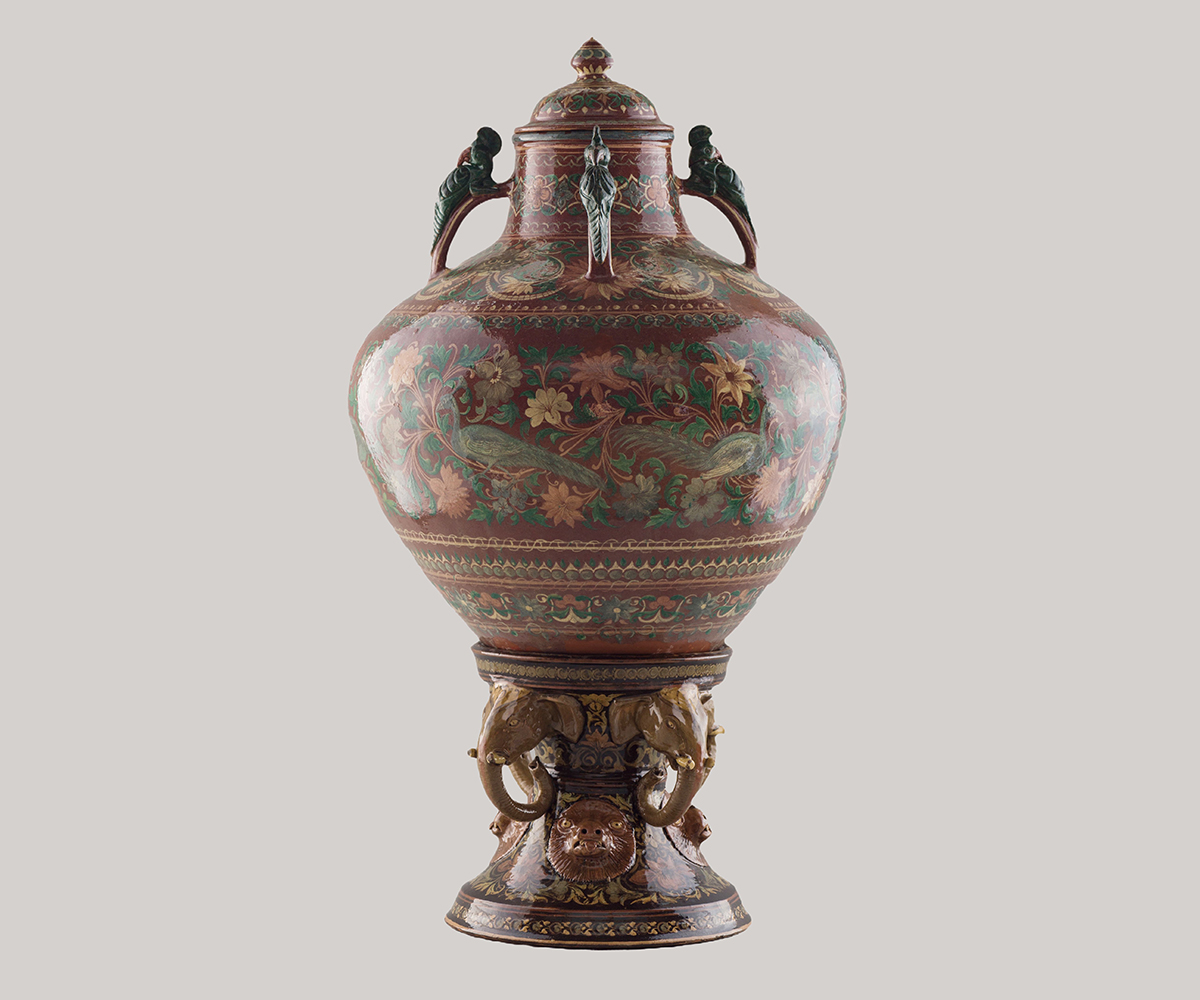
Vases were the most common export of the studio, with plates and hookahs among others. While their forms were at times modelled on those of Chinese and European wares, Western design elements were generally avoided in favour of Indic ones, especially in surface decoration. They are typically glazed in the Sindhi style and technique — in a low-temperature kiln using vivid green-blue, deep blue, and sepia, derived from cobalt oxide, copper and manganese. Typically, decorative painting covers nearly the entire external surface of these objects. Intricate floral motifs appear prominently, often repeated in horizontal bands around vases and concentric circular designs on plates. The central imagery often comprises motifs from the Buddhist murals at the Ajanta caves such as hamsas and lotuses, and, less frequently, kirtimukhas, makaras, deities and other figures from the Jataka tales, rendered with fine lines, elongated features, intricate drapery and heavy jewellery.
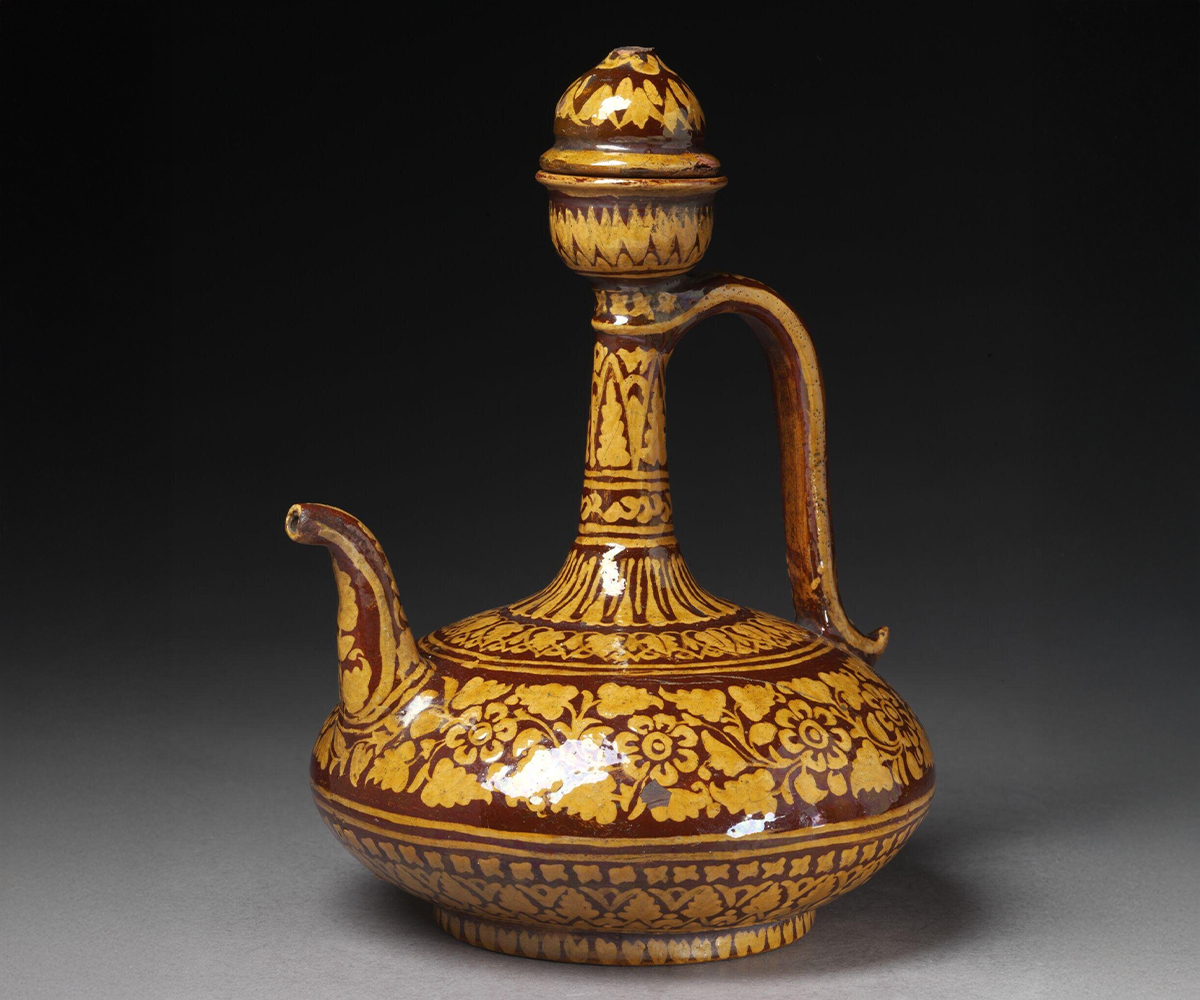
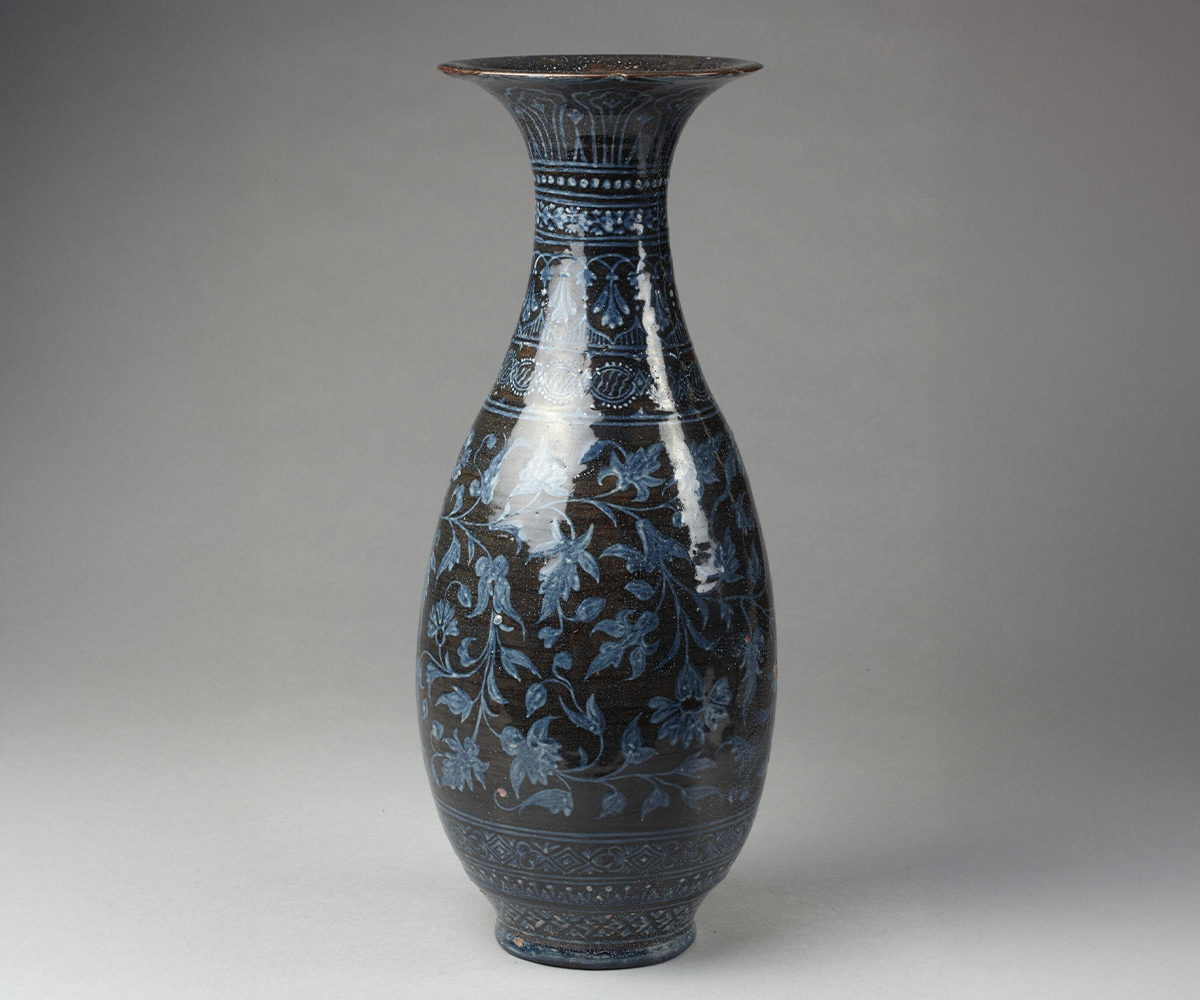
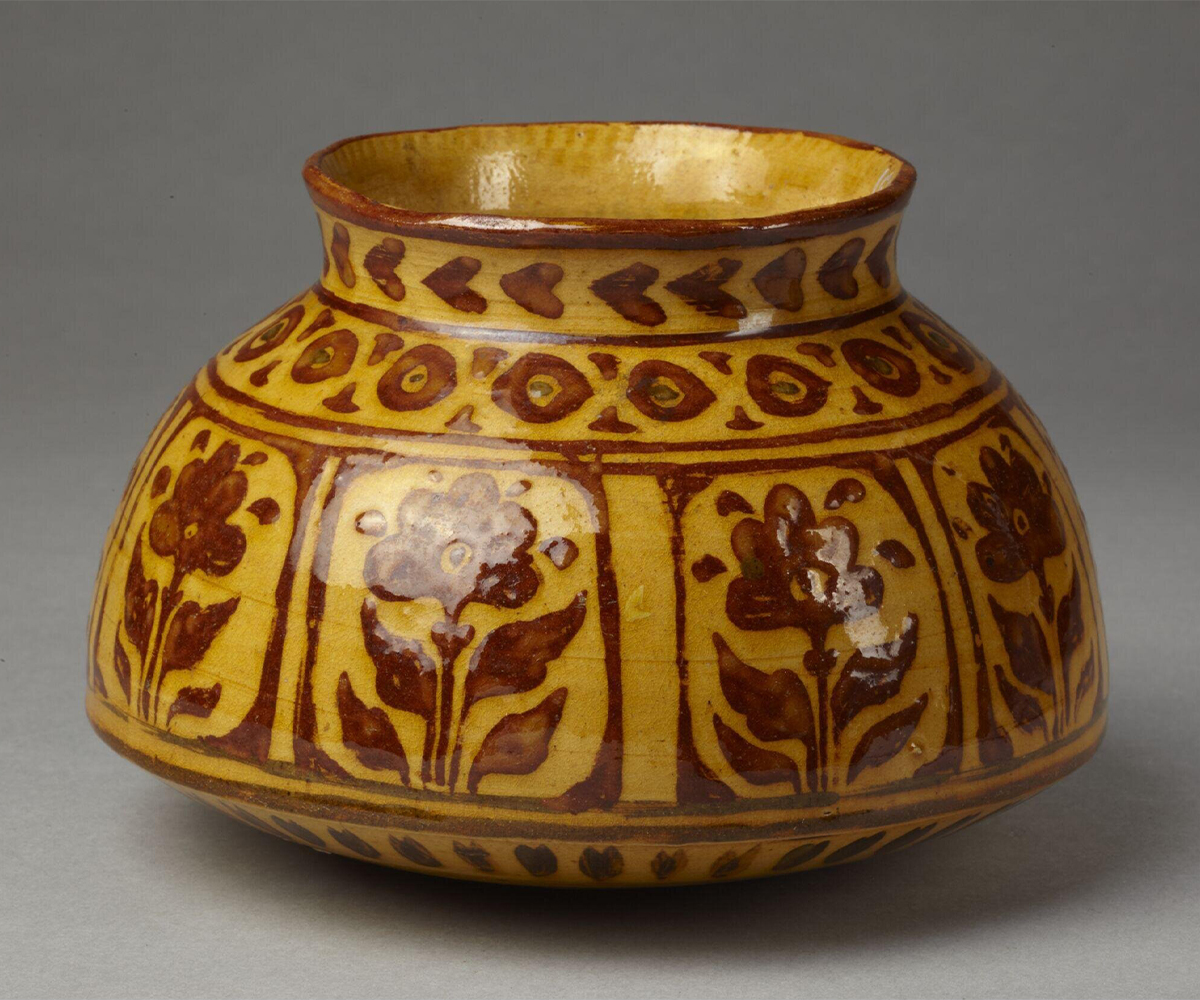
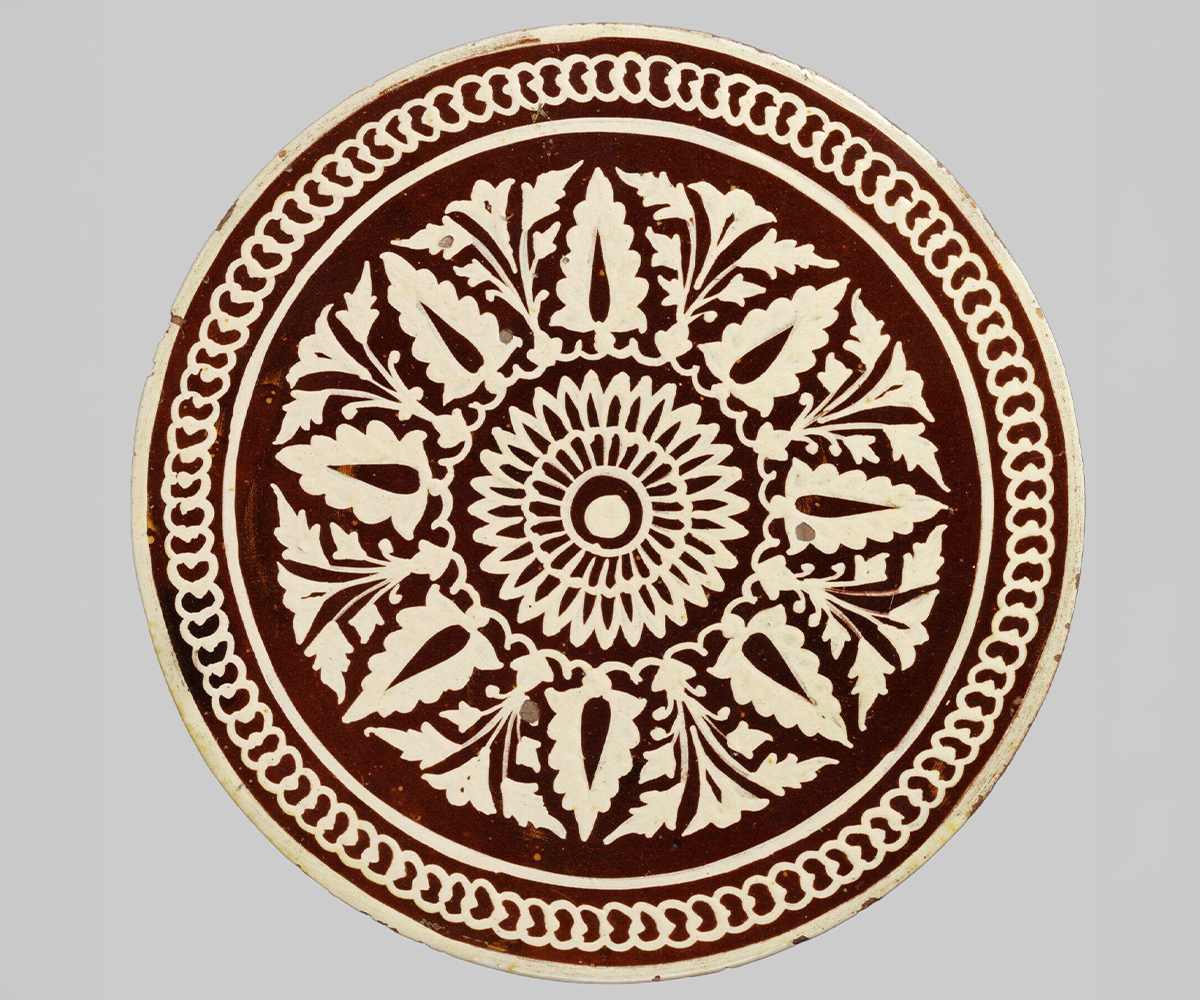
Some particularly elaborate examples of Bombay School pottery also feature sculpted animal forms such as peacocks and tigers, as seen in a vase currently housed at the Dr. Bhau Daji Lad Museum in Mumbai and a hookah at the V&A Museum, London. Another exceptional example is a plate in the Royal Collection, with a central image of Vishnu riding a composite elephant consisting of nine women, surrounded by intricate concentric borders of flowers, vines and human figures. This type of Vaishnava imagery, in which the design suggests particular numbers, may have been derived from the design of the Dashavatara Ganjifa playing cards made in the nearby town of Sawantwadi.
First published: 1 September 2025
Image Gallery
Bibliography
Birdwood, George. “Indian Pottery at the Paris Exhibition.” Journal of the Society of Arts 27, no. 1371 (1879): 305–11. https://www.jstor.org/stable/41326427.
Burns, Cecil L. “The Functions of Art Schools in India.” Journal of the Royal Society of Arts 57, no. 2952 (1909): 629–50. https://www.jstor.org/stable/41338695.
Dr Bhau Daji Lad Mumbai City Museum. “Bombay School Pottery.” Google Arts & Culture. Accessed February 20, 2025. https://artsandculture.google.com/asset/bombay-school-pottery/GwFz_b6eXtEwZA?hl=en.
Dr Bhau Daji Lad Mumbai City Museum. “Pottery, Sir JJ School of Art: Abalal Rahiman, 1887.” Google Arts & Culture. Accessed July 20, 2025. https://artsandculture.google.com/asset/pottery-sir-jj-school-of-art-abalal-rahiman/pQG8KifEK0F7mQ?hl=en.
Fern, E. R. “The Pottery Department of the School of Art.” In The Bombay Revival of Indian Art, edited by W. E. Gladstone Solomon. Mumbai: Sir J. J. School of Art, 1924.
Howard, Samantha. “South Asian Pottery and Kipling Connections.” Midlands Art Papers 5 (2022). Accessed February 20, 2025. https://www.birmingham.ac.uk/research/projects/midlands-art-papers/issue-5/objects-in-focus-south-asian-pottery-and-kipling-connections.
Mathur, Saloni. India by Design: Colonial History and Cultural Display. Berkeley; Los Angeles; London: University of California Press, 2007.
McGowan, Abigail. Crafting the Nation in Colonial India. New York: Palgrave Macmillan, 2009.
Royal Collection Trust. “Dish.” Collection. Accessed February 19, 2025. https://www.rct.uk/collection/28710/dish.
Victoria and Albert Museum. “Vase.” Collections. Accessed Feb 19, 2025. https://collections.vam.ac.uk/item/O16018/vase-vase-wonderland-art-pottery/.
Feedback