-
ChicagoImpart Encyclopedia of Art. "Afghan War Rugs." June 30, 2025. https://imp-art.org/articles/afghan-war-rugs/.
-
MLA"Afghan War Rugs." Impart Encyclopedia of Art, Jun. 30, 2025, https://imp-art.org/articles/afghan-war-rugs/.
-
HarvardImpart Encyclopedia of Art (2025) Afghan War Rugs. Available at: https://imp-art.org/articles/afghan-war-rugs/ (Accessed: 3 March 2026).
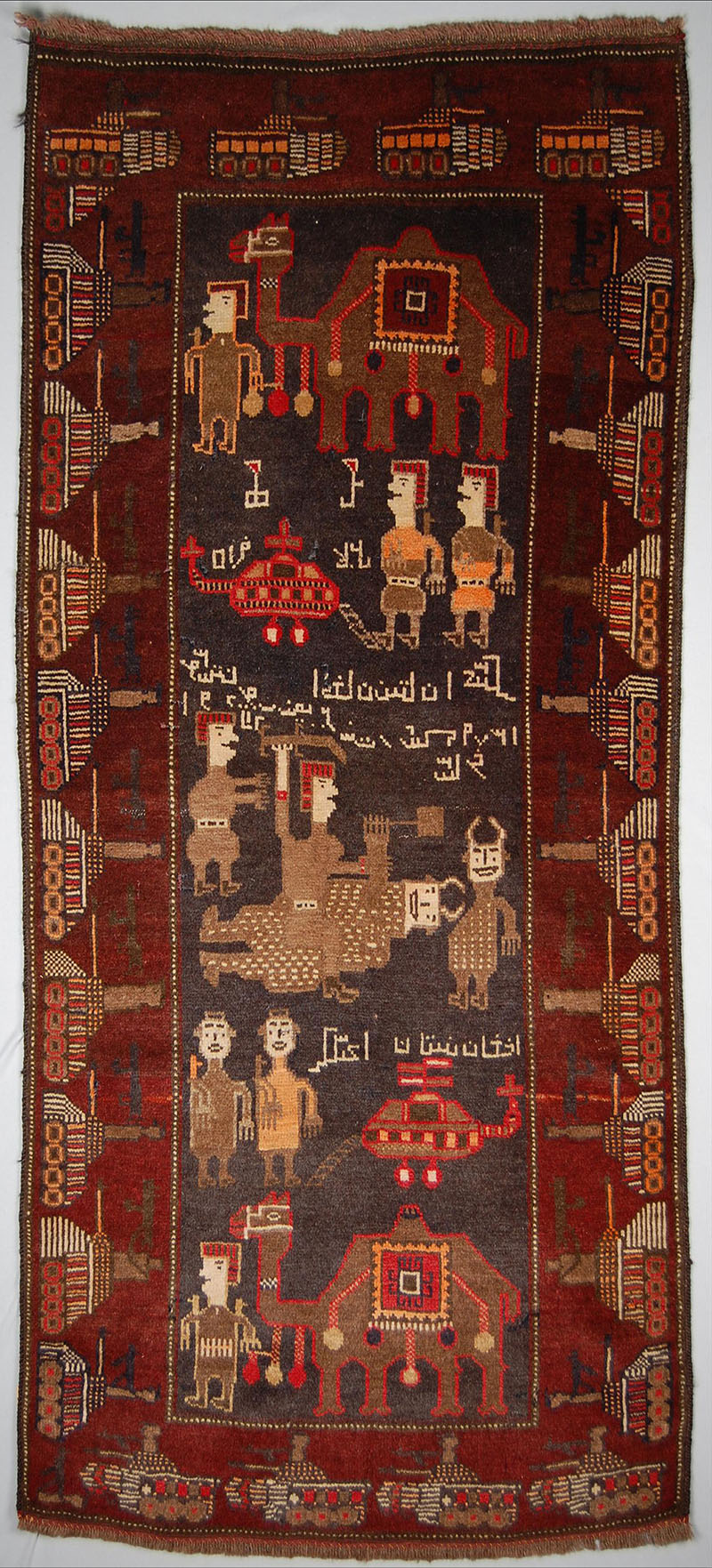
In a modern development of traditional rug-weaving, weavers from various ethnic groups in and around Afghanistan produce what are known as ‘war rugs’ — generally pile-woven woollen rugs in diverse designs depicting weapons and warfare, often with explicit political imagery. Called qalin-e jangi or qalin-e jihad in Dari (literally, ‘rug of war’), war rugs emerged with the Soviet invasion of Afghanistan in 1979 and have primarily been sold to Western consumers in an unregulated market.
Historical background
Central and south-central Asia has historically been home to varied and culturally significant weaving traditions, especially in wool. Women weavers of the region — largely from pastoral, nomadic and semi-nomadic tribes — have developed their own distinctive techniques and designs with established yet flexible motifs, weaving articles largely for their own use and trading surplus within their community or on the market. War rugs were primarily produced by the Baloch, Hazara, Turkmen, and Taimini peoples, though people from non-weaver communities took up the craft after the loss of other forms of livelihood as a result of the Soviet–Afghan war (1979–1989). Various other groups such as the Uzbek have also likely contributed to war rug design.
Soviet military operations in the areas north of Afghanistan in the 1930s displaced various communities, disrupting their weaving practices; some groups, including the Turkmen and Baloch, migrated into Afghanistan. Here, weaving received impetus from the growth of international trade and collectors who were increasingly interested not only in the upmarket Afghan carpets that had interested Western connoisseurs since the nineteenth century, but also in rugs woven by various nomadic groups, especially the Baloch. Scholars suggest that the earliest war rugs were made by Baloch weavers in northern Afghanistan soon after the Soviet invasion in 1979. During the Soviet–Afghan war, millions of Afghans fled to refugee camps in northern Pakistan and Iran — here, women weavers from different communities worked side-by-side, producing war rugs that show a synthesis of various styles. They also taught the craft to others — even men, who typically did not weave — who took it up as a means to economic survival. The industry continued to evolve with subsequent political changes; after the US invasion of Afghanistan, Kabul became another major centre of production and export of war rugs.
While war rugs mark a distinct branch of Afghan weaving, they have grown out of a longer history of Baloch weavers responding to contemporary events and contact with other cultures, incorporating, for example, portraits of political leaders or foreign animals, people, or weapons into their compositions alongside traditional motifs. Such rugs, that emphasise a ‘realistic’ pictorial motif rather than a largely geometrical/abstracted patterned design with figurative elements, typically in the central field, are known as qalin-e-aksi (from Persian aks, ‘picture’), and are considered precursors to the war rug, though they comprise a small minority of Afghan carpets made — both for export and daily use — before the twentieth century. Scholars have also compared Afghan war rugs to other pictorial textile traditions that have been responsive to contemporary political changes, such as Hmong story cloths, among others.
Visual characteristics
Most war rugs are woven with a pile; some are flatweaves. Military imagery such as weapons and vehicles is incorporated into traditional compositions and forms — this is subtle, relatively abstract, and limited to the central field in the early rugs, and becomes progressively more explicit and widespread, with many later designs consisting entirely of military motifs. Common colours include dark blue, often used for the ground, black, brown, beige, and shades of red. Lesser used colours are green, light blue or orange. The colour palette has expanded with the introduction of synthetic dyes in the 1990s.
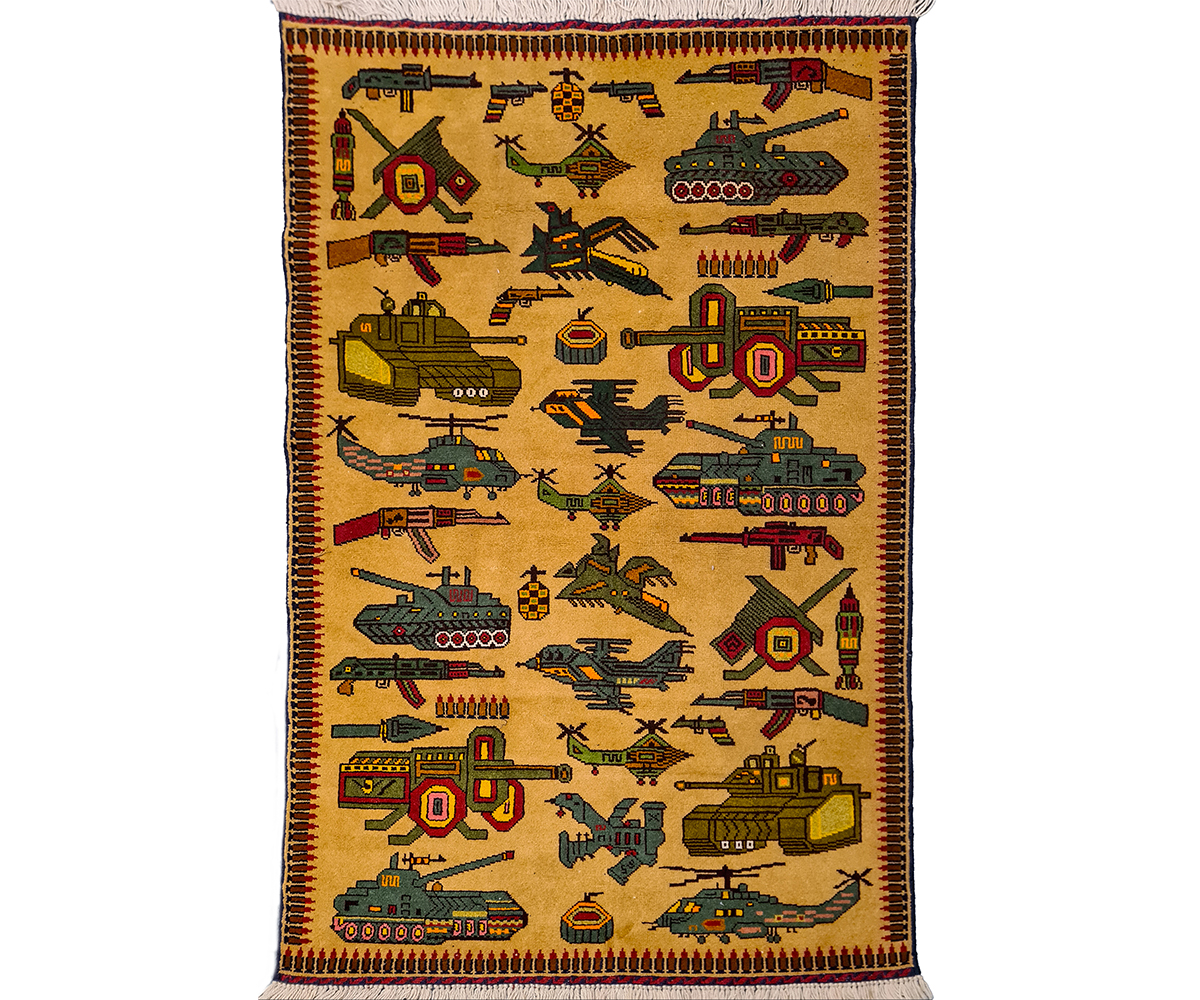
A notable aspect of war rug design is how it adapts traditional motifs into newer imagery. The buta or boteh, known in English as paisley, morphs into weapons of a similar shape, such as grenades. Stars and flowers become indicators of explosions. The angular gul motif of Turkmen weaves — typically octagonal, with variations — stands in both for military tank treads or, in some cases, the tank itself. These are incorporated into traditional rug compositions such as urban or rural landscapes, narrative scenes, or all-over geometric patterns.
War rugs vary hugely in size, design, technique, and quality of workmanship. Some may also feature maps, monuments or political portraits as the central image. Rare types include prayer-mat type Baloch war rugs; rugs showing the Tree of Life motif; and Turkmen rugs from the Baghlan region made between the 1980s and 1990s, which are long and narrow, have a fine weave of wool and cotton and typically show rows of weaponry. Text is also occasionally incorporated into rug designs. Besides tribal or regional variations, design and techniques have also been shaped by the conditions of production and sale, which have been changing in step with major political developments in Afghanistan. Whilst motifs have evolved to reflect newer military technology, the rugs’ designs have, as a general trend, become more standardised to cater to market demands.
Ethnic influences
The earliest war rugs are typically Baloch in style and technique: smaller in size, relatively thin, with a pile weave in coarse wool, and elaborate all-over patterning in the central field, enclosed by a border. Common Baloch motifs include botanical and geometric patterns, animals such as peacocks and goats, water ewers and vases — all evoking domestic prosperity and protection — which, in war rugs, are juxtaposed with tanks, bombs, rifles, and other weaponry. The designs of these earlier rugs show more variations than later rugs; however, war rugs in the Baloch style continue to be common. A traditional Baloch composition, most often seen in rugs from Herat, comprises a single central medallion, or several, in a large diamond-shaped lozenge enclosed by a border.
Other specific ethnic influences discernible in war rugs include the prominent Turkmen weaves and design — a common type featuring a striking red ground derives from the Turkmen bokhara or bukhara carpet — as well as those of the Uzbek, Hazara, and Tajik weavers. However, scholars note that it is relatively easier to identify these rugs with their place of production than with the people who made them, especially as motifs and styles begin to overlap and transform with the expansion of the industry in the 1980s. Later war rugs show more integration of previously foreign design elements such as isometric perspective.
Popular military motifs
During the Soviet–Afghan war, images of Russian tanks, helicopters and Kalashnikov rifles were incorporated into village landscapes or other pictorial scenes; the Kalashnikov type (qalim-e-kalashnikov) was especially popular. The all-over war rug pattern of the Zakini sub-group of the Baloch replaces the usual geometric patterns entirely with fighter jets arranged in a symmetrical composition. In the so-called ‘Peshawar style’ of war rugs, traditional border patterns are replaced with lines of bombs.
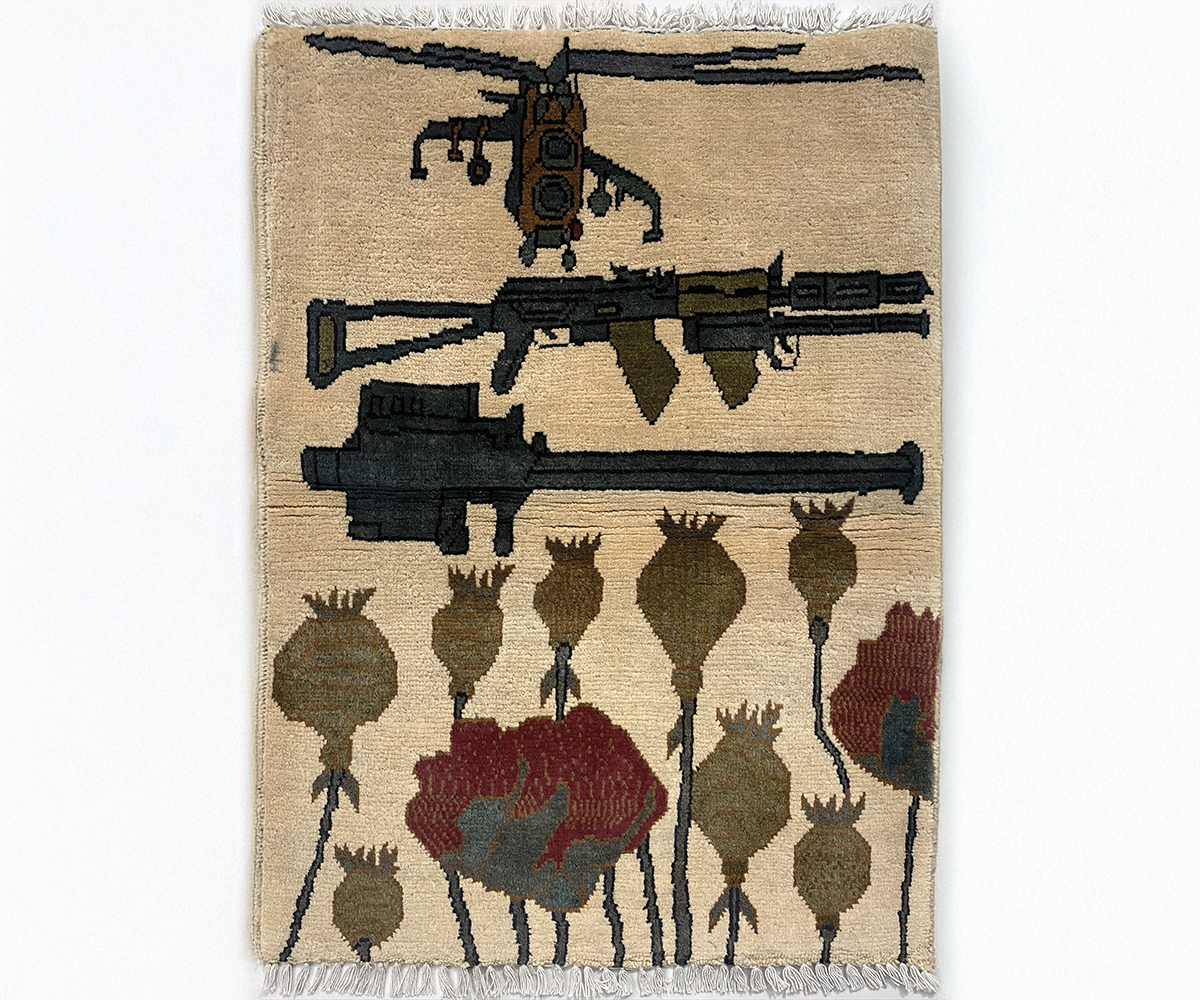
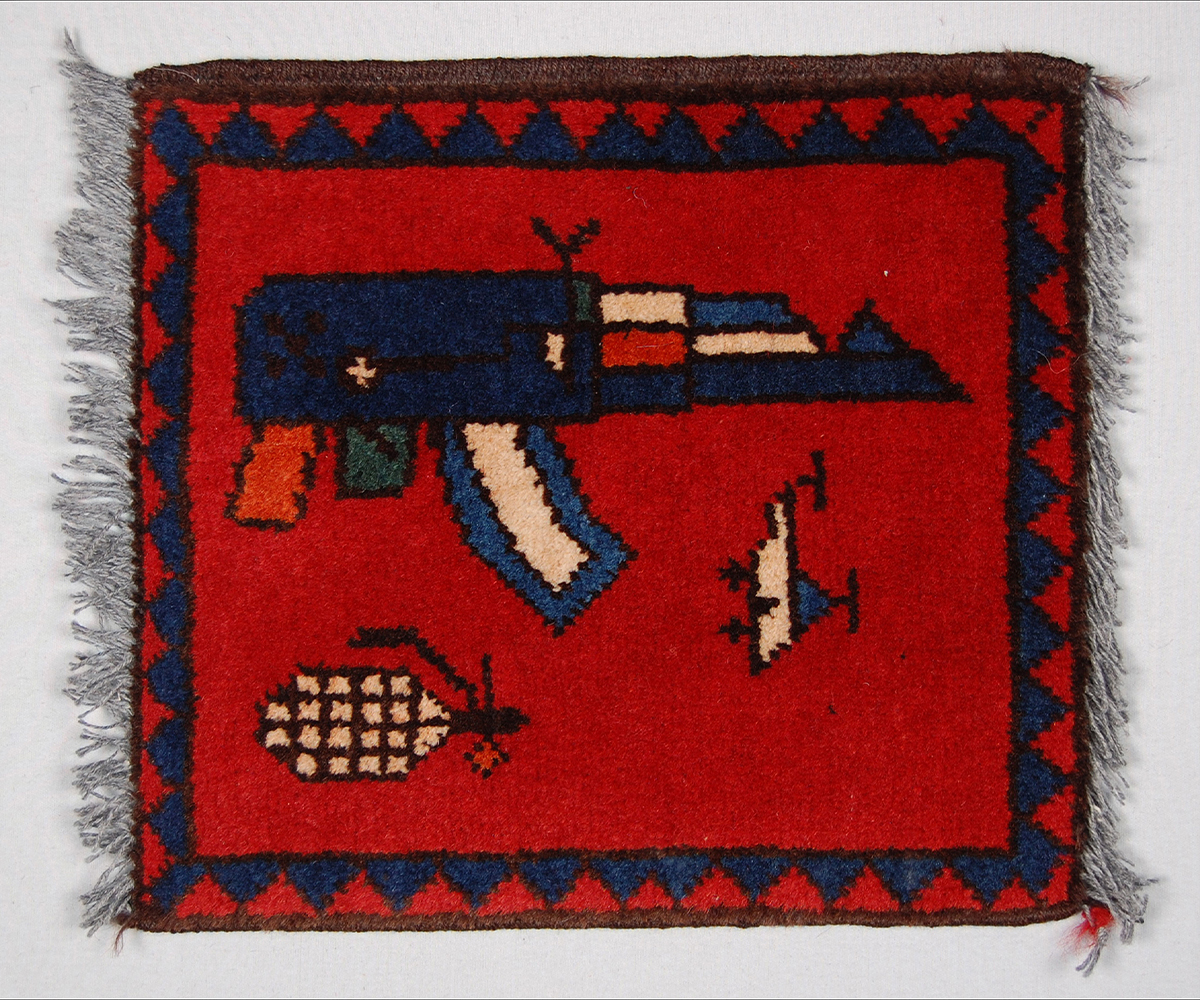
A rug composition from Mazar-e-Sharif — known as the ‘ten-tank rug’ — shows two central vertical columns with five tanks each, in a pattern that echoes the octagonal gul, depicting the formation of Soviet tanks as they retreated. With the escalation of US drone strikes in the region in the mid 2010’s, ‘drone rugs’ — showing American drones on a plain ground — became a popular type in the market.
Portraits and maps
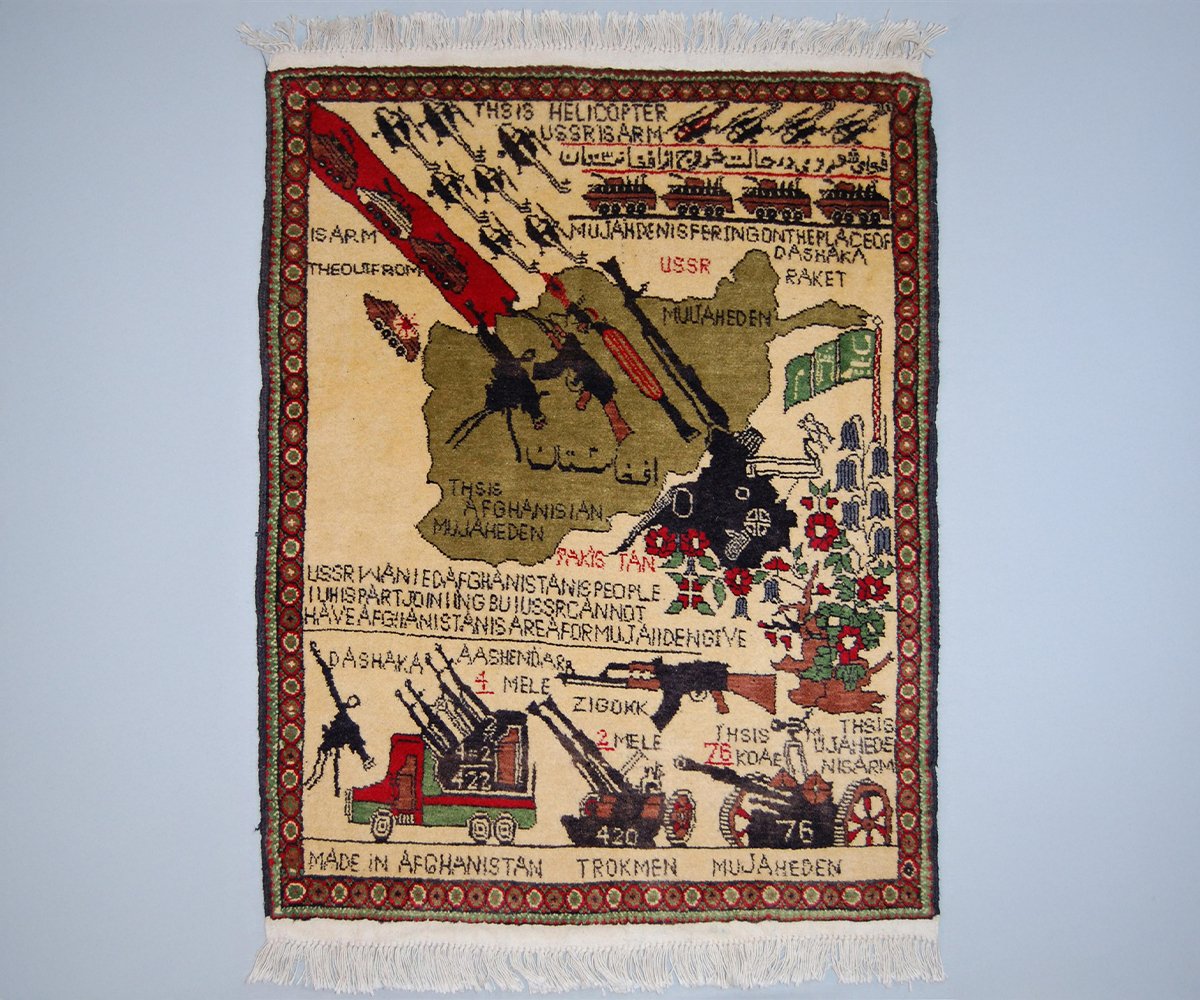
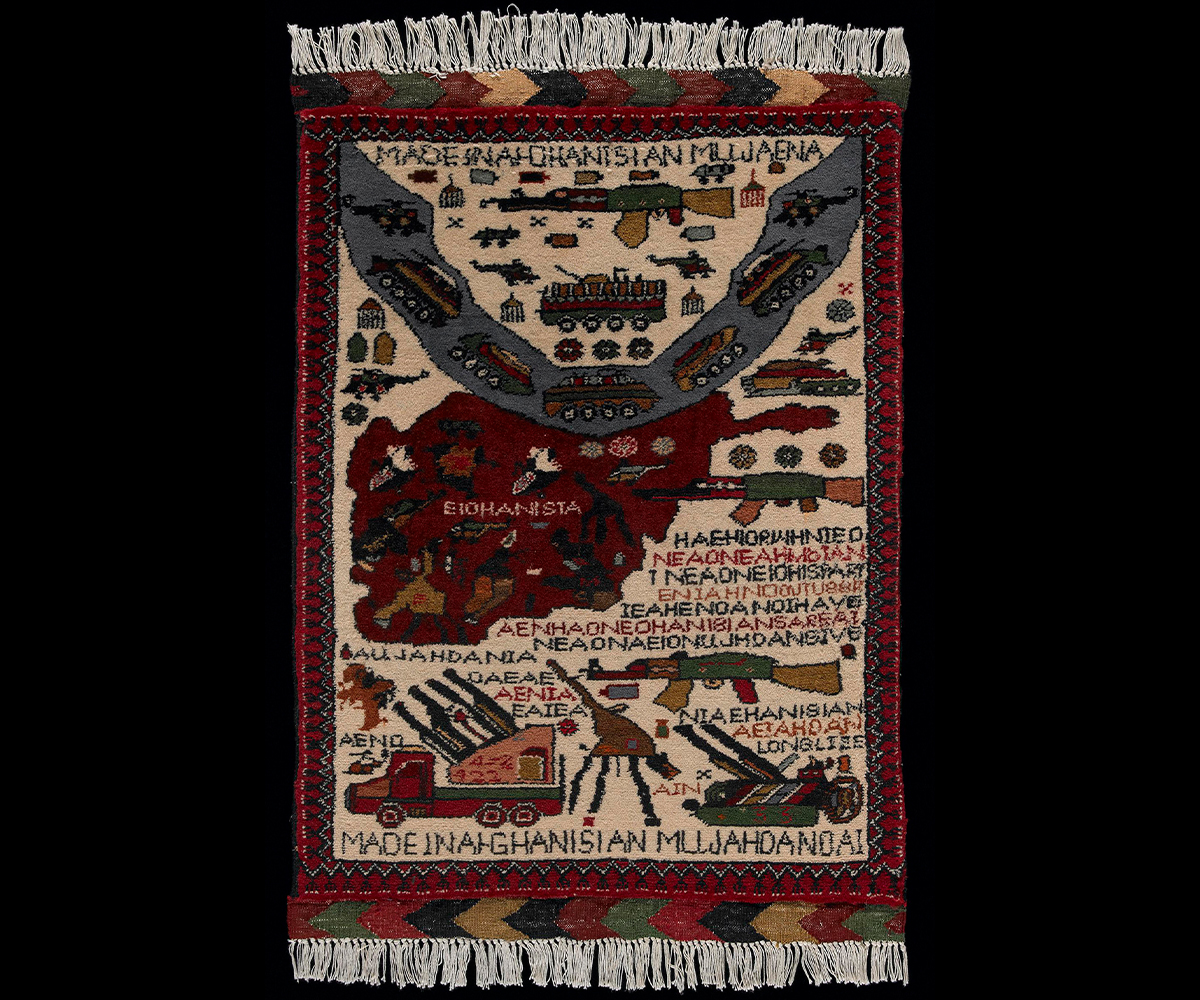
In addition to landscape imagery rugs, portrait and map war rugs are examples where the central ground is almost fully occupied by a prominent pictorial motif. Soviet-era war rugs often showed portraits of Babrak Karmal and Mohammad Najibullah — Afghan leaders installed by the Soviet regime — as puppets held in a fist bearing the Communist hammer and sickle motif, hanging over a map of Afghanistan. Map rugs (map-e qalin or map-e aksi), which have been attributed to Hazara and Tajik weavers, typically feature a yellow or camel-coloured ground, though some are made in red using high-quality Ghazni wool. These rugs have maps with various themes occupying the central field: the Soviet exodus, with tanks leaving on paths out of the country; the Battle of Tora Bora; Afghanistan’s provinces, often with distinct landscapes and motifs; and Iraqi maps, produced after the US invasion of Iraq in 2003.
Text
War rugs, especially the map type, often feature text placed alongside figurative designs. Soviet-era rugs often use the Cyrillic script; others feature English or Dari, sometimes both. Place names or the community and location of the weavers may be designated in text, or political slogans in support of the mujahideen or the US military. Text on rugs showing the World Trade Centre attacks often feature messages that glorify the US military or express gratitude for the US defeat of the Taliban; these rugs are often read by scholars as efforts to appeal to the American market. Other text may be more personal, with weavers sometimes indicating that the landscape or building shown on the rug was destroyed by bombing or was where their family members were killed.
Materials and technique
War rugs are largely made on horizontal, portable wooden looms that have historically been used in nomad settlements rather than professional workshops, though today vertical looms — which allow for greater production with less space — are also sometimes used. As with other Afghan carpets, sheep wool is generally the preferred and most widely available material for the warp and weft threads; sometimes camel hair is used instead. Cotton may also be used for the warp, and rarely silk. A pile-woven war rug might have anywhere between 15 to 60 knots per square centimeter. Some war rugs are made with a flat weave in the form of kilims, which necessitates more angular designs. Many use the slit-tapestry weave, along with a range of other techniques. Flat weave is also used to finish the top and bottom ends, or ‘skirts’, of pile-woven Baloch war rugs. Both pile and flatweave war rugs are sometimes finished with fringed edges at the top and bottom.
Industry and design evolution
The rapid commercialisation of war rug production towards the end of the Soviet–Afghan war significantly influenced their design and made the rugs a popular commodity in the international art market. The late 1980s and early 1990s saw more centres of production in Afghan cities, and in refugee camps in Pakistan and Iran. Some US aid agencies funded weaving workshops, which provided economic livelihood to displaced Afghans. The rugs were marketed towards Western aid workers, travellers and various government officials and diplomats operating in the region. Peshawar, as the base for the Afghan mujahideen and several international aid agencies, was a major centre of production and trade. Hamburg became a major international trade centre for war rugs.
After a brief but energetic interest by Western scholars and institutions in the rugs in this period — including the first institutional exhibition of the rugs in Italy and the United States — demand slumped along with the supply of US aid to Afghanistan and the Taliban takeover in 1996. However, after the American invasion of Afghanistan in 2001, the rugs regained popularity with collectors in the West and Kabul became a centre of production and trade. Rug design was increasingly dictated by dealers and brokers who sought to cater to market forces and collectors’ tastes, providing weavers — many of whom were children or otherwise equipped with rudimentary skills compared to the specialist weavers of early war rugs — with standardised patterns and colour schemes. These templates are especially prominent in rugs depicting the 2001 World Trade Center attacks, which were popular on the market. Brokers also ensured that the designs remained in step with evolving military technology.
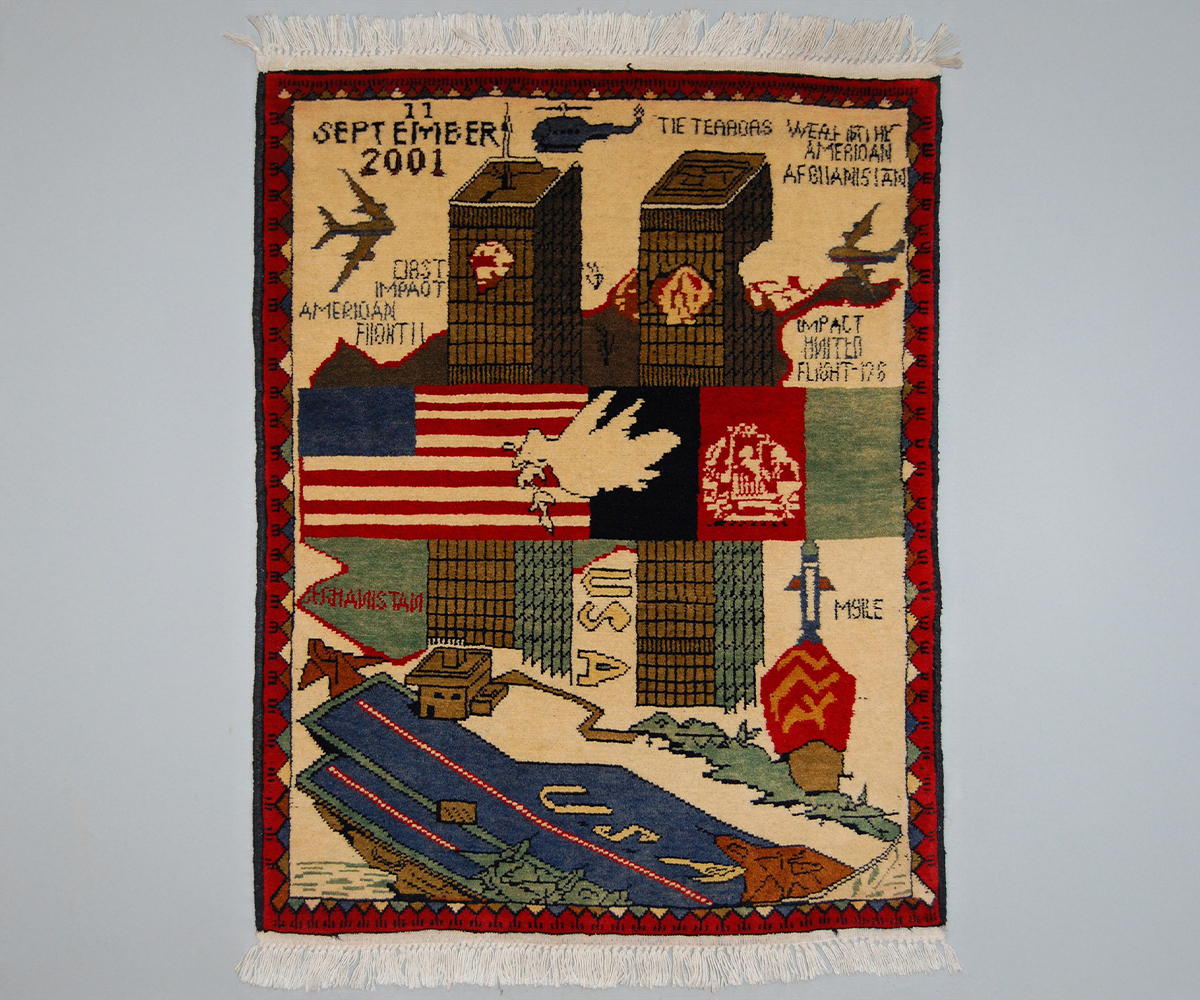
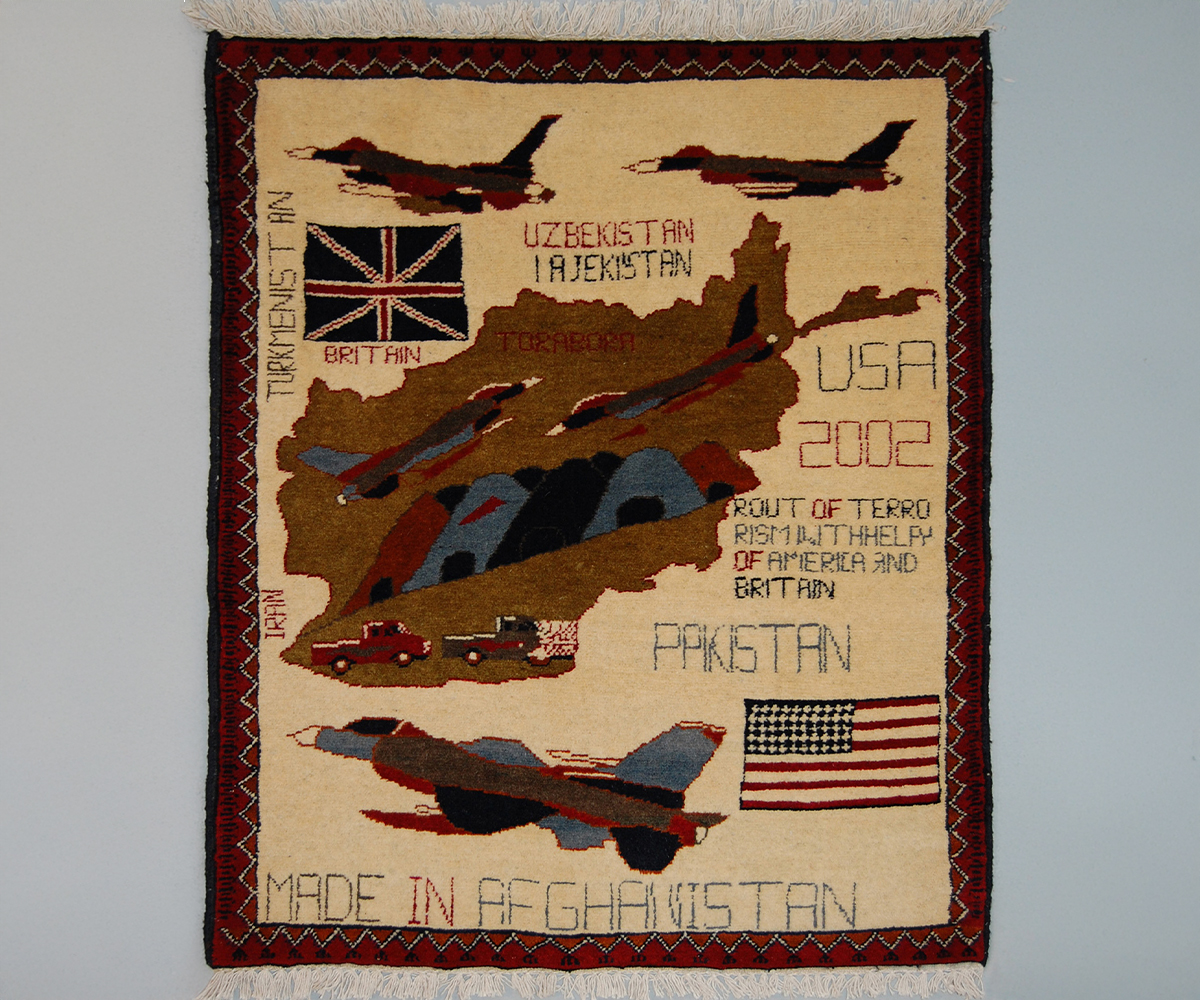
Today, war rugs — mostly produced by Afghan refugees in Pakistan — continue to be circulated in the global market but it is unclear what the status of weavers in Afghanistan is after the withdrawal of the US in 2021.
Interpretations and criticism
The development of the rugs and their popularity among Western buyers has been discussed widely in scholarship, and the rugs themselves variously interpreted. At times seen to symbolise the exploitation of a people made vulnerable by war and displacement — including concerns about child labour and treatment of the weavers in general — they are also seen as displays of the weavers’ resilience and creativity. Besides being appreciated as specimens of women’s skilled labour or children’s art, and as artworks that straddle both the ‘traditional’ and the ‘contemporary’, they are also seen as valuable documents of a regional history. They have also been interpreted as anti-war protest objects. Afghan war rugs continue to feature at recent exhibitions at many major institutions in the West, including at the British Museum, the Textile Museum of Canada, the Museum of International Folk Art, and the Penn Museum.
First published: 30 June 2025
Image Gallery
Bibliography
Bizzarri, Cosimo. “Afghan Carpet Weavers Are Putting Drones on Their Rugs.” Quartz, January 30, 2015. Accessed October 9, 2024. https://qz.com/333733/afghan-carpet-weavers-are-putting-drones-on-their-rugs.
Bonyhady, Tim, Nigel Lendon and Jasleen Dhamija. The Rugs of War. Canberra: Australian National University School of Art Gallery, 2003.
Charland, William. “War Rugs: Woven Documents of Conflict and Hope.” Art Education 64, no. 6 (2011): 25–32. https://doi.org/10.1080/00043125.2011.11519149.
Elias, Jamal J. “Afghanistan’s War Rug Industry Distorts the Reality of Everyday Trauma.” The Conversation, September 21, 2021. Accessed October 9, 2024 http://theconversation.com/afghanistans-war-rug-industry-distorts-the-reality-of-everyday-trauma-167608.
Gräf, Bettina. “Drone Rugs: Knotted Images as a Reminder of the Cruel Global Present.” In Suzanna in the Bath: Essays on Middle East Studies and Public Discourse, edited by Sune Haugbølle, Tina Dransfeldt Christensen, and Søren Møller Christensen. Copenhagen: Forlaget Vandkunsten (2023). https://doi.org/10.5167/uzh-256396.
Lendon, Nigel. “Beauty and Horror: Identity and Conflict in the War Carpets of Afghanistan.” In Crossing Cultures: Conflict, Migration and Convergence. The Proceedings of the 32nd International Congress in the History of Art. Bowen Hills: Miegunyah Press. 2008. https://rugsofwar.wordpress.com/wp-content/uploads/2011/07/beauty_and_horror.pdf.
Mascelloni, Enrico. War Rugs: The Nightmare of Modernism. Milano: Skira. 2009.
Spooner, Brian. “Afghan Wars, Oriental Carpets and Globalization.” Expedition Magazine 53, no. 1, 2011. https://www.penn.museum/sites/expedition/afghan-wars-oriental-carpets-and-globalization/.
Stone, Peter F. Oriental Rugs: An Illustrated Lexicon of Motifs, Materials, and Origins. North Clarendon: Tuttle Publishing. 2013.
Sudeith, Kevin. “Style Index.” WarRug.com. Accessed June 23. https://warrug.com.
Feedback