-
ChicagoImpart Encyclopedia of Art. "Koftgari." July 2, 2025. https://imp-art.org/articles/koftgari/.
-
MLA"Koftgari." Impart Encyclopedia of Art, Jul. 2, 2025, https://imp-art.org/articles/koftgari/.
-
HarvardImpart Encyclopedia of Art (2025) Koftgari. Available at: https://imp-art.org/articles/koftgari/ (Accessed: 3 March 2026).
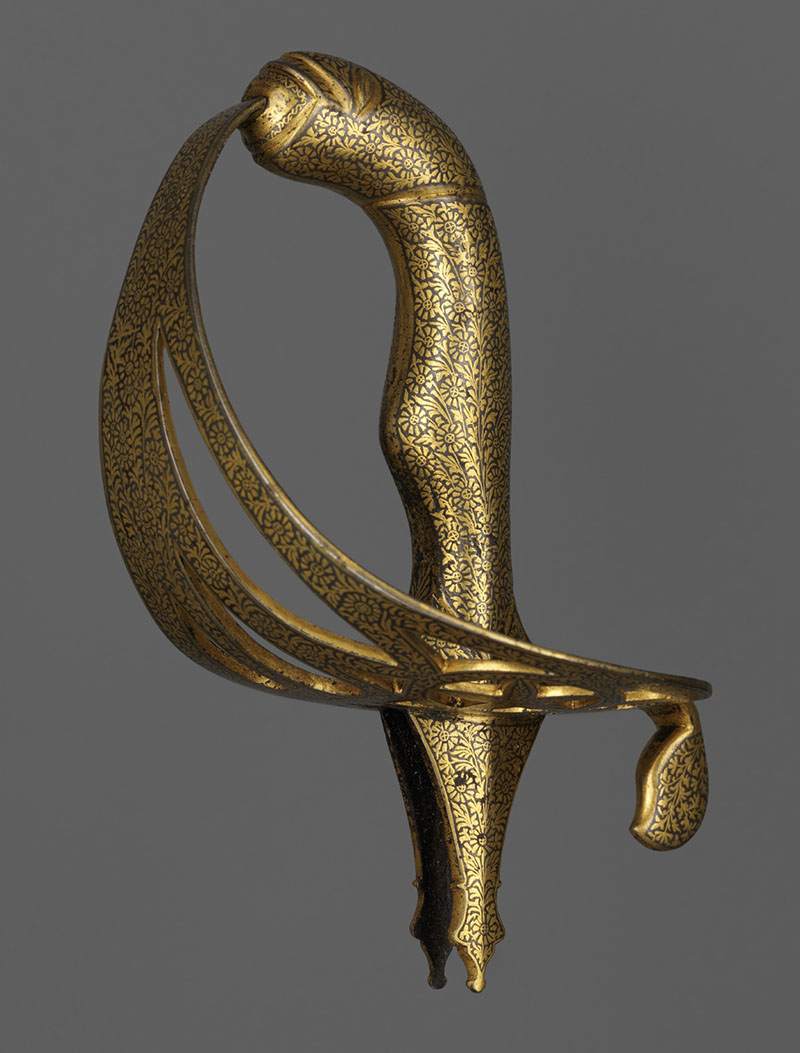
A type of damascening originating in Persia (present-day Iran) and practised in India, Pakistan, Afghanistan, and Syria, koftgari (Urdu and Farsi: koft, ‘beating’ or ‘bruising’; gari, ‘craft’ or ‘trade’) is a decorative metalwork technique in which gold or silver is inlaid or encrusted on blued metal, usually steel or iron. In South Asia between the sixteenth and nineteenth centuries, koftgari was used to embellish weapons and armour, patronised by Rajput and Mughal kingdoms, the Sikh states of the Punjab, other princely states, as well as some wealthy zamindars.
Terminology
‘Koftgari’ (or simply ‘koft’) is often used in a general way to describe the application of gold or silver wires on another metal in one of three ways: deep or ‘true’ inlay; shallow inlay, also called ‘false damascening’; and gilting or overlaying. Sometimes, however, koftgari is used more particularly for shallow inlay, and distinguished from true inlay — the Persian technique of tab-neshan, known in South Asia as teh-i-nishan (Urdu: teh, ‘fold’; nishan, ‘mark, scar’). In teh-i-nishan wires are fitted into deep grooves in the base metal, rather than simply beaten and burnished onto a cross-hatched surface. Many collectors, in particular, maintain a distinction between the two as the durability and value of teh-i-nishan artefacts is higher than those embellished with the shallow inlay of so-called ‘ordinary’ koftgari (talakub in Persia).
Historical background
Koftgari likely spread from West-Central Asia to South Asia in the fourteenth century CE with the Timurid invasion of the Punjab, from where it spread further to the Rajput territories encompassing modern-day Rajasthan and parts of Gujarat and Madhya Pradesh (constituting Rajputana). The craft was likely practised in Persia until the late-nineteenth or early twentieth century. By this time, centres of production in South Asia included Sialkot and Gujrat in the Punjab (in present-day Pakistan), as well as Kashmir, Lucknow, Karauli, Jaipur, Alwar and Datia in north and northwest India, Hyderabad in the Deccan, and Thiruvanathapuram in the south. Colonial-era sources also mention specimens of koftgari work from Thanjavur in southern India. Between the sixteenth and nineteenth centuries, koftgari was primarily used on weapons and armour, including the hilts and blades or tips of swords, daggers and axes, scabbards, shields, torches, staffs, rifle butts, helmets and elephant goads.
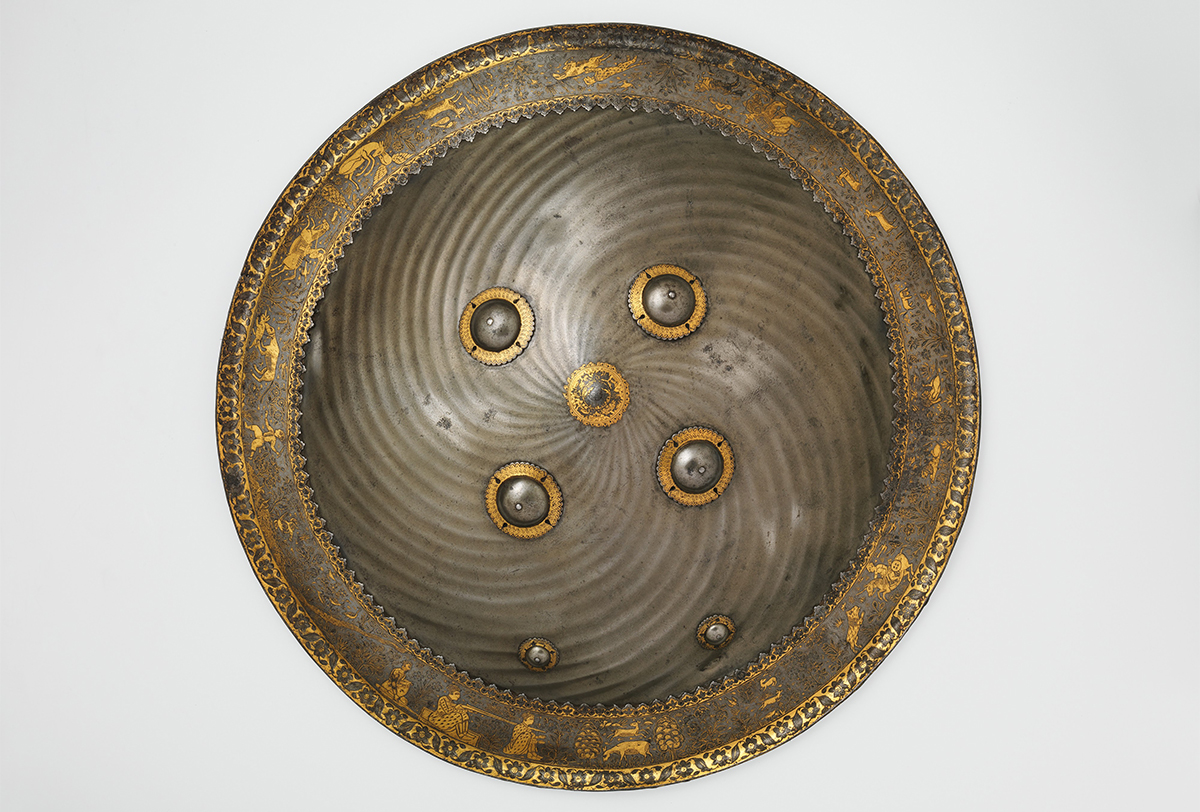
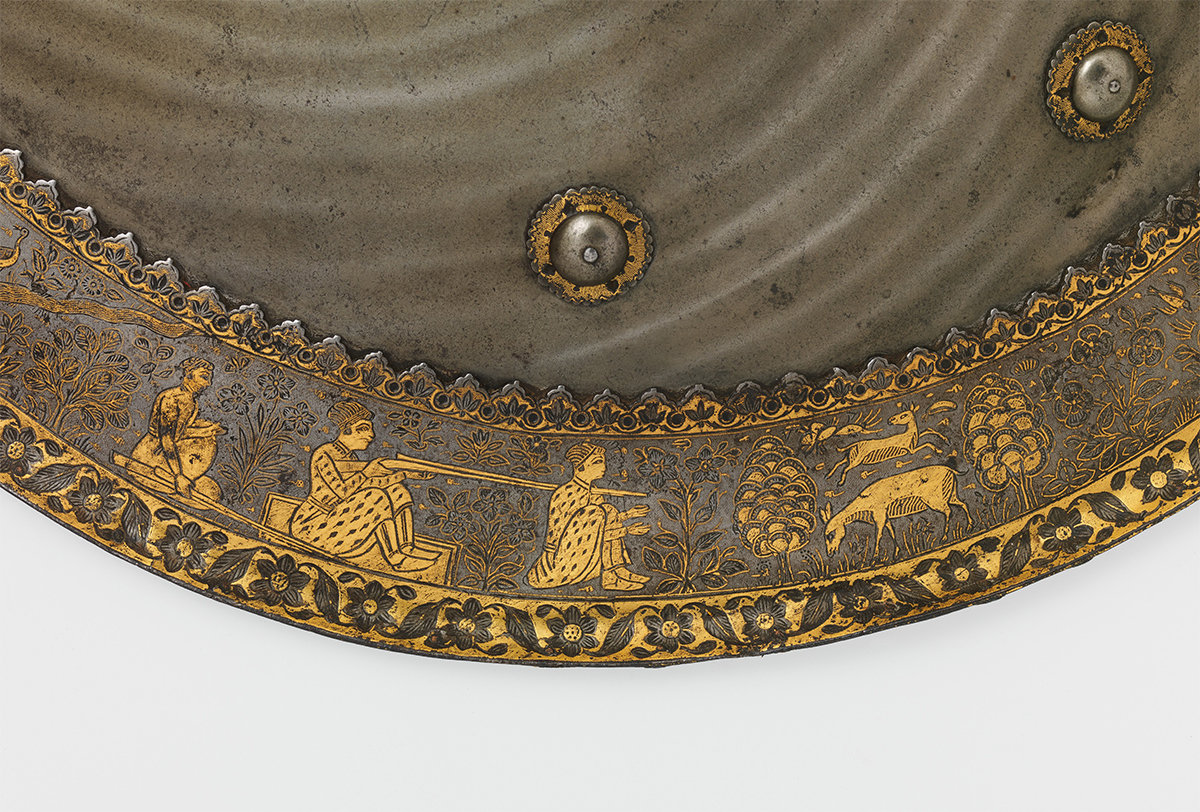
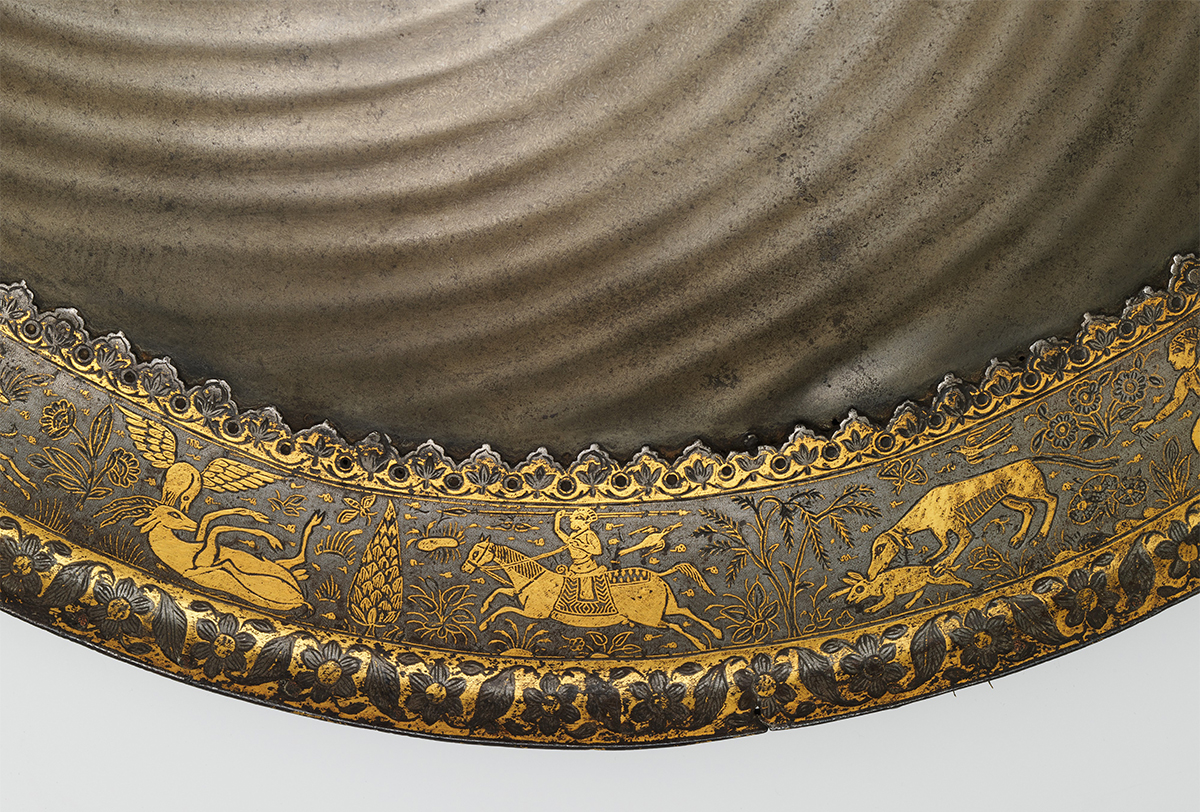
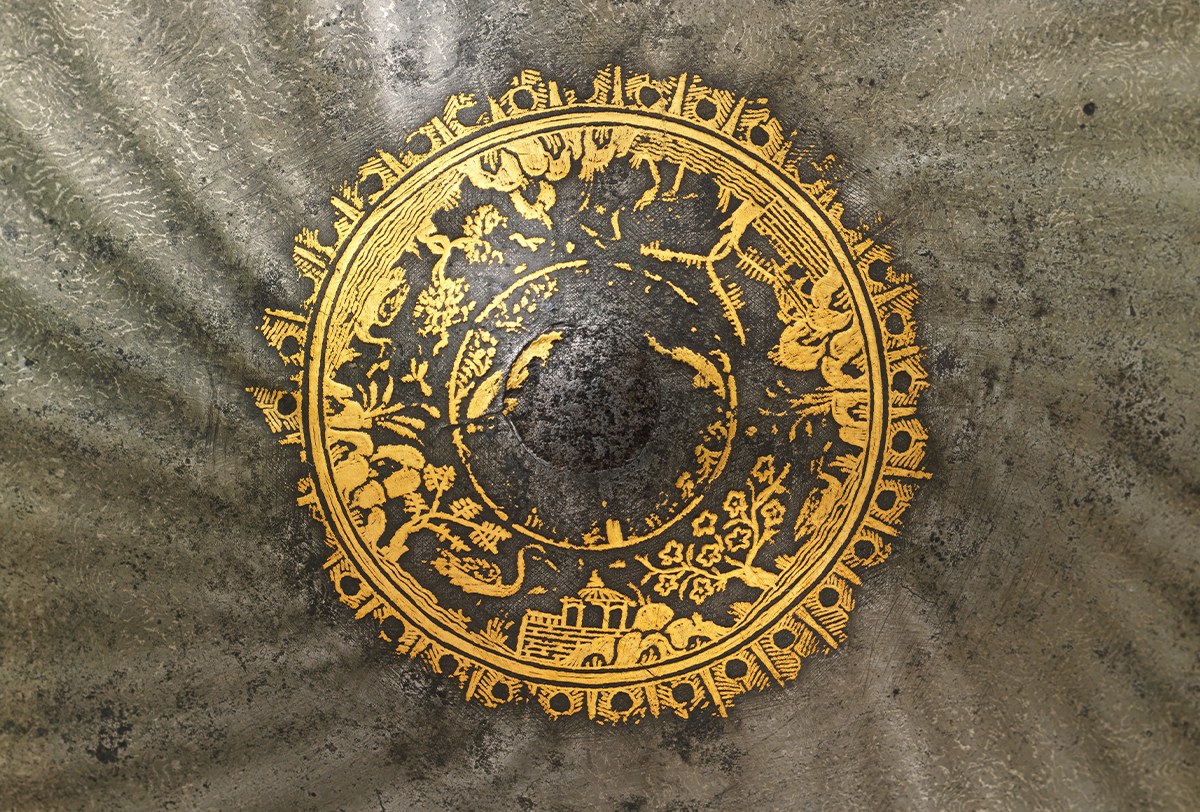
In the mid-nineteenth century, with increasing consolidation of the British Empire in South Asia and the weakening of regional kingdoms and princely states, the domestic manufacture of arms declined sharply and koftgars had to practice their craft on everyday objects. Many of these were shown at major international exhibitions such as the Great Exhibition of 1851, generating demand in the European market for koftgari goods.
Artisan groups
Koft metalworking is typically done by men, but women are involved in other steps such as polishing, and in some cases sewing velvet cases for the product. The artisans are known as koftgars; their status and background varies widely by region as well as patronage. Historically, koftgars belonged to the Lohar caste (from the Hindustani loha, ‘iron’), which also included Sikh and Muslim metalsmiths. Some koftgars in Punjab and Rajasthan also come from the Sikligar caste, some of whom claim to have migrated from Mewar to Punjab, where they converted to Sikhism and were recruited by Guru Hargobind to forge intricately decorated swords used ceremonially and in combat by the Sikhs. Scholars note that with increasing migration to urban areas in the early modern period, people from agricultural or other caste backgrounds also took up metalwork.
Process
The gold and silver wires used for koftgari are drawn from sheets using a perforated steel plate. The object to be embellished is heated, either in a kiln or with a blowtorch, until its surface acquires a deep blue colour — the steel retains the blue colour when removed from heat at a particular temperature, though uniform blueing requires great skill. For shallow inlay, patterns are etched onto the hot surface with a short knife using cross-hatching. Very thin gold or silver wire is pressed onto these using a pointed steel scriber. The roughened surface provides a tooth for the inlay to adhere to the base metal. Excess wire is trimmed; the surface is then heated again and the wires are beaten down using a pointed hammer. Finally, the object is rubbed with a porous stone such as a moonstone or a pumice stone to smoothen and polish the surface. Silver and gold wires are sometimes used together in the same pattern, in what is called the Ganga–Jamuna technique, after the two differently coloured rivers of northern India. Shallow inlay koftgari can often leave pockets of air in the grooves, leading to the inlay loosening and oxidising over time.
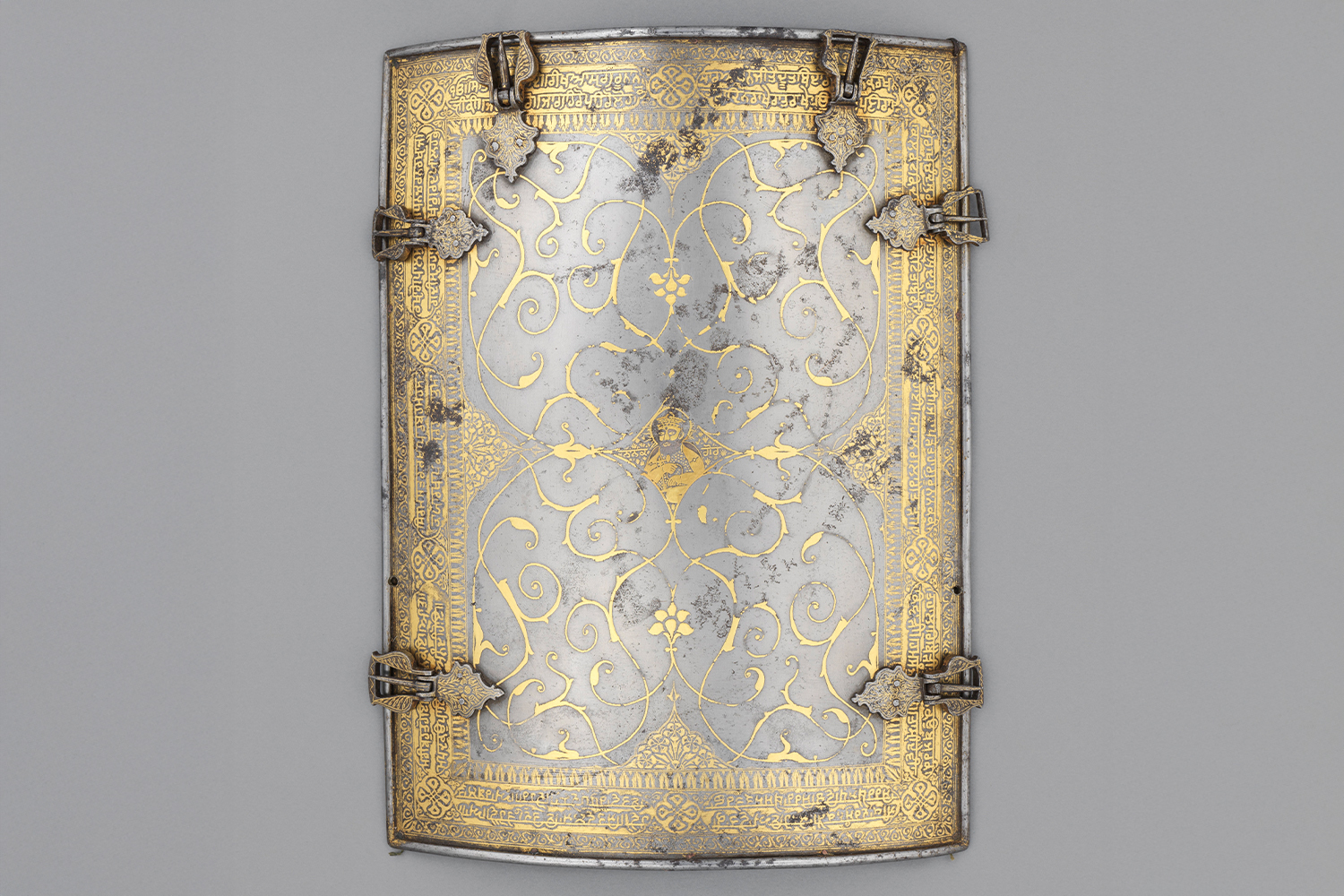
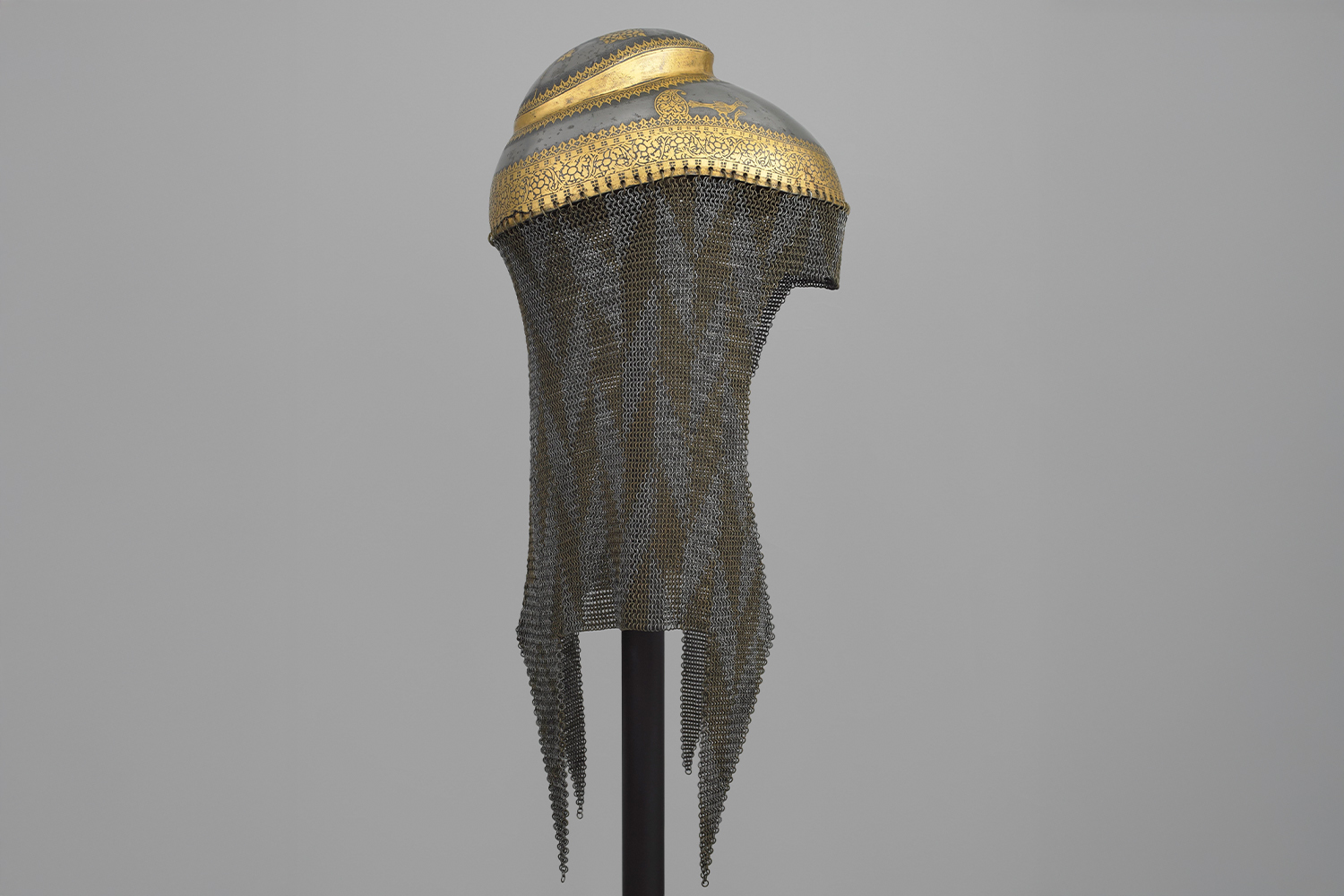
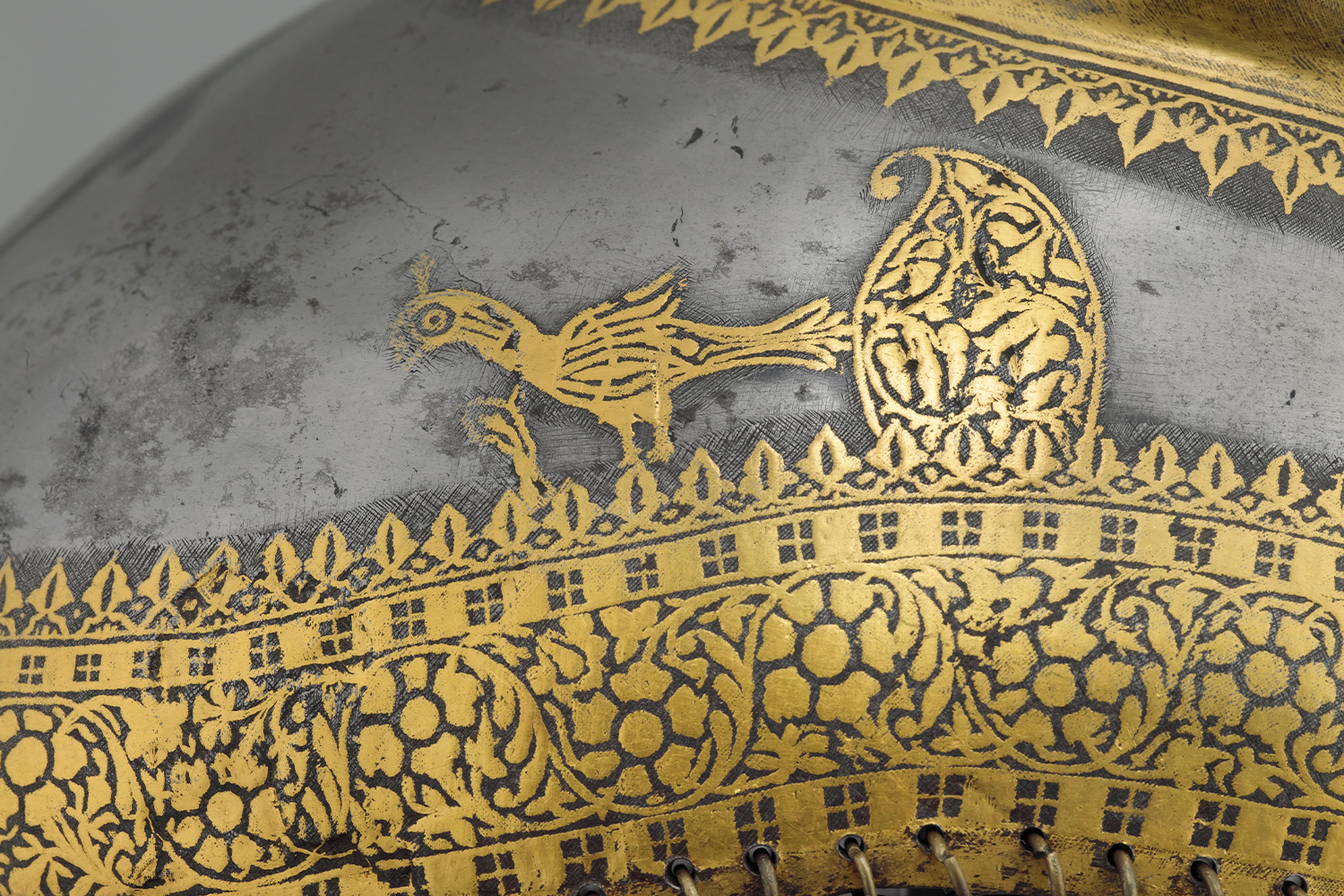
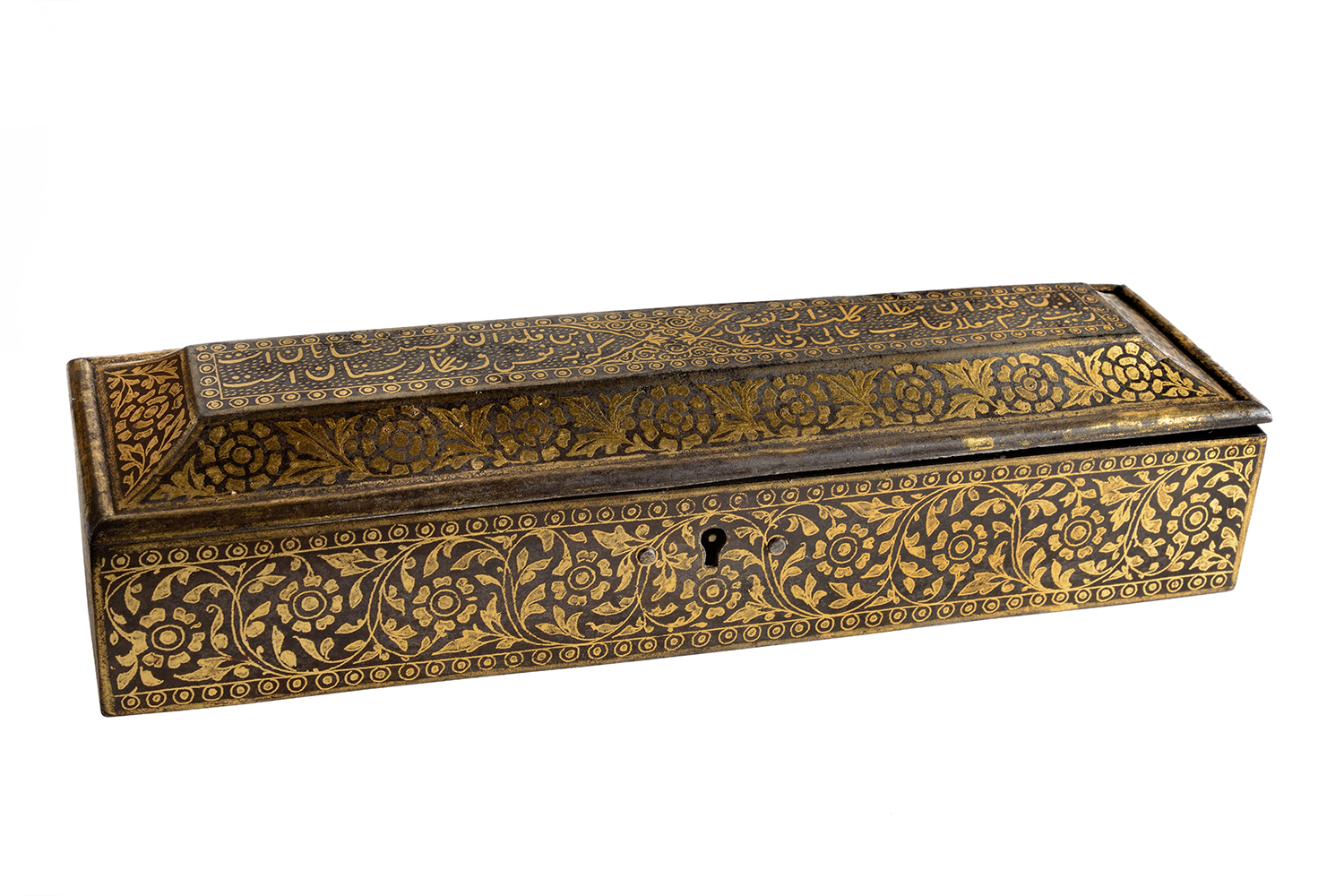
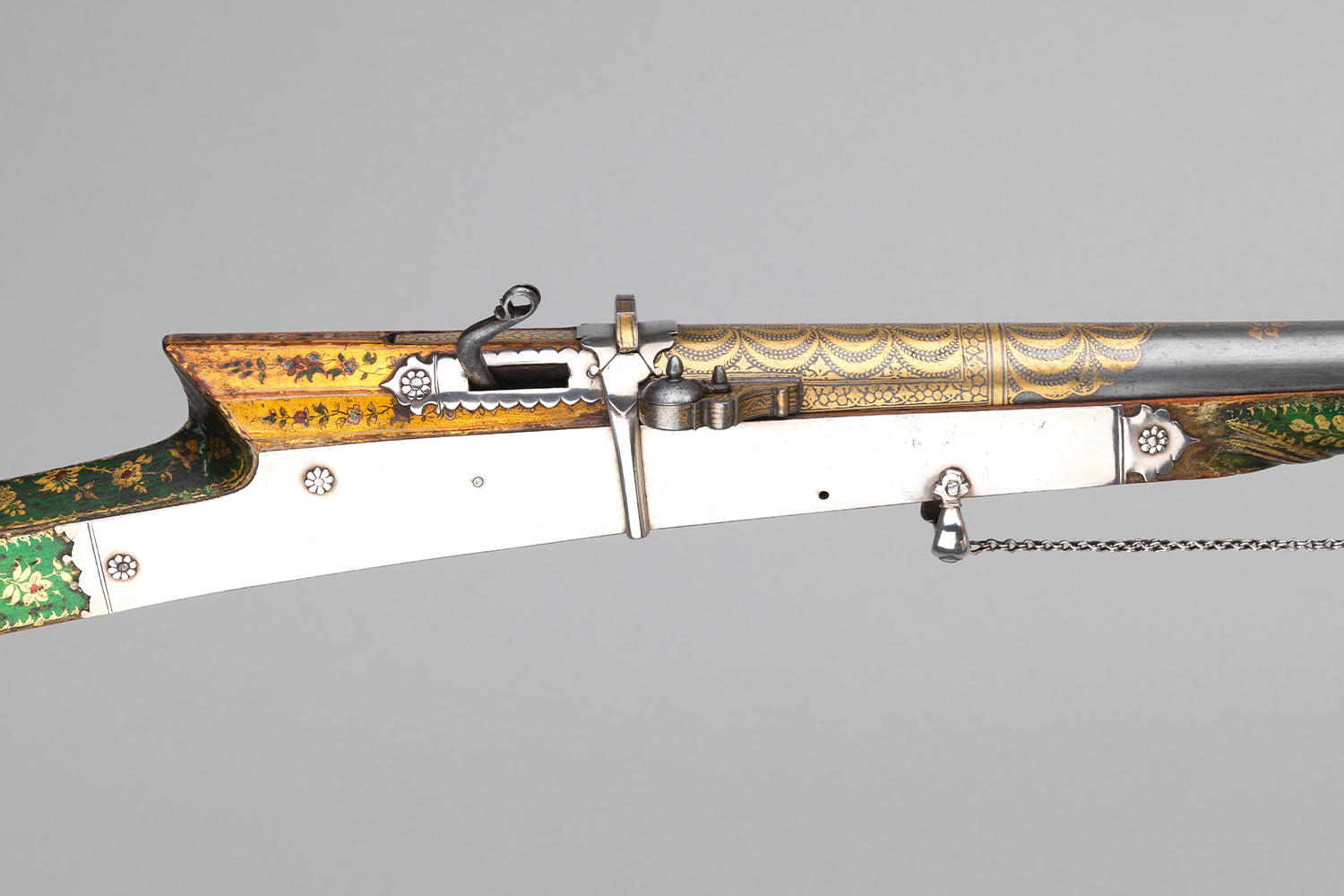
Teh-i-nishan or ‘true inlay’ also begins with blueing the metal using heat. Thin grooves are engraved into the hot surface, to a depth that is two-thirds of the diameter of the wire to be inlaid. The wire is heated to make it more pliable and pushed into the grooves using a pointed tool; it is then usually hammered flat. The surface is then burnished with an agate stone, and a polish of lime juice may be used to brighten the inlaid metal — the latter, however, turns the surrounding metal white, which must then be heated again to restore its blue colour. This technique typically creates a durable inlay flush with the surface; in some cases the wires are allowed to remain slightly raised from the surface, so that the pattern appears in low relief.
Some specimens of koftgari work feature gilting or overlay rather than inlay, used for larger surfaces such as shields. Here silver or gold leaf cut in the desired pattern or motif is applied over broad cross-hatched areas of the blued surface, and sprinkled with lime juice. The leaf is rubbed and beaten to adhere to the rough surface below. This technique is referred to in some sources as dewali and considered the least sophisticated of all koftgari types.
Motifs and artefacts
The motifs seen on koftgari designs vary widely by context, period, and the object on which they appear. Historical specimens of koftgari weapons often feature elaborate calligraphic inscriptions of religious verses in addition to decorative floral patterns, likely to bring good luck and protection to the wielder. Weapons and armour used by Rajput clans often featured images of the sun and moon, symbolic of the clans’ ancestry. Guns used for hunting sometimes featured scenes of a hunt or animals in a dense jungle. Historical sources also mention koftgari specimens belonging to the Maharaja of Travancore bearing distinctive designs unlike those seen in northern India.
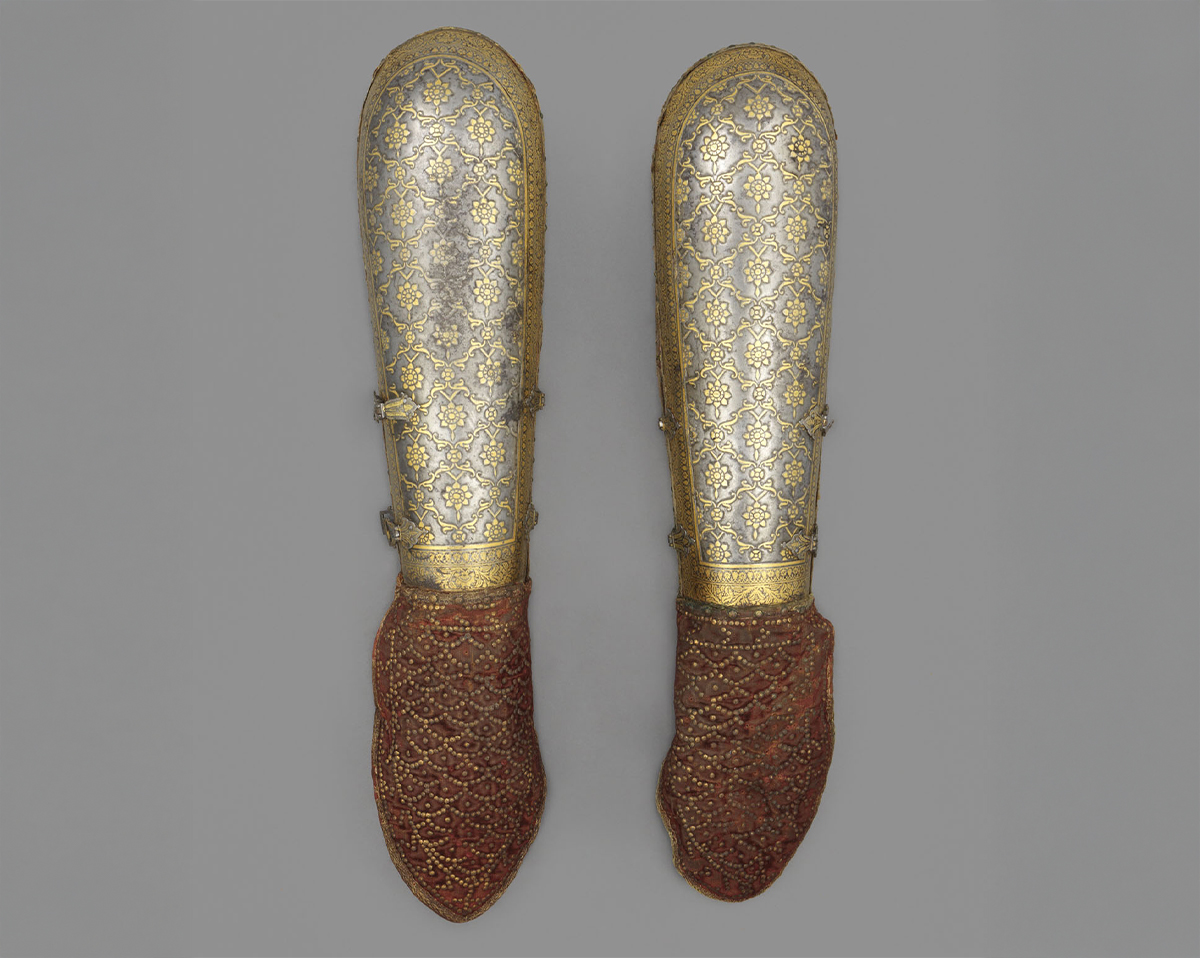
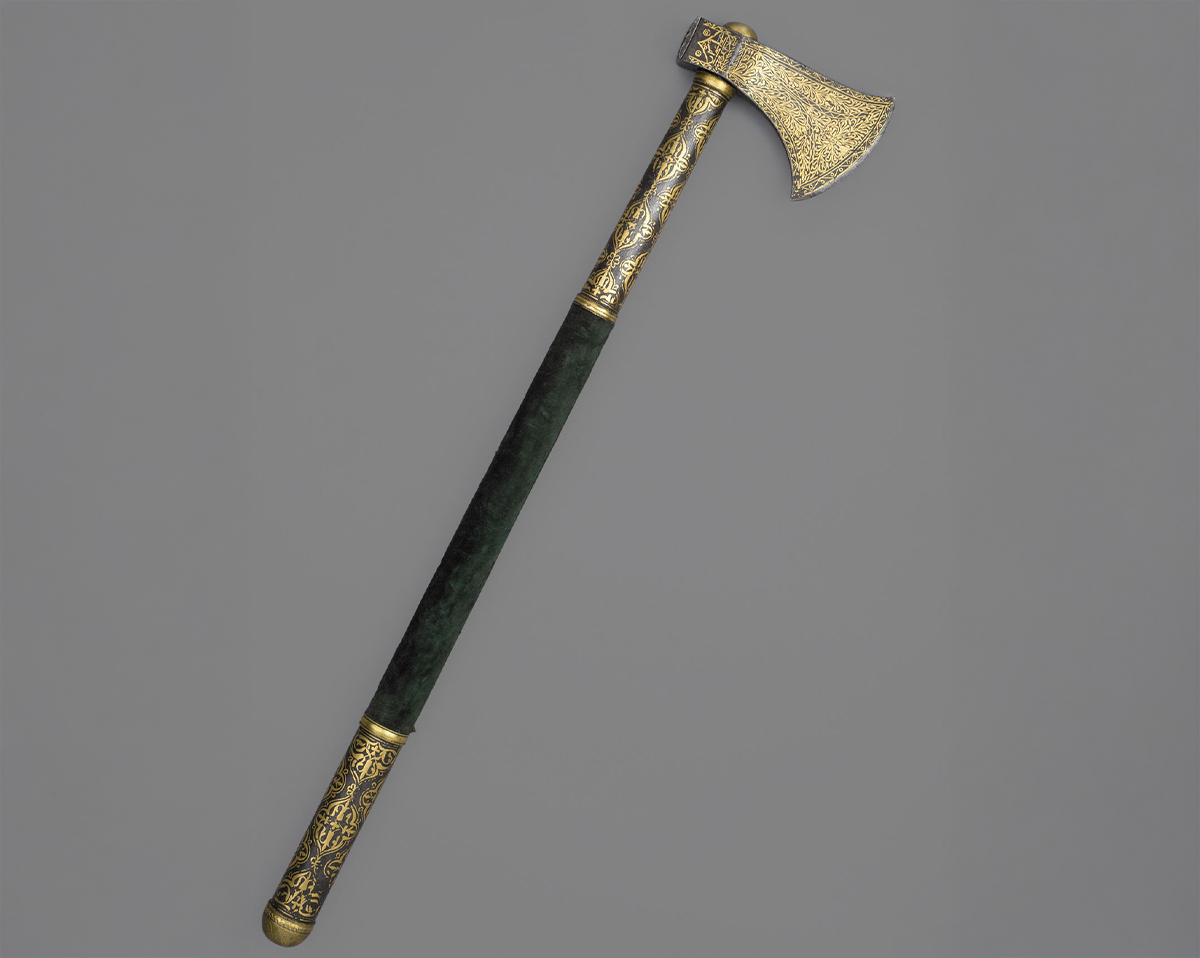
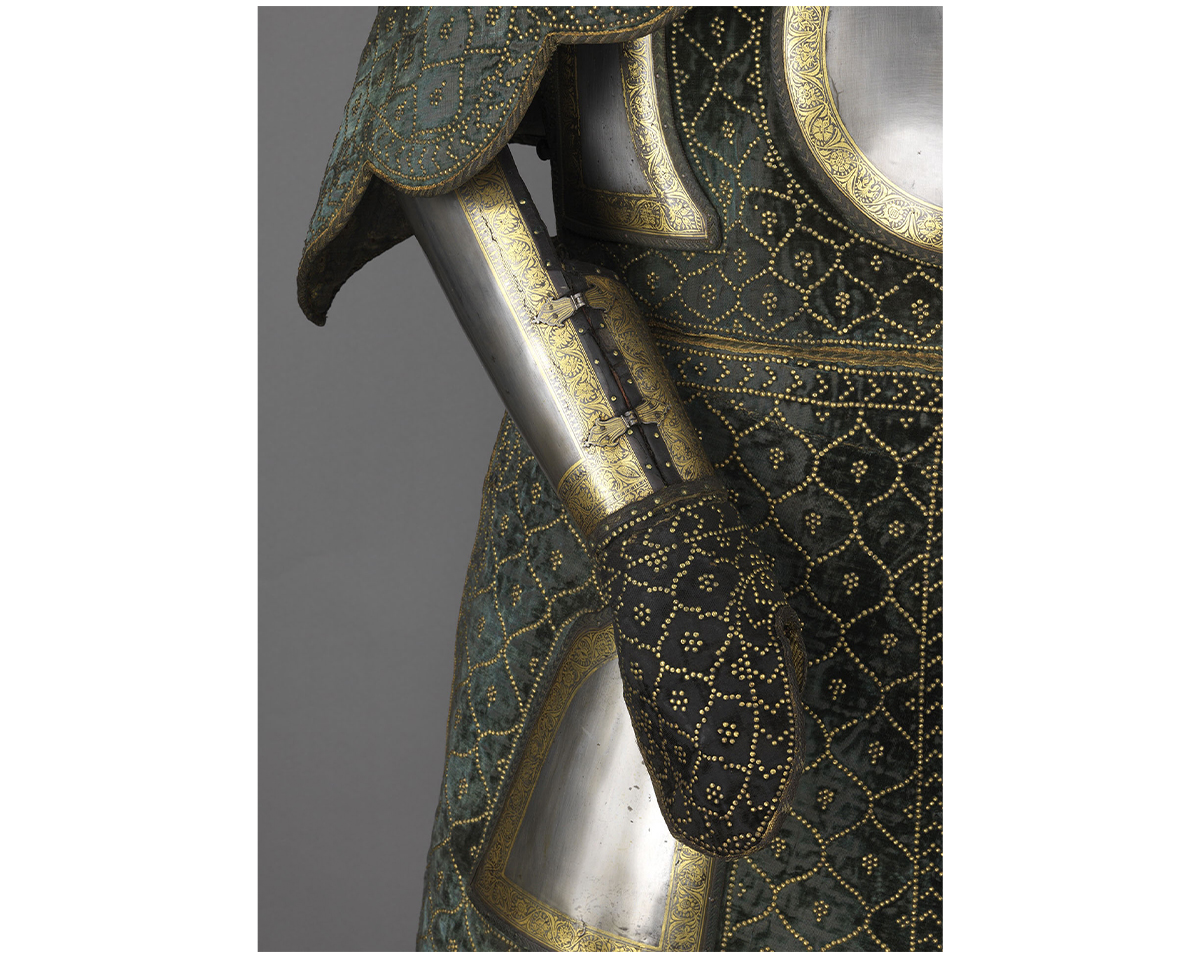
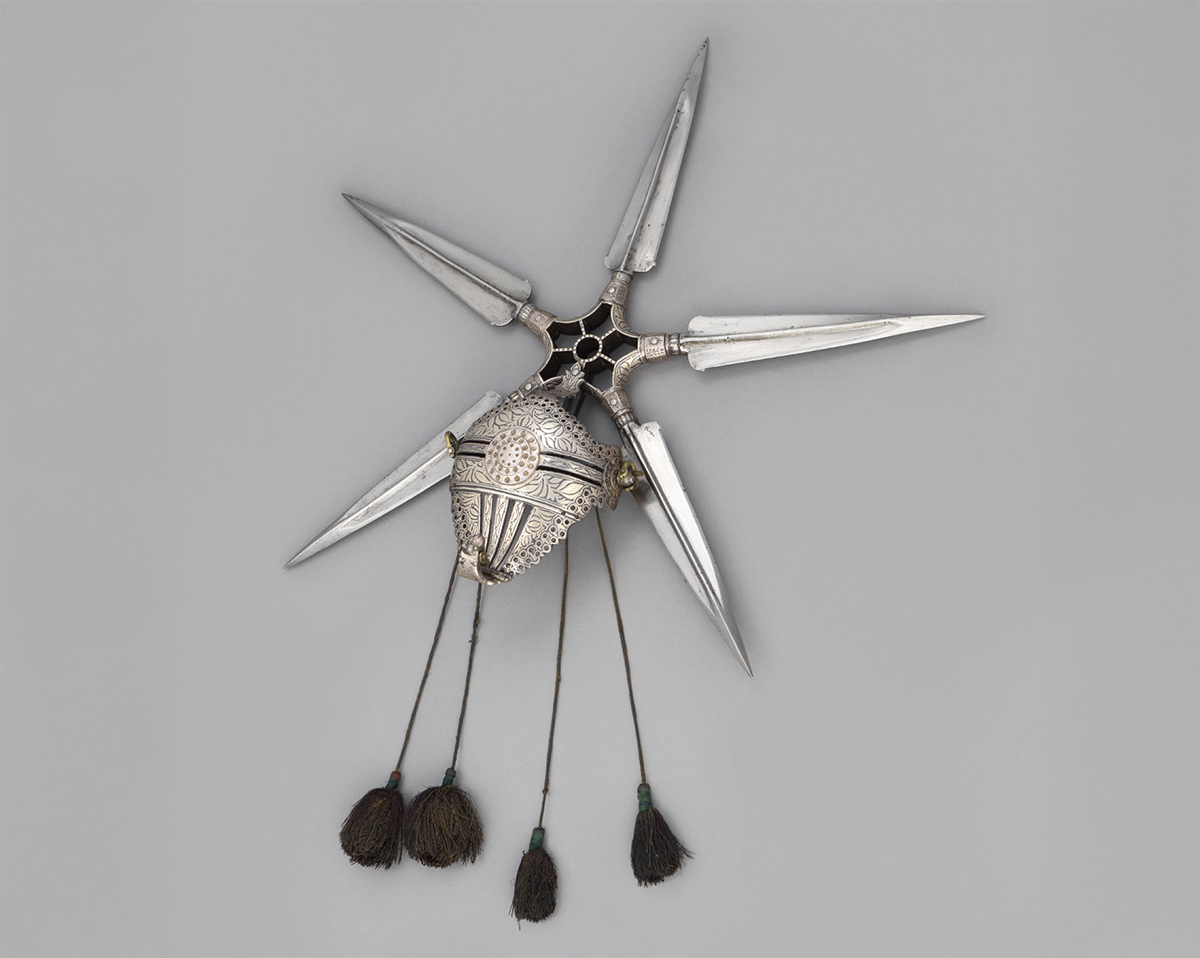
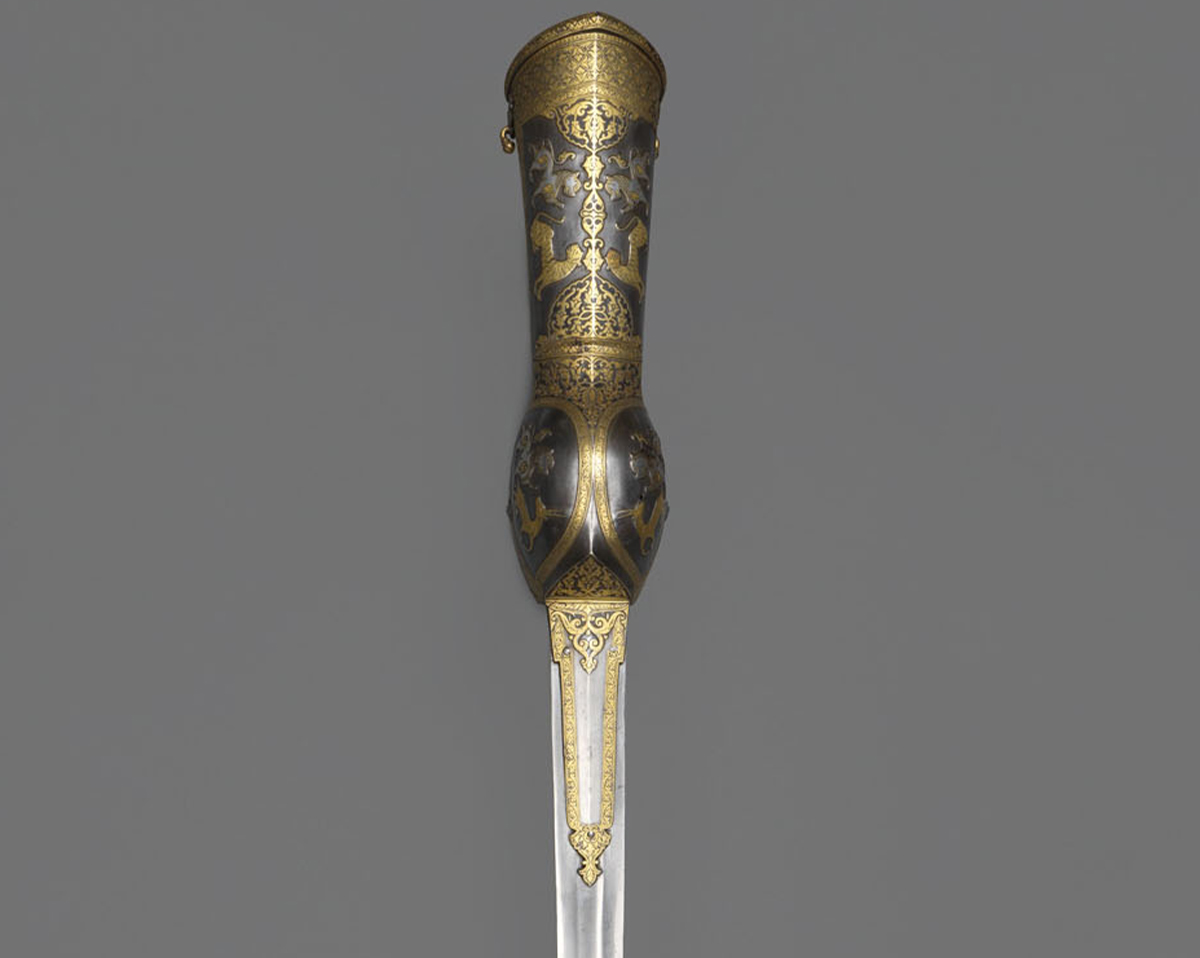
Koftgari weaponry is now rarely made — elite Rajputs may occasionally commission a coat of arms or sword for ceremonial use, for example, but today the craft is generally applied on a range of objects meant for sale in the commercial market: hookahs, jugs, candle stands, vases, boxes, jewellery and so on. Most of these feature a shallow inlay or overlay; the teh-i-nishan technique has become rare, partly because it requires more precious metal to fill deeper grooves and is therefore more expensive.
Historical artefacts featuring koftgari decoration are widely traded by collectors of antiques and can be found at several museum collections, including the Napier Museum, Thiruvanathapuram; the Mehrangarh Museum, Jodhpur; the National Museum, New Delhi; the Salar Jung Museum, Hyderabad; the Lahore Museum, Pakistan; Metropolitan Museum of Art, New York; and the Virginia Museum of Fine Arts, Richmond.
First published: 2 July 2025
Image Gallery
Bibliography
Baden-Powell, B. H. Handbook of the Manufactures and Arts of the Punjab. Lahore: Punjab Printing Company, 1872.
Breiding, Dirk H. “Techniques of Decoration on Arms and Armor.” The Metropolitan Museum of Art: Timeline of Art History. October 1, 2003. http://www.metmuseum.org/toah/hd/dect/hd_dect.htm.
Brij Bhushan, Jamila. Indian Metalware. New Delhi: All India Handicrafts Board, 1961.
Brown, Percy. A Descriptive Guide to the Department of Industrial Arts: Lahore Museum, Punjab. No. 2. Calcutta: Thacker Spink & Co. 1909.
Chattopadhyay, Kamaladevi. India’s Craft Tradition. New Delhi: Ministry of Information and Broadcasting, Government of India, 1980.
Coldstream, W. “Industrial Art Work in the Punjab.” Journal of the Royal Society of Arts 62, no. 3188 (1913): 116–19. http://www.jstor.org/stable/41341389.
Earl’s Court, London, S.W. Official Catalogue of the Empire of India Exhibition. London: J. J. Keliher & Co. 1895. https://archive.org/details/gri_000033125011113186/page/n227/mode/2up?q=koftgari.
Feuerbach, Ann. “Damask, Inlay and Koftgari: A Call for a Definition of Terms.” History of Antique Arms, Researches 2014.
Geographical Indications Registry. “Application Details: Udaipur Koftgari Metal Craft.” Accessed December 08, 2022. https://search.ipindia.gov.in/GIRPublic/Application/Details/747.
Harvey, Medill Higgins, Moira Gallagher, and Anne Grady. “Damascening.” The Metropolitan Museum of Art. Accessed December 09, 2022. https://www.metmuseum.org/perspectives/articles/2022/9/metalworking-damascening.
Hendley, Thomas Holbein. Damascening on Steel or Iron, as Practised in India. London: W. Griggs and Sons, 1892.
Hunter, Alexander. “Metal and Wood-Work among the Hindoos: Inlaid Works in Different Metals; Steel Inlaid with Gold and Silver.” The Art Journal (1875-1887) 1 (1875): 261–64. https://doi.org/10.2307/20568750.
Lanzillo, Amanda. “Electroplating as Alchemy: Labor and Technology among Muslim Metalsmiths.” In Pious Labor: Islam, Artisanship, and Technology in Colonial India, 1st ed.: 45–70. University of California Press, 2023. http://www.jstor.org/stable/jj.6947020.7.
Ranjan, Aditi, and M. P. Ranjan. Handmade in India: Crafts of India. New Delhi: Mapin, 2007.
Singh, Birinder Pal. Indigeneity and Occupational Change: The Tribes of Punjab. New York: Routledge, 2020.
Singh, K. S. People of India: Volume 1. Calcutta: Anthropological Survey of India, 1992. https://archive.org/details/people-of-india-intro/page/n1/mode/2up.
Welch, Stuart Cary. India Art and Culture: 1300–1900. New York: The Metropolitan Museum of Art; Holt, Rinehart and Winston, 1985.
Feedback