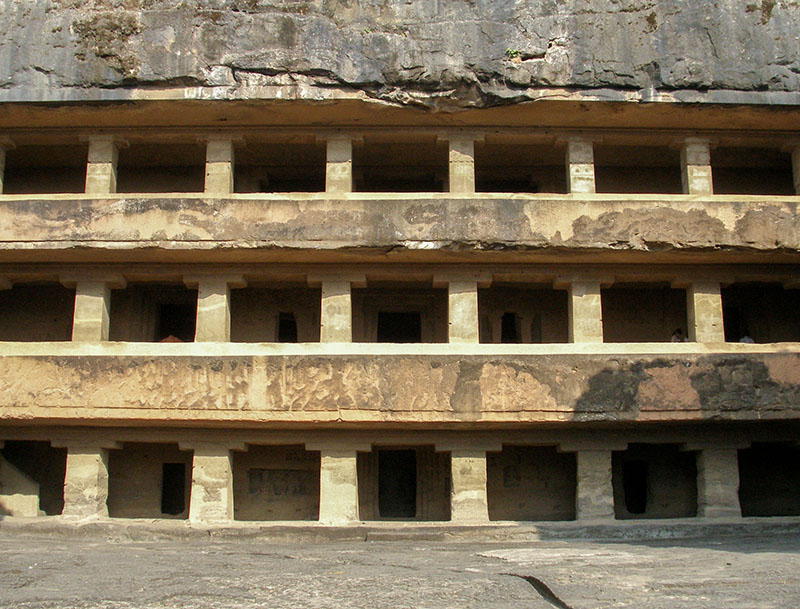
Referring to the act of leisurely strolling as well as a garden or dwelling place in Pali and Sanskrit, vihara is a Buddhist monastery and place of religious education. It typically comprises multiple residential cells for monks, connected to an open central court and an entrance porch. Initially serving as places of rest for wandering monks, the earliest surviving viharas are rock-cut structures accompanying early Buddhist cave temples in India dating to the second century BCE. These evolved into large centres of learning known as mahaviharas, such as Nalanda in India and the Shalban Vihara in Bangladesh.
More Definitions
Doric Order
Originating in western Greece, it is oldest of the three orders of the classical architecture of ancient Greece, along with…
Mahamandapa
A pillared pavilion or hall found in Dravida temples. Typically the largest mandapa (pavilion) of the temple, the mahamandapa serves…
Pilaster
A decorative architectural motif where a narrow portion of the wall projects outwards and resembles a rectangular pillar-like structure. In…
prakara
Straight enclosure wall surrounding the shrine and other structures, and demarcating pathways around them, in Dravida-style temples of South India.…
Ratha
A spoked-wheel chariot or cart, usually drawn by horses. Evidence of their use and construction has been found in the…
Triratha
An outward square projection from the main shrine of the temple, occuring in a cluster of three. Trirathas are typically…
Double-Voluted
An architectural or design element consisting of two scroll-shaped ornamental figures mounted on pillar capitals. The curving shape is believed…
Shamiana
A ceremonial tent or awning featuring removable walls that consist typically of decorated or coloured cloth. They were used by…