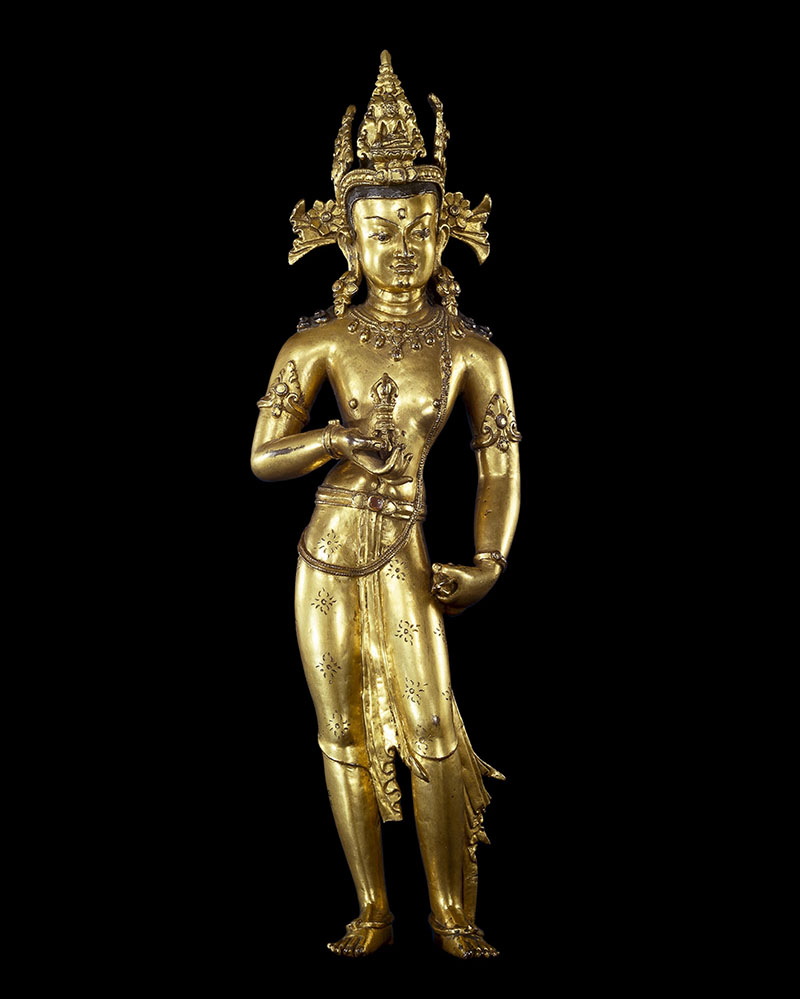
A bodhisattva in the Mahayana and Vajrayana traditions of Buddhism, he is primarily associated with the Akshobhya Buddha. Iconographically, he is white in color with a vajra or thunderbolt in his right hand and an upturned bell or ghanta in his left. Some sub-traditions of Buddhism regard him as the second patriarch of Buddhism after Vairochana Buddha. Within Tibetan Buddhism, rituals related to him are believed to purify the mind and soul.
More Definitions
Syed Ahmad Khan
Syed Ahmad Khan (b. 1817; d. 1898) was an educator, philosopher and reformer who is considered to be one of…
Amitabha
A principal figure in Pure Land Buddhism, he is one of the five Dhyani Buddhas. According to Mahayana texts, the…
Shaktism
A major sect of Hinduism wherein the metaphysical reality is considered to be a woman, and the primordial cosmic energy,…
Bharthari
Also known as Jogi Sant Bharthari, he is a popular king from the folk legends of northern and central India.…
Brahmi And Sundari
Within Jainism, they were the daughters of the first Tirthankara Rishabhanatha and princesses in the kingdom of Ayodhya. According to…
Jaya
In Hindu religious mythology, he is an attendant of the deity Vishnu. Along with Vijaya, he is a dvarapala or…
Ardhanarishwara
A composite form of the Hindu god Shiva and his consort Parvati, depicted equally split down the middle, half-male on…
Trishul
A trident used as one of the principal symbols of Hinduism, and to a lesser extent by some Buddhist sects.…