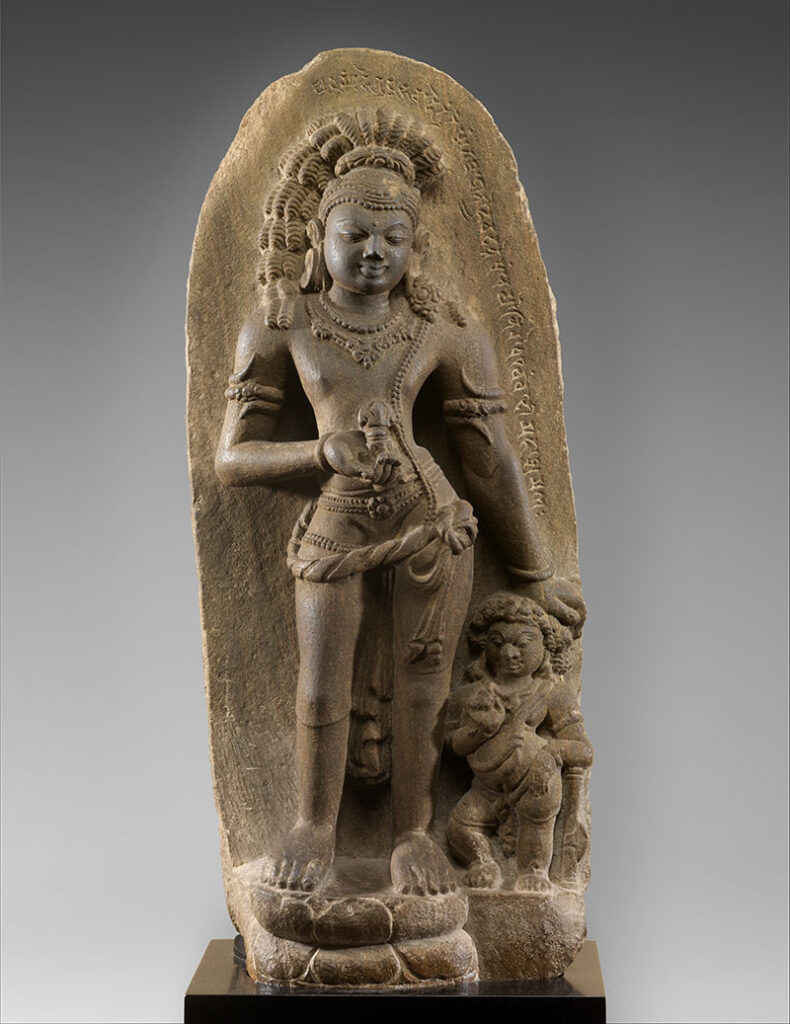
A bodhisattva from Mahayana Buddhism and the protector and guide of the Gautama Buddha as well as a manifestation of his power. He is considered one of the earliest of the three protective deities surrounding the Buddha and one of the major dharmapalas (protectors of dharma) in Mahayana Buddhism. The deity is manifested in two distinct ways — his human form, which is depicted with a vajra (weapon) in his right hand, and his dharmapala form, Acarya-Vajrapani, depicted with four heads, arms, legs and a third eye, and shown holding a bell and a lasso. He is depicted as a yidam (a manifested deity representing Buddhahood) in Vajrayana Buddhism, with multiple limbs, treading on demons or lying on snakes. He is also depicted in the yab-yum (primordial union) position with his consort. From the Sanskrit words vajra, meaning “thunderbolt” and pani, meaning “in hand.”
More Definitions
Vrishabhavahana
A benevolent form of the Hindu deity Shiva in which he appears with the bull Nandi, his mount or vahana.…
Bhagavad Gita
Section of the Sanskrit epic Mahabharata, composed as a dialogue between the Pandava prince Arjuna and his charioteer and companion…
Manushi Buddhas
A Buddha in human form, they attain enlightenment once they perform their allotted task on Earth and are released from…
Yoni
It symbolises the goddess Shakti as well as the feminine procreative power within Hindu iconography. The word itself literally translates…
Anandatandava
Meaning “dance of bliss,” it is a cosmic dance performed by the Hindu deity, Shiva, in his Nataraja form.
matrika
Any of a group of mother goddesses (matrika, Sanskrit, ‘divine mother’) mainly in Hinduism, especially in Shakta and Shaiva cults;…
Chakrapurusha
The personification of Vishnu's discus, the Sudarshan Chakra, as a male figure. It is an example of the Ayudhapurusha tradition…
Nandi
The vahana (mount) of the Hindu deity, Shiva, he is represented in the form of a white bull. In Hindu…