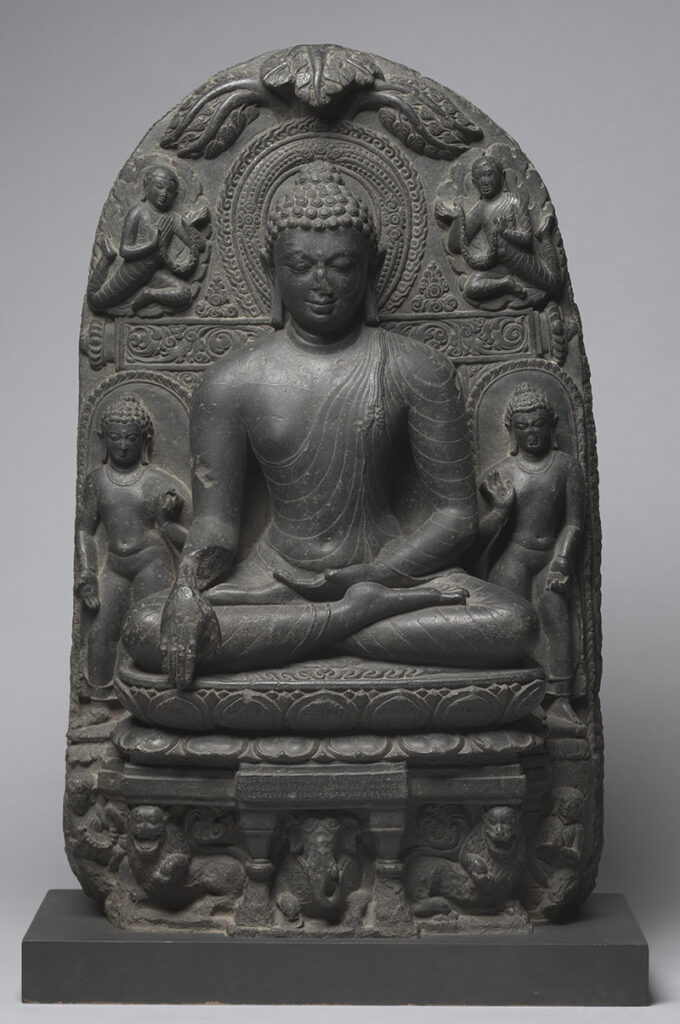
A term used by the Gautama Buddha to refer to himself or other Buddhas in the Pali canon. It is used to define someone who knows and sees reality as it is and is beyond all transitory phenomena. Early Pali texts refer to seven Tathagatas or great Buddhas, whereas Vajrayana Buddhism refers to five Tathagata Buddhas. The etymology of the term is widely contested, but it is generally thought to have derived from the Pali words tatha and gata, meaning “one who has thus gone” or “one who has thus come.”
More Definitions
Devasenapathi
One of the names of the Hindu deity Subrahmanya. The name derives from his role as commander (senapati) of the…
Tenjur
A sacred text belonging to the Tibetan Buddhist canon, comprising commentaries, treatises and a collection of abhidharma (ancient Buddhist texts).…
Gandharva
Celestial beings in Hindu, Jain and Buddhist mythology. They are depicted as having golden or blackish complexions and are often…
Ganas
In Hindu mythology, they are attendants of Shiva who live with him on Mount Kailasa. They are usually depicted alongside…
Vayu
The god of wind in the Vedic pantheon, who represents the cosmic life-breath. He is one of the vasus (attendants)…
Sundereshwara
A form of the Hindu deity Shiva worshipped as one of the principal deities of the Meenakshi Temple, Madurai, in…
Mahishasura
A shape-shifting figure in Hindu mythology, usually depicted with the head of a buffalo. He is associated with the Hindu…
Khasarpana
An esoteric form of the bodhisattva Avalokitesvara that emerged due to the absorption of Hindu elements into Buddhism, particularly within…