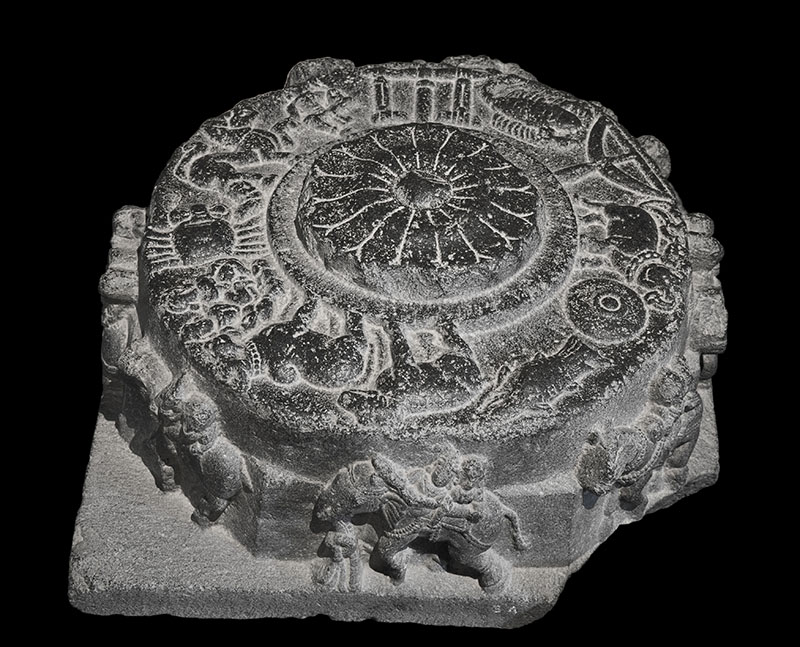
A carved sundial and marker of directions featuring the sun and eight celestial bodies, collectively known in Hindu astrology as the navagraha (nine planets). Also known as a solar altar, it was typically placed atop a tiered pedestal. The central figure was that of a lotus, representing the sun. It was surrounded by the eight planets, which symbolised the eight cardinal directions. The symbols of the twelve constellations were carved around the circumference of the dial, marking the path made by the sun across the sky, every twenty four hours.
More Definitions
Chatta
A mat comprising four square pieces of cloth joined together, it is a culturally significant object in the Banjara community.…
Trishul
A trident used as one of the principal symbols of Hinduism, and to a lesser extent by some Buddhist sects.…
banalingam
Smooth stones found on the bed of the Narmada River in central and western India, which are worshipped as the…
Dhvaja
Meaning ‘banner’ or ‘flag’ in Sanskrit, dhvaja also refers to a high flag-bearing column erected at the entrance to a temple or a shrine in…
Bichauni
A bedding or bedsheet typically made of cotton. From the Hindi word bichauna, meaning “bedsheet.”
Discstones
Stone sculptures that developed from ringstones, dated approximately to the first century BCE; although similar in shape, disc stones consist…
votive object
An object that is ritually offered or sacrificed to a deity, typically to mark the fulfilment of a vow, express…
Vanamala
An important motif in Vaishnavite Hinduism, it is offered as a garland to Krishna and Vishnu. It is usually identified…