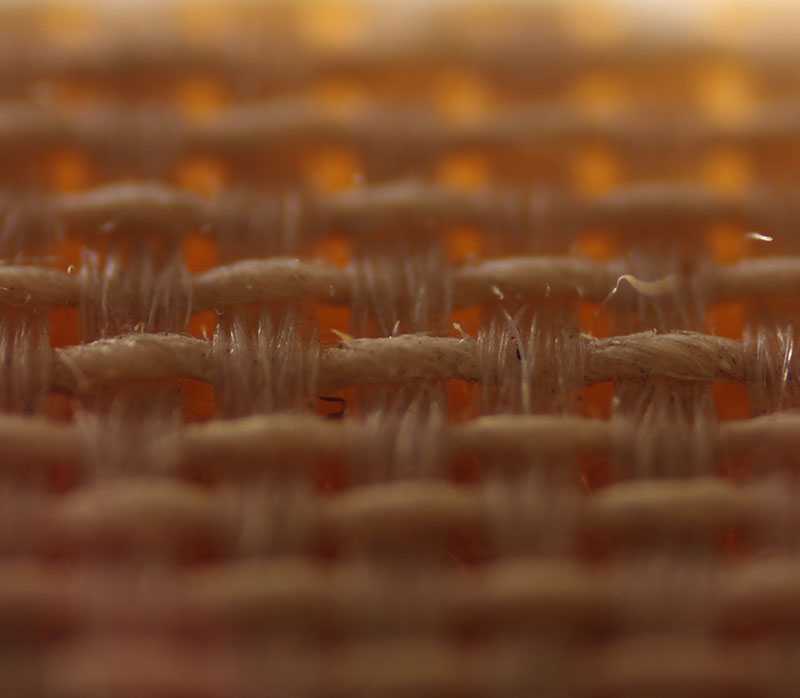
Also known as tabby weave, it is the most common weave in textiles. In this weave, each weft yarn passes over one warp yarn and under the next one, with this alternating sequence continuing across rows of weft in a 1:1 ratio. Other weaves, such as twill or satin, feature differing ratios and sequences of the weft yarn, which results in fabrics of different patterns and qualities.
More Definitions
Cross-Stitch
A type of sewing and embroidery that incorporates x-shaped stitches to create a design. It is considered to be one…
Amli
Also known as amlikar, it is a needle-embroidered Kashmiri shawl dating to the nineteenth century. While it is likely to…
Herringbone Stitch
A needlework technique that uses stitches resembling bones extending from the spine of a herring fish. It is found in…
Tintype
A photograph made by creating a positive directly on a thin sheet of black-enamelled metal coated with collodion. They were…
Sapma and Thrima
Discontinuous patterning techniques in Bhutanese weaving, using supplementary weft to create single-faced motifs and patterns (invisible on the reverse of…
Lohori Running Stitch
A form of kantha embroidery that is characterised by running stitches that resemble waves. From the Persian word lehr, meaning…
Kashika Vastra
Meaning “clothes from Kashi” in Sanskrit, it is a possible reference to the brocaded fabric produced in Kashi (now Varanasi).
Gilt
An object that is covered with a thin layer of gold, often used in jewellery, ornamentation and textile. From the…