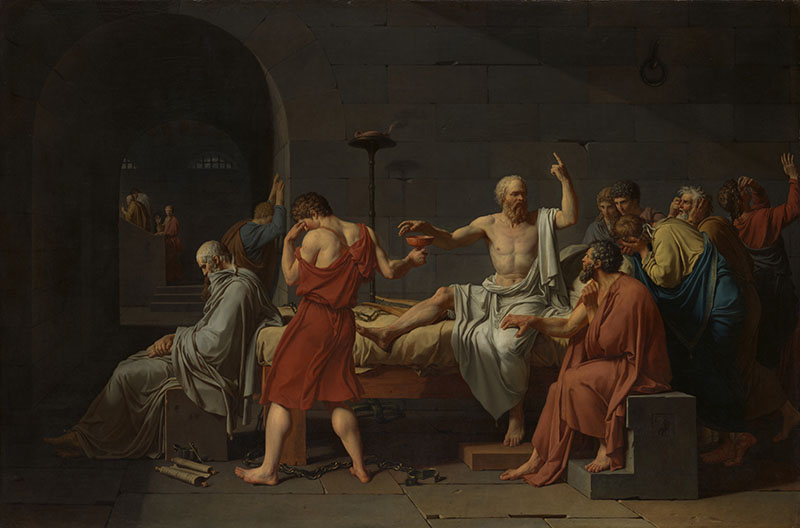
An eighteenth century cultural movement that drew inspiration from the arts and culture of classical antiquity. It embraced classical themes and subject matter as well as principles of linear design, harmony and idealism. Prominent artists include Jacques-Louis David, Jean Auguste Dominique Ingres, Jean-Baptiste Debret and Angelica Kauffman.
More Definitions
Cubism
A modern art movement developed in the twentieth century by artists such as Pablo Picasso and Georges Braque which rejected…
Post Painterly Abstraction
An artistic movement that derived from Abstract Expressionism and synthesised styles such as action painting, colour field painting and colourism…
Colour Field Painting
An abstract painting style categorised within American Expressionism, it is characterised by large-scale canvases painted expansively with flat, solid colour…
Formalism
An approach to art which emphasises aspects of form, such as line, shape and colour. Formalism engages with the visual…
Second Diffusion
A religious revival movement between c. tenth and eleventh centuries CE, credited with establishing Buddhism as a majority religion in…
Lyrical Abstraction
Romantic, expressive and abstract paintings made using loose and gestural brushstrokes. The style developed in France and the United States…
Firka
A genre of paintings associated with the Patna School, which depicted people engaged in caste-based occupations. Frequently produced and sold…
Neo-Romanticism
A cultural movement in Britain during the 1930s and '40s which was influenced by eighteenth-century Romanticism and emphasised individualism and…