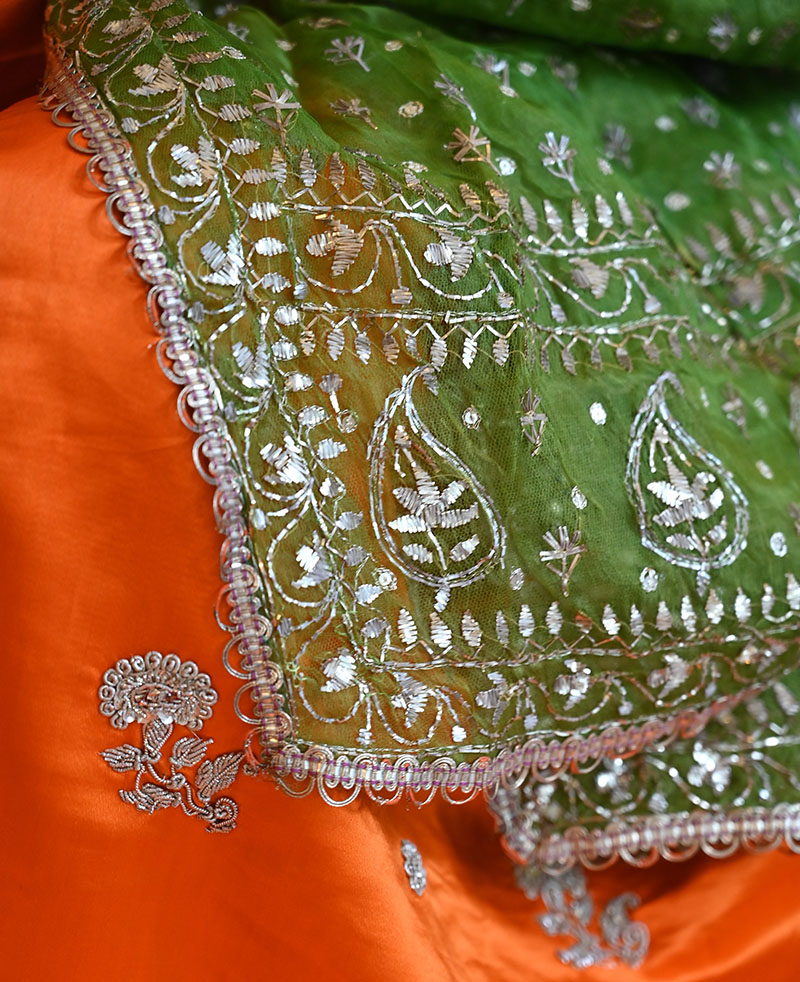
A variant of badla embroidery in which metallic wires are sewn onto the fabric with the help of a needle to create patterns that are finished by hammering and burnishing the metal. The technique gained popularity in the Awadh region during the Mughal era, particularly in the city of Lucknow. The two chief techniques within mukaish embroidery are kamdani and fardi ka kaam.
More Definitions
Double-Interlock
A technique of tapestry weaving wherein two differently coloured weft threads interlock on a single warp thread. This method allows…
Chromolithography
A chemical-based printing method for the production of coloured prints using stone or grained zinc surface plates and grease-based inks.…
Size
A solution that is applied to warp threads before they are set on a loom for weaving, it protects the…
Dorukha
A textile with double-sided design, typically seen in Kani weaving and kantha embroidery. The embroidery is executed in a way…
Serigraphy
A stencil-based printing process which involves forcing ink through a fine screen, usually made of silk, polyester or nylon, onto…
chamfer
A slope or bevel, typically at 45º, at the intersection between planes in woodwork, architectural and engineering detailing, and other…
Tiraz
Textiles with embroidered inscriptions produced in Iran during the early Islamic period, until the fourteenth century CE. Robes made of…
Relief Printing
A printmaking process in which the printing surface is cut or etched with the design to be printed. Methods of…